Get Full Government Meeting Transcripts, Videos, & Alerts Forever!
Get email alerts on the Water Quality topic
No spam. Unsubscribe anytime.
Finance committee approves $320,000 carryover to continue water softener rebate program
Summary
The Waukesha City Finance Committee voted to carry over $320,000 from 2024 to 2025 in Clean Water Plant Fund 603 to continue a $200-per-unit water softener removal rebate aimed at lowering chloride levels in the city’s wastewater.
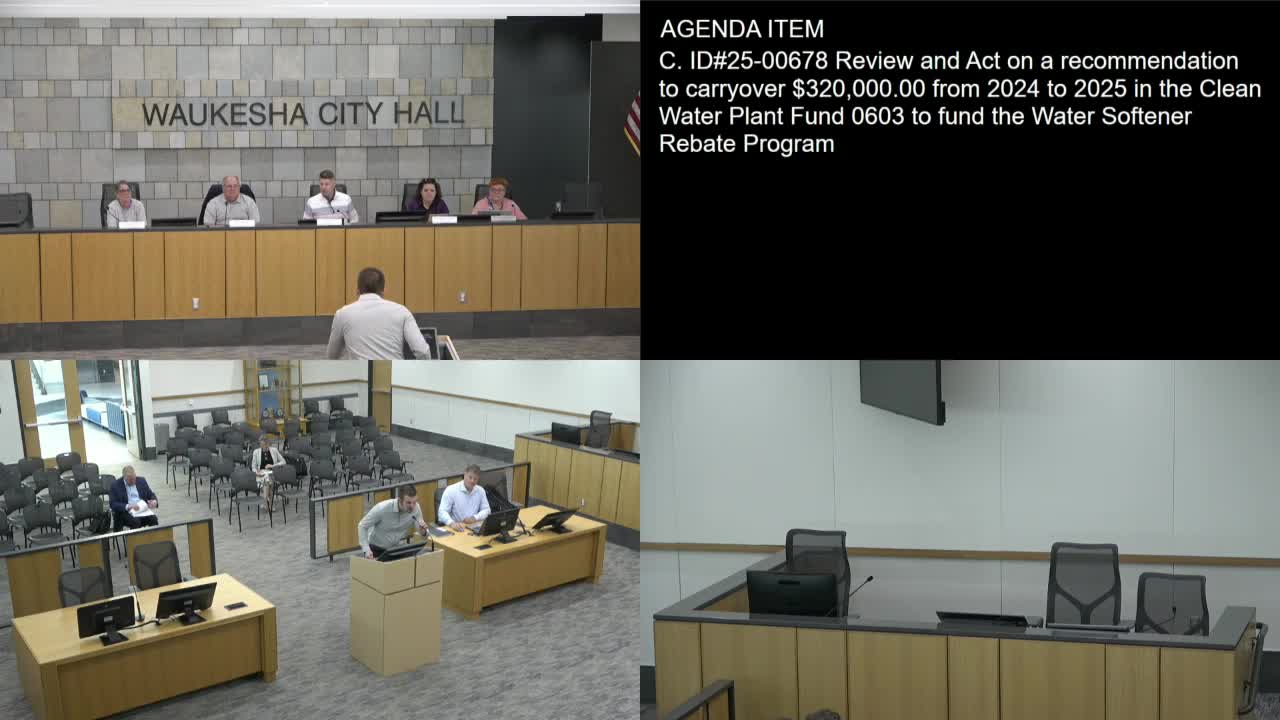
The Waukesha City Finance Committee voted unanimously April 29 to carry over $320,000 from 2024 to 2025 in Clean Water Plant Fund 603 to continue the city’s water softener rebate program.
City plant manager Zack Eisner told the committee the program pays $200 to residents who remove qualifying water softeners and that demand averages about 10–20 new applicants a week. "We are using up all the funds slotted for this rebate program," Eisner said, and the carryover would allow the program to continue while staff monitor interest.
The committee asked whether the rebate funding is new money or a reallocation; Eisner and staff confirmed the $320,000 are funds remaining from 2024. Committee members also asked about the program’s effect on chloride levels. Eisner said a residential softener removal reduces chloride concentrations by about 12 milligrams per liter per removal, and that citywide baseline chlorides have fallen roughly 100 mg/L since switching from Lake Michigan water, from the high 400s to the high 300s milligrams per liter.
Committee members raised concerns about the permit threshold and seasonal salt spikes. Eisner said the city’s monthly permit limit is 400 mg/L and that winter road salt can cause spikes of about 100 mg/L; the rebate program seeks to lower baseline chlorides to provide a buffer against those spikes.
Alderman Lemke moved to approve the carryover; Alderman Alvin Slavin seconded. The motion passed on a voice vote with all members present recorded as voting in favor. Zach Eisner thanked the committee after the vote.
The committee did not specify how many residents must participate to reach the target chloride reduction, and staff said there is no precise citywide count of remaining residential softeners because verifying would require individual inspections. Eisner said the city’s seed funding for the program includes $100,000 from an account created during the Lake Michigan water diversion planning process and additional contributions from the water utility.