Get Full Government Meeting Transcripts, Videos, & Alerts Forever!
Get email alerts on the Automated Enforcement topic
No spam. Unsubscribe anytime.
Committee recommends Somerville home-rule petition for automated traffic enforcement; committee to refine implementation and equity details
Summary
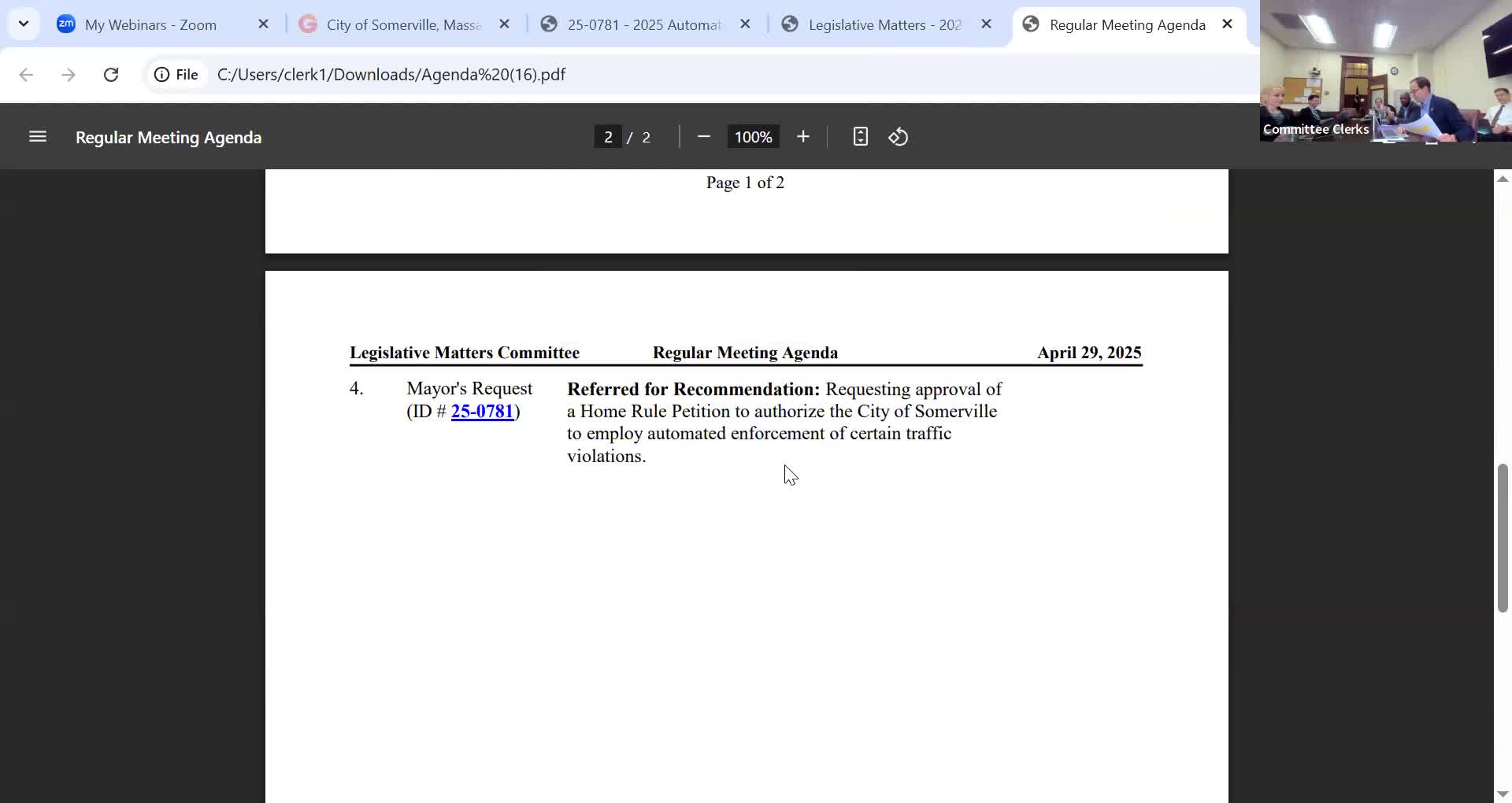
The Somerville City Council Committee on Legislative Matters on April 29 voted to recommend approval of a home-rule petition authorizing automated-camera enforcement for selected traffic violations (item 2081).
The Somerville City Council Committee on Legislative Matters on April 29 voted to recommend approval of a home-rule petition that would authorize the city to use automated-camera enforcement for certain traffic violations (item 2081).
Brad Rosson, director of mobility and OSPCD, presented the petition and compared it with competing state legislative proposals. Under the city’s home-rule petition as presented, automated enforcement could cover speeding, red-light violations, right-on-red violations and blocking an intersection; frontal images that could identify operators would be explicitly prohibited and audio capture would not be used for these enforcement purposes.
Rosson said the home-rule petition gives the city more flexibility than the governor’s or senate bills in several ways: it would not require MassDOT preapproval for camera deployment, it does not cap the number of cameras by a per-population formula, and it would not mandate a written-first-warning period for all first offenses (the petition allows the city to determine whether to issue warnings). "Frontal images of vehicles that could detect an operator's face are explicitly prohibited in the home rule petition," Rosson told the committee.
Rosson and staff described additional privacy and operational safeguards in the petition: images are captured and preserved only when an infraction is detected, stored until a case is resolved and then destroyed within 48 hours; camera images may be used only for the described violations; vendor compensation may not be structured as a revenue generator and any net revenues would flow to the state transportation fund rather than to city general revenue.
The petition requires a formal notification, a hearing and a full city-council approval vote before any specific camera deployments; it also envisions a 60-day public information campaign and physical signage at camera locations. Staff noted distinctions among legislative vehicles on written warnings, annual reporting to MassDOT, and other procedural steps.
Council members raised equity concerns about fines. Several members urged a cautious approach to penalty levels and suggested an educational warning period for drivers who may be unfamiliar with new camera enforcement, noting that even modest fines can be burdensome for low-income residents and for gig-economy drivers. Legislative liaison Senator Dassie said the petition caps fines at no more than those authorized by comparable state legislation and includes language that the city may send written warnings for educational purposes.
A number of council members signaled support for advancing the petition while reserving further implementation questions for subsequent committee work. The committee voted to recommend approval of the home-rule petition; the motion carried by voice vote. Members instructed staff to return with implementation details, including operational triggers for image capture, retention and review procedures, and an equity analysis for fines and enforcement mechanisms.