Get Full Government Meeting Transcripts, Videos, & Alerts Forever!
Get email alerts on the Housing Policy topic
No spam. Unsubscribe anytime.
Minn. House passes multifaceted housing policy bill HF2309 after amendment; final vote 109-22
Summary
The Minnesota House passed House File 2309 on third reading after adopting an amendment that expanded statewide rental-assistance eligibility; the bill bundles technical fixes, tenant protections, and provisions to expand housing tools for public housing authorities.
The Minnesota House of Representatives passed House File 2309, a housing policy package, on third reading after adopting an amendment. The clerk recorded the final tally as 109 yeas and 22 nays, and the bill’s title was agreed to.
HF2309 assembles technical corrections and policy changes affecting low-income housing tax-credit awards, voucher utilization, public housing authority options and other housing programs. Representative Ray Rauer (R-Anoka), who introduced the bill, said it incorporates language from several bipartisan housing bills that previously passed the House housing committee.
The bill requires allocating agencies and sub-allocators of low-income housing tax credits to use responsible contractors and, where applicable, create wage-theft prevention plans. It also updates terminology across statutes to improve consistency, and adds a provision allowing agencies greater flexibility to move unplaced vouchers to ensure utilization.
Representative Fisher (role: Representative) explained an amendment she had filed to address a situation in her district involving accessibility improvements paid with government funds. “We’ve got over $86,000 of government investment into this unit, and the people are no longer able to stay there,” Fisher said, describing temporary accessibility improvements that became attached to rental units and were then lost to tenants after a change in ownership. Fisher withdrew that specific amendment after discussing further work with committee chairs and said she would continue to pursue related fixes in other bills and in conference committee.
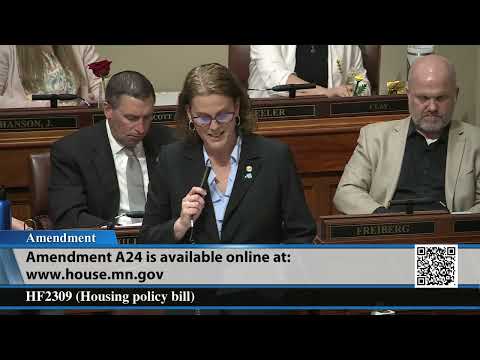
A separate amendment offered by Representative Ray Rauer (identified in the record as amendment A24) was adopted. Rauer said the amendment — drawn from a tax bill provision — modifies statewide rental-assistance program rules so that households whose incomes rise slightly above a 50 percent area median income threshold can remain on the program if their household income devoted to rent remains at or above 30 percent.
Representative Howard (D-Hennepin), sponsor of portions of the bill, described HF2309 as a “narrow housing policy bill” that combines several small but important changes intended to maximize state and federal resources for public housing authorities and to expand tools for affordable housing development. The bill includes a provision intended to allow public housing authorities to reposition properties and create new entities to access federal resources administered by HUD while addressing potential conflicts with state general obligation bond rules.
Representative Kozlowski (D-St. Louis) framed the bill in broader terms, urging colleagues to consider housing as a foundation for stability. “Over 690,000 Minnesotans are cost burdened and living on the edge,” Kozlowski said, adding that the package includes “the little things that are the big things” for renters and owners across the state.
Other provisions in HF2309 that were discussed or noted on the floor include: a carve-out excluding certain nonprofit volunteer board members from definitions of "officer" (when they receive no financial benefit), a requirement that income generated by a workforce housing program (for example, interest earned on loans) be returned to the program, a reduction in the timeframe for grantees to use certain grant funds from eight years to five to align with Office of Grants Management practices, and a change allowing adaptive reuse of public school buildings as housing infrastructure.
There was little extended floor debate after the amendments were resolved. The clerk took a roll call of members participating remotely; after the votes were tallied the clerk announced the bill as passed and the title agreed to.
Votes at a glance: House File 2309 (as amended) — Final passage: yeas 109, nays 22.