Get Full Government Meeting Transcripts, Videos, & Alerts Forever!
Get email alerts on the Telecommunications Tax topic
No spam. Unsubscribe anytime.
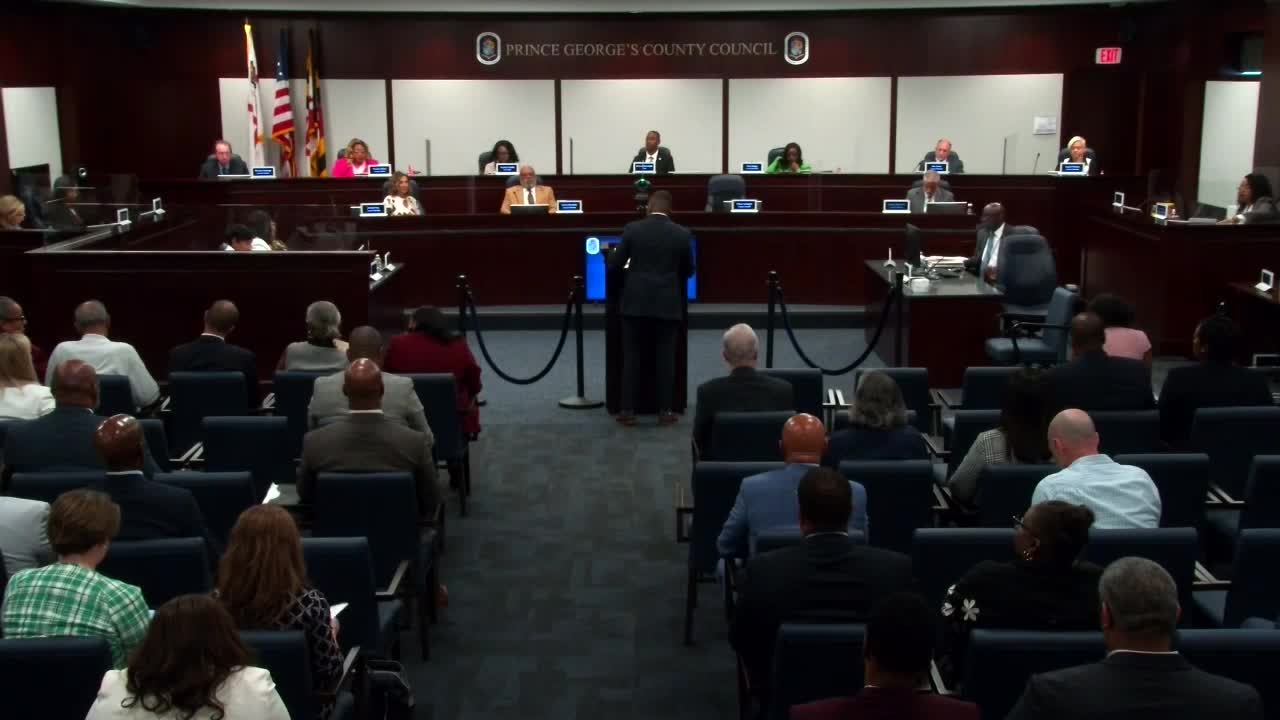
Prince George’s County council hears opposition to proposed flat per-line telecommunications fee
Summary
At a public hearing on April 29, 2025, business and telecom representatives urged the County Council to reject or revise CB18, a bill that would replace the county's percentage-based telecommunications tax with a flat per-line fee, saying the change would sharply raise costs for low-income residents, families and small businesses.
The Prince George's County Council held a public hearing April 29 on CB18, a proposed change to the county's telecommunications tax that would replace the current percentage charge with a flat monthly fee per wireless line.
Supporters of the existing percentage-based levy did not testify at the hearing; several industry and business witnesses urged the council to amend or oppose CB18. Addison Pruitt, representing CTIA (the wireless trade association), said the draft bill would replace the county's 9% telecommunications tax with a flat fee that he described as $3 per line and "would result in a drastic 269% tax increase," raising annual collections from about $14 million to nearly $52 million, according to his testimony.
Why it matters: Witnesses warned the change would be regressive, imposing the same dollar fee on all users regardless of income or plan structure. Candace Austin, Verizon's state director of government and local affairs, told the council CB18 (as she described it) would substitute the 9% tax with a $3.50 per-line fee and "impose a significant and unfair tax increase on wireless customers in Prince George's County, disproportionately impacting low income customers, working families, and small businesses." Alexander Austin, president and CEO of the Prince George's Chamber of Commerce, said the measure would "place an inequitable tax burden on wireless consumers" and small firms that rely on multiple lines.
Details and testimony: Both industry witnesses and the chamber offered numerical examples. Pruitt described a hypothetical family with four lines and said the flat fee would raise their annual wireless taxes by roughly $100 a year compared with the percentage tax; he and Verizon cited countywide estimates that collections could jump from about $14 million to more than $50 million annually. Witnesses noted wireless customers already pay state and local sales taxes and other per-line charges.
Alternatives urged: Testimony repeatedly urged the council to preserve a percentage-based structure or otherwise mitigate regressivity. Pruitt recommended keeping the percentage model and increasing the rate to achieve revenue goals without imposing a flat fee; he said an 18% rate would double collections while remaining percentage-based. Witnesses also pointed to recently authorized state-level revenue options (the Maryland General Assembly authorized an increase in some local income tax piggybacks during the 2025 session, witnesses said) as alternatives to a flat per-line fee.
Outcome at the hearing: The public hearing record captured opposition from major wireless carriers and business groups and no formal council vote on CB18 was taken at the hearing itself. The bill remains before the committee listed on the council agenda (TIEE) for additional consideration.