Get Full Government Meeting Transcripts, Videos, & Alerts Forever!
Get email alerts on the City Budget topic
No spam. Unsubscribe anytime.
Mayor’s proposed FY26 budget totals roughly $539 million; council adopts $520.94 million revenue figure
Summary
Commissioner Aaron Hensley presented the mayor’s FY26 proposed budget on April 29, projecting $520,939,560 in recurring revenue and a total budget package of about $539 million. The council voted to adopt the administration’s revenue figure to begin budget deliberations.
Commissioner Aaron Hensley presented the mayor’s proposed fiscal 2026 budget to the Lexington‑Fayette County Council Committee of the Whole on April 29, describing a package built from constrained revenue assumptions, prioritized personnel funding and targeted capital choices. After the presentation, the council voted to adopt the administration’s recurring revenue figure of $520,939,560 to begin formal council budget discussions.
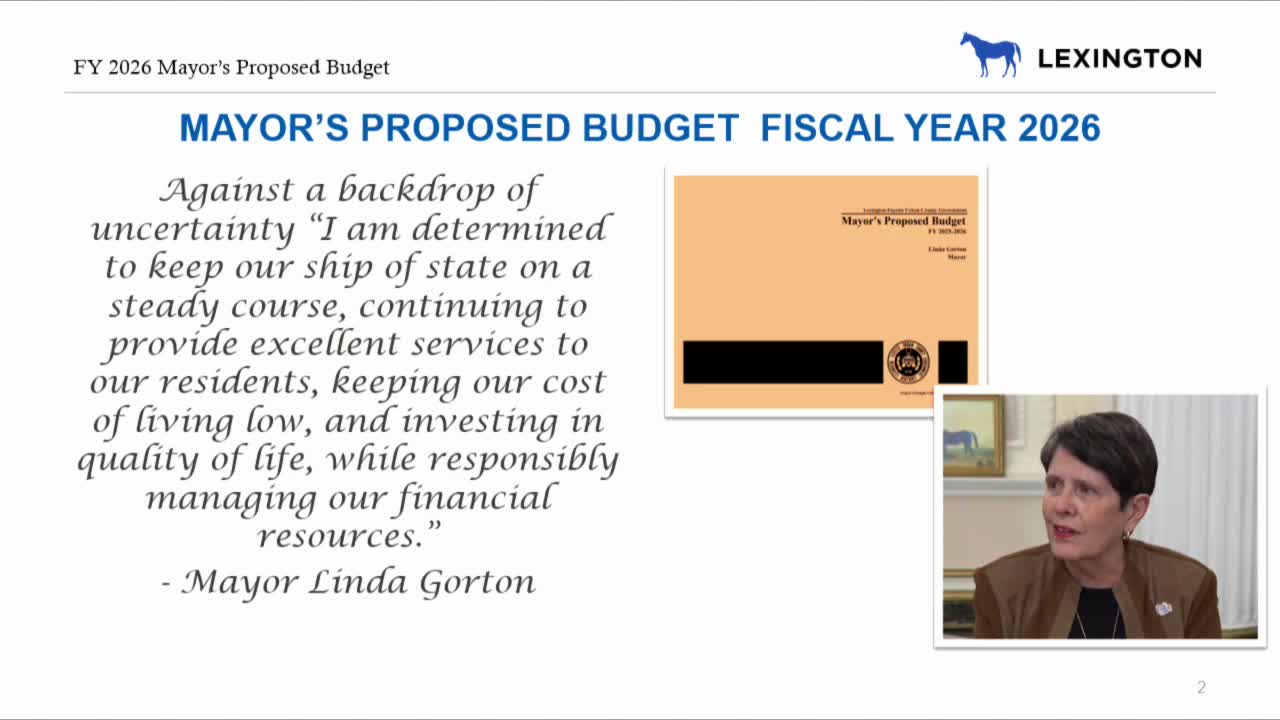
“The budget is very specifically put together to maximize the resources that we had on hand,” Commissioner Hensley said, noting administration priorities to “serve our residents, keep our cost of living low, invest in quality of life, and responsibly manage our fiscal resources.” The proposed package combines $520.9 million in recurring revenue with an $18.0 million prefund to create a total FY26 general fund package of about $539 million.
Key elements of the mayor’s FY26 proposal presented to council: - Revenue assumptions: Administration cited adopted recurring revenue growth of 5.6% year over year, driven primarily by payroll withholding, net‑profits collections and insurance‑premium tax receipts. Staff said payroll withholding and net profits remain the largest recurring lines and that net‑profits timing (April tax filings) can create month‑to‑month swings. - Personnel and priorities: Personnel costs account for about 65% of the proposed general fund budget. The proposal includes 16 new positions (described in the budget documents) and emphasizes retention and funding for existing positions over new hiring. Commissioner Hensley said the mayor prioritized addressing existing staff needs before approving additional positions. - Debt and capital: The administration proposed about an $18 million new bond package focused on police vehicles and paving that can be delivered quickly; the presentation noted that fire apparatus purchase timelines have lengthened and that administration prefers to use cash for long‑lead items to avoid multiyear interest and unused debt service. Debt service is projected to remain near 10% of the operating budget. - Prefunding and reallocation: The proposal uses a number of one‑time strategies — pre‑funding, capital reallocations and limited new bonding — to balance one‑time needs without increasing recurring obligations beyond the conservative revenue forecast. The administration cited an $18.3 million prefund in the proposed budget. - Community investments and partners: The budget documents list nearly $20 million of direct community investments and partner agency funding spread across divisions and programs; staff provided a three‑slide summary to make those commitments more accessible to council and the public.
Council action: Council member Ehlinger moved to adopt “the total funds available amount of 520,939,560 for the purposes of the council discussions of the mayor’s proposed fiscal year 2026 general fund budget.” The motion was seconded and passed; the transcript does not record a roll‑call vote tally.
Why it matters: Adoption of the revenue figure is a formal first step that fixes the administration’s recommended recurring revenue baseline for council subcommittee and link discussions. Council members may now propose adjustments inside that revenue envelope during the budget review process.
Next steps: Council members have several meetings and departmental “link” sessions ahead to review priorities; administration staff said they will provide follow‑up materials, respond to requests for clarifying breakdowns (for example partner agency and contingency balances) and process budget amendments needed before fiscal year end.