Get Full Government Meeting Transcripts, Videos, & Alerts Forever!
Get email alerts on the Housing Homeownership topic
No spam. Unsubscribe anytime.
Rockville staff propose down-payment, employee and first‑generation homebuyer assistance; council asks for adjustments and data
Summary
Housing staff proposed a Rockville down-payment assistance program targeted at low‑ and moderate‑income households and a city-employee assistance benefit; the council supported launching programs but asked staff to raise the AMI threshold, prioritize employees for initial awards, and return with additional data and program design details.
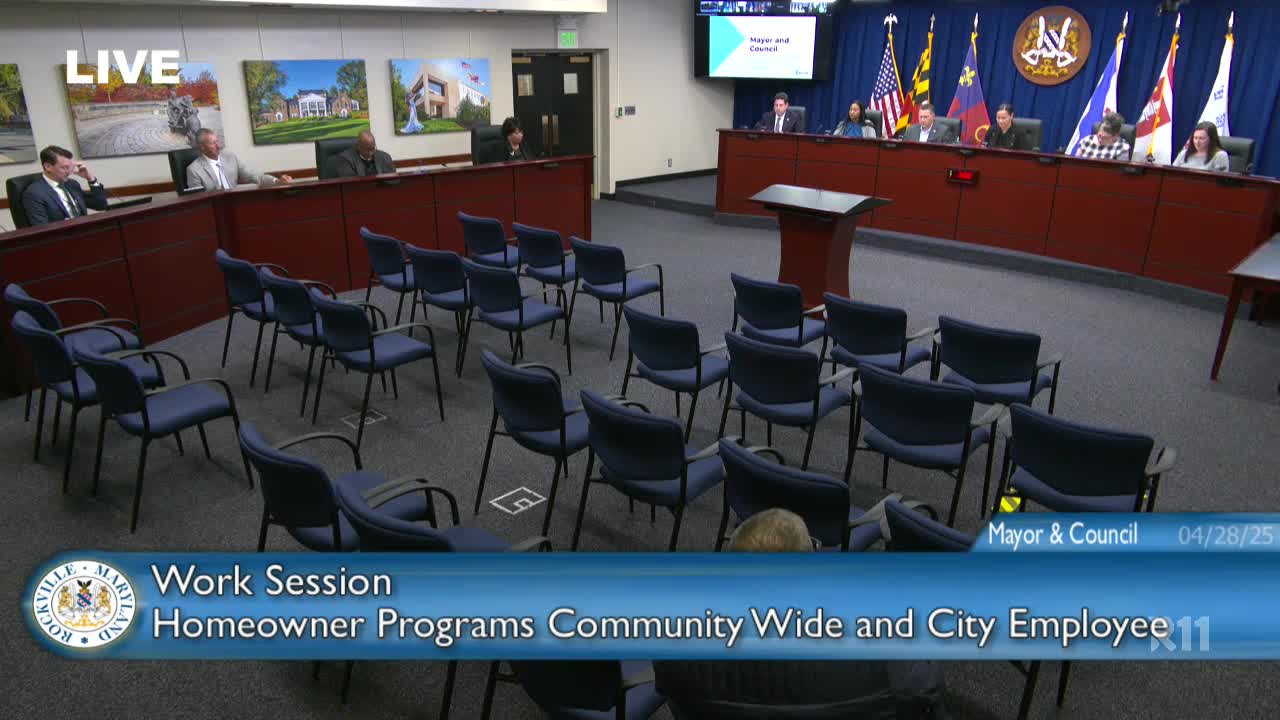
City housing staff presented a proposed package of homeownership assistance programs at the Rockville City Council work session on April 28, 2025, recommending a community down-payment assistance (DPA) program targeted to households at or below 80% of Area Median Income (AMI), a separate employer-assisted program for city employees, and two optional “bonuses” for first‑generation homebuyers and purchases in higher‑opportunity census tracts.
Ryan Trout, presenting the proposal, said national and local data show first‑time homebuyer participation is down and that lack of down-payment savings remains a primary barrier. He described a recommended community program that would offer up to 10% of a household’s maximum purchase capacity as deferred second‑mortgage assistance (no interest; repayment at sale or refinance). Staff recommended an 80% AMI eligibility threshold for the community DPA after modeling how different income thresholds affect market access.
The proposal also described a separate employee homeownership assistance benefit, which Mayor and Council previously set aside $250,000 to seed. Under the draft design staff described, eligible city employees would be able to receive up to $25,000 in deferred second‑mortgage assistance if they buy a home in Rockville; employees must have worked for the city at least six months. Staff said the employee benefit could be layered with the community DPA and the first‑generation or opportunity‑area bonuses where the borrower qualifies for multiple components.
For the first‑generation bonus, staff proposed a $10,000 forgivable assistance (forgivable after 10 years) to help households lacking parental homeownership history build equity. Staff proposed that borrowers use GSE (government‑sponsored enterprise) definitions for first‑generation certification. Staff also proposed a $15,000 “opportunity area” bonus for families with children who purchase in the city’s highest upward‑mobility tracts as defined by Opportunity Insights.
Council members generally supported an assistance program but raised several concerns and requests for changes. Multiple council members said 80% AMI was too restrictive for the city’s employees and for some middle‑income groups (teachers, more‑senior police officers), and asked staff to model higher AMI thresholds such as 120% and to show how that change would affect program costs and the number of households served. Several members also asked staff to compare a flat dollar cap (for example, $25,000) to a percentage of purchase price, and to estimate how many households the program could serve under different AMI and assistance‑level scenarios.
Council members asked staff to prioritize city employees in the initial roll‑out to honor prior council direction and because several employees have inquired about the benefit. Staff said the program launch target is October 1, 2025, and that staff will try to process employee applications quickly, but also noted administrative resources and the need to integrate outreach and counseling with partner lenders.
Members debated the opportunity‑area bonus. Some members said research shows child outcomes improve when families move to higher‑opportunity neighborhoods and supported a targeted bonus for families with children. Other members, including council members from the city’s east side, objected that the proposal appeared to imply some neighborhoods are “better” than others and said they would not support a program that favored higher‑opportunity tracts over longstanding neighborhoods with strong schools and community assets. Several members urged staff to focus on maximizing the number of households assisted rather than concentrating limited funds in a bonus for higher‑cost tracts.
Staff told the council the program would use existing local funds (the $250,000 set aside for the employee benefit and HCI/REACH funds that the city is negotiating to transfer back to the city), and provided a preliminary year‑one target to assist roughly 10 DPA households and five employees at an estimated total program cost near $626,000 (staff noted final costs depend on program parameters and demand). Trout stressed the city intends to recycle repaid deferred loans into the program so repaid funds can help additional households over time.
Ending: Council members asked staff to return with revised program design and cost scenarios that model 80% and higher AMI thresholds (including 120%), flat-dollar versus percentage assistance options, an employee-prioritization plan for initial awards, and a set of outcome metrics and data‑reporting items (including demographic disaggregation) to track equity and program performance.