Get Full Government Meeting Transcripts, Videos, & Alerts Forever!
Get email alerts on the Procurement Diversity topic
No spam. Unsubscribe anytime.
Council hears options on minority/female/disabled/veteran outreach, disparity studies and local preference in procurement
Summary
Procurement staff briefed the Rockville City Council on the city’s informal MFDV outreach, the legal and resource implications of a formal disparity study and subcontracting goals, and trade-offs around local vendor preference and environmental/social procurement criteria.
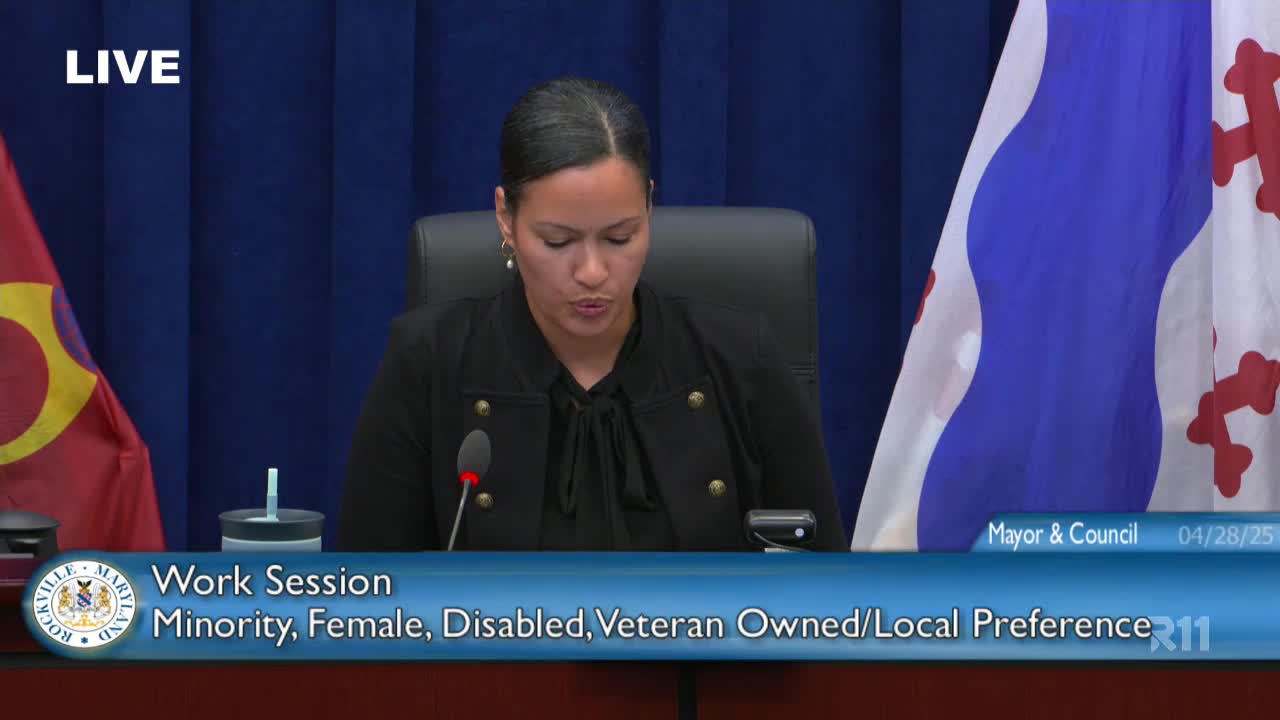
The Rockville City Council received a comprehensive work-session briefing on April 28, 2025, about the city’s current outreach to minority-, female-, disabled- and veteran-owned (MFDV) businesses, the option of conducting a formal disparity study, and potential changes to local preference and environmental/social procurement practices.
Jessica Lewis, the city’s Director of Procurement, described the existing informal outreach program that the procurement office operates through annual outreach events, quarter‑by‑quarter “how to do business” sessions with partner organizations, one-on-one vendor assistance and solicitation language that encourages subcontracting with MFDV firms. Lewis said staff recently expanded tracking from mayor-and-council awards to all awards and are offering debriefs to unsuccessful bidders.
Lewis briefly summarized the legal backdrop for formal programs: jurisdictions that seek a court‑defensible minority/women‑owned enterprise program typically commission a disparity study (citing City of Richmond v. J.A. Croson Company). She described that a disparity study analyzes procurement activity, market availability and anecdotal evidence to determine whether disparities exist and, if found, to support remedial goals and program design. Lewis warned that a formal program requires staffing, compliance monitoring and periodic re‑study; she gave an estimate range (similar studies have cost in the low hundreds of thousands of dollars in recent years).
Council members asked for more data and comparisons. Several members requested: (a) multiyear procurement data on total spend and the portion going to MFDV-certified firms (beyond mayor-and-council awards) and disaggregated by category (minority, female, disabled, veteran) where possible; (c) examples and legal analysis from other cities of Rockville’s size; and (d) clarity about the cost and work required to implement and administer a formal program. City staff confirmed they would provide multi‑year spend charts and add better vendor-category breakdowns in future reports.
On local preference, staff explained the current Rockville code gives a tiebreaker preference to local bidders only in exact tie low-bid situations, and outlined trade-offs if the city adopted more expansive local-preference rules (e.g., 2–5% bid adjustments or point-based systems). Staff noted professional procurement organizations generally caution that local‑preference rules can increase costs and reduce competition and that some jurisdictions have faced legal or reciprocal challenges. Council members asked procurement to bring back options used successfully by other municipalities (examples cited included a small‑contract local-reservation window and point‑based preferences used by the county).
Members also discussed environmental and social outcomes in procurement. Lewis said some vendors and national suppliers offer “green” product lines and that staff can build environmental scoring or minimum sustainability requirements into solicitations. Council members asked procurement to research concrete ESG (environmental, social, governance) scoring approaches and examples, and to return with options and estimated administrative costs.
Outcome: The council did not direct staff to pursue a disparity study at this meeting. Instead members asked for additional data, peer-city examples and options for: expanded outreach, alternatives to a full disparity study, defined local‑preference models (including small‑contract reservation windows and point-based approaches), and procurement language to incorporate environmental and social criteria. Staff said they will return with the requested analyses and updated multi‑year procurement reporting.
Ending: Procurement staff will deliver additional multi‑year data, model options for local preference and ESG scoring approaches, and recommendations on the cost and structure of a disparity study for council consideration.