Get Full Government Meeting Transcripts, Videos, & Alerts Forever!
Get email alerts on the Rezoning topic
No spam. Unsubscribe anytime.
Board approves rezoning of Blaylock & Brown property to FAR after public hearing and legal objections
Summary
On second reading the board rezoned two tracts owned by Blaylock and Brown Construction from R-1 (low-density residential) to FAR (Forest Agricultural Residential). The owner opposed the town-initiated rezoning; the board voted to approve the ordinance.
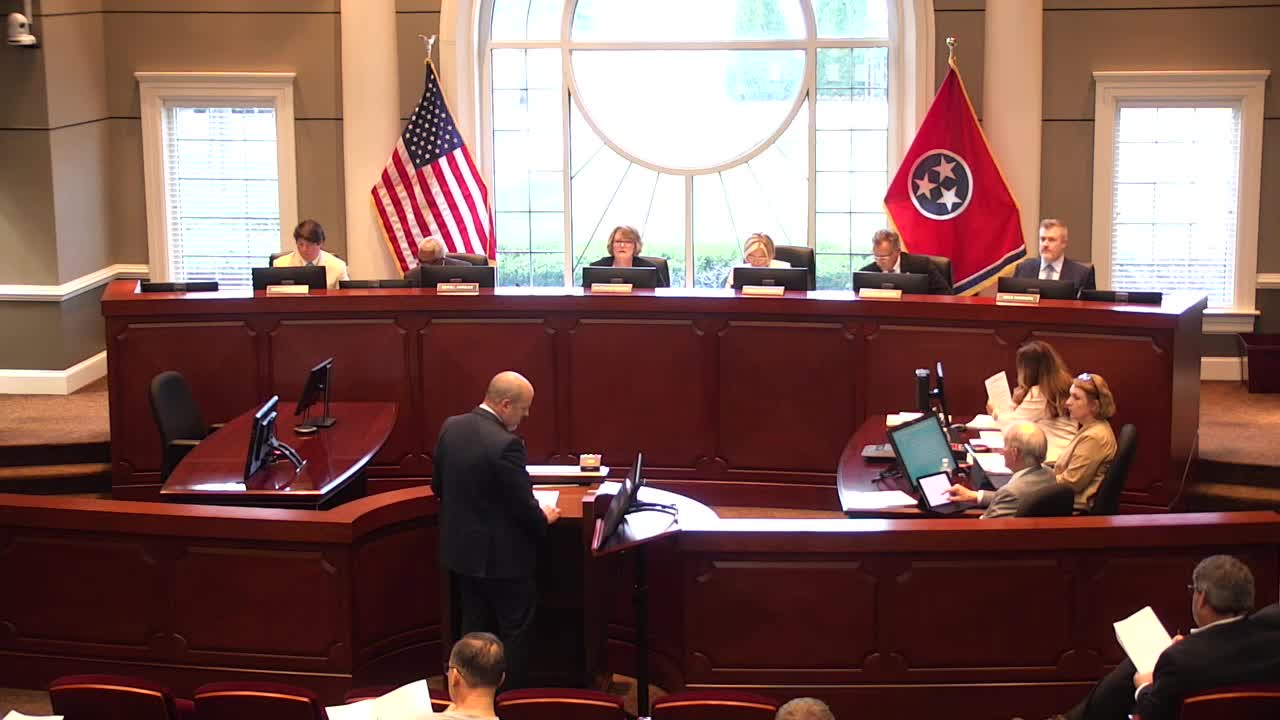
The Collierville Board of Mayor and Aldermen voted on April 28 to rezone two tracts owned by Blaylock & Brown Construction from R-1 (low-density residential) to FAR (Forest Agricultural Residential) on second reading after a public hearing.
Staff presentation: Jamie Gross, planning division director, said the town initiated the rezoning after learning the northern tract included a capped landfill being closed under Tennessee Department of Environment and Conservation (TDEC) oversight. Gross said FAR better aligns with the town’s 2040 land-use plan and with physical constraints on the site — including landfill capping, floodplain and areas of former gravel mining and ponds — and would set a five-acre minimum lot size more consistent with the environment and limited infrastructure (notably limited sewer availability and rural road cross-sections).
Public comments: Several nearby residents — including homeowners association officers Randy Turner and Gary Kersey — said they support the rezoning because it better reflects infrastructure limits and preserves neighborhood character; they asked the town to monitor traffic and protect common-area easements and lake drainage. Blaylock & Brown’s attorney, Lou Wardlow of Martin Tate, spoke in opposition for the owner, saying the rezoning was initiated by the town, not the owner, and argued it would reduce the property’s marketability. A neighbor, Greg Ariane, urged strict controls on grading, drainage and preservation of tree buffers.
Legal position and staff response: Town legal counsel told the board the municipality has legal authority to initiate rezoning and that the BMA must decide whether rezoning criteria are met. Gross told the board TDEC is managing landfill closure and capping; the state is paying those closure costs and will monitor the site for two years after capping.
Vote and next steps: The board approved the rezoning on second reading by roll call (Aldermen Marshall, Stamps, Robbins, Hall, Jordan and Mayor Frasier voted yes). Staff recommended final (third) reading on May 12. The rezoning does not itself authorize development; staff said any future activity would need project-specific review and compliance with TDEC requirements where applicable.
Implications: Rezoning to FAR raises minimum lot size, restricts higher-density residential development, and signals town intent to align zoning with environmental constraints and infrastructure capacity. The owner objected; the board approved the town-initiated change after considering planning staff analysis and resident comments.