Get Full Government Meeting Transcripts, Videos, & Alerts Forever!
Get email alerts on the Castle Creek Daylighting topic
No spam. Unsubscribe anytime.
Mount Shasta council backs grant-seeking for Castle Creek daylighting project
Summary
The Mount Shasta City Council unanimously approved a resolution supporting grant applications to study and potentially daylight Castle Creek downtown; councilmembers said the resolution is intended to strengthen grant competitiveness and would not commit the city to construction without CEQA and further approvals.
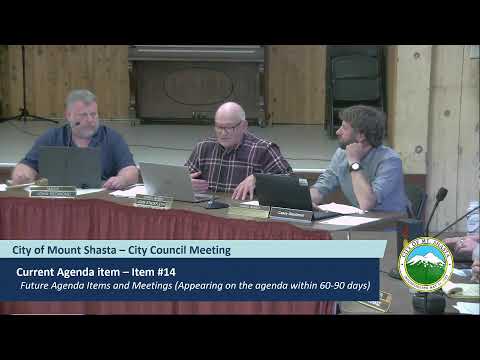
The Mount Shasta City Council voted unanimously to approve a resolution supporting efforts to seek grant funding for a project to daylight Castle Creek in downtown Mount Shasta.
City Manager Todd introduced the item and said the resolution would help the city be competitive for state grant programs. Project presenter Tom Hesseldens told the council that tonight’s vote would not be approval to build, but a step to pursue funding and move toward environmental review. "What's being asked of you now is not approval of the project — we have to go through CEQA," Hesseldens said, and added the project's objective was to secure grant money that would cover study, permitting and construction costs so the city would not bear the primary cost.
Hesseldens described alternatives for the block in front of the ACE Hardware parking area, including phased approaches that would maintain some parking while providing an 8-foot multiuse trail and a daylighted creek channel. He said grant proposals must include a realistic first-phase construction scope, civil engineering and hydrology work, and permitting costs in order to be competitive. He also cited a prior local experience in which a less-than-unanimous council vote discouraged a grant agency from funding a project.
During the public comment period, speakers expressed both support and concern. A resident (statement read into the record) questioned the project's fiscal impacts, potential loss of parking, maintenance costs and whether it would increase liability or reduce downtown business revenue; the statement suggested instead enhancing existing Parker Plaza and preserving undisturbed wetlands. Another resident told the council the project could help create a more walkable village core and reduce parking pressure if sidewalks and walls were improved.
Council members asked whether seeking grants would entail costs to the city. Hesseldens said he had donated some work and billed for part of the effort, and that much of the grant-writing would use work already completed; he said staff and the consultant would try to minimize billable hours. Councilmember comments noted that unanimous support can improve competitiveness for certain state funding programs. The council then approved the resolution by voice vote.
Because the council's vote only authorizes pursuit of grants, any construction or maintenance commitments would require later actions, environmental review (CEQA) and separate funding approvals. Hesseldens said public outreach would be part of the CEQA process and that alternatives would be refined with community input.
The council directed staff and consultants to proceed with preparing grant applications and environmental studies as the next steps.