Get Full Government Meeting Transcripts, Videos, & Alerts Forever!
Get email alerts on the Environment Natural Resources topic
No spam. Unsubscribe anytime.
Senate panel trims policy from omnibus environment bill, advances budget provisions
Summary
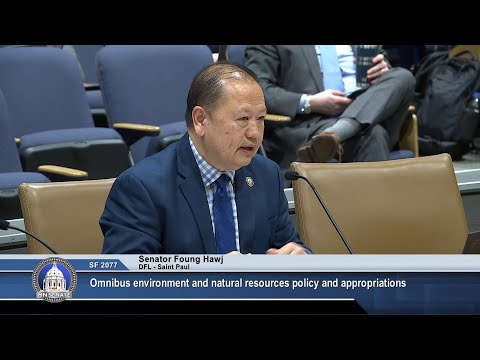
The Minnesota Senate Finance Committee advanced the omnibus environment and natural resources finance bill (Senate File 2077) on a voice vote after removing several contentious policy provisions and moving policy work to a separate bill.
The Minnesota Senate Finance Committee advanced the omnibus environment and natural resources finance bill (Senate File 2077) on a voice vote after removing a set of controversial policy provisions and moving several policy sections to a separate bill.
The committee adopted the A52 amendment, which strips multiple policy items from Article 4 and removes entire articles on e‑waste/battery stewardship and environmental permitting reform. The amendment passed by voice vote after staff described the specific deletions and senators debated fiscal and program details.
Committee chair Senator Hur brought the bill back to the committee “on a different shape and form,” said he would remove “the controversial policy” and asked members to move the A52 amendment. Staff member Mr. Stanley summarized the deletions: among other changes, the amendment would repeal a Department of Natural Resources (DNR) reporting requirement; remove a provision declaring the state’s wild rice policy; treat off‑road vehicle trail passes like snowmobile trail passes; modify rules on possession and importation of eviscerated carp; allow the use of purple paint in lieu of trespass signs; extend a sunset for crossbow hunting; repeal a shotgun zone; adjust trapping provisions; provide for a continuous bass season; authorize commercial burbot harvest on Lake Superior; revise the statutory definition of commissioner in chapter 115; and add provisions favoring projects that address PFAS when awarding financial assistance. The amendment also removed the bill’s e‑waste and battery stewardship article and the environmental permitting reform article in full.
Budget and appropriations remained central. Mr. Mueller, who walked the committee through the change‑only spreadsheet, said the bill stays within the committee’s general fund target of a minus $1,000,000 for fiscal 2026–27 and shows a $2,000,000 positive in the tails (fiscal 2028–29). He summarized major items: $103,000,000 from the Environment and Natural Resources Trust Fund for 124 projects recommended by the Lessard‑Sams Outdoor Heritage Council/LCCMR; appropriations tied to the Environment and Natural Resources Trust Fund community grant program established by the 2024 constitutional amendment; and a DNR land bill. The spreadsheet showed operating adjustments and fee‑driven changes across agencies including the Pollution Control Agency (PCA), the DNR, the remediation fund, and the Game and Fish Fund.
Mueller listed selected fiscal details: permitting‑related FTEs and operating adjustments for PCA (several million dollars and increased fees to satisfy federal requirements), a $75,000 shift/extension related to firefighter gear and PFAS in the Department of Health, and a $6.5 million per‑year direct appropriation from the Closed Landfill Investment Fund to continue prior statutory funding. With the e‑waste provisions removed, Mueller said the bill’s total spending above forecast would be roughly $57.3 million in 2026–27 and less in the tails.
DNR Assistant Commissioner Bob Meyer told the committee the agency appreciated the inclusion of operating adjustments and other items, but he warned the bill omits some governor’s proposals the department considered critical — including state park permit fee increases, funding for legal costs, and public safety preparedness funding for conservation officers. Meyer said, “With that additional shift and spending in the bill, it puts the balance of the Game and Fish Fund at approximately covering around 5%, which we're concerned about, which may force us to come to the legislature with a fee increase for the Game and Fish Fund in the coming biennium.”
Committee members offered both support and concern. Senator Pratt asked whether the A52 deletions had fiscal impact; staff replied the removed e‑waste article had been self‑funding and its deletion shows as reduced expenditures and revenues on the spreadsheet. Senator Dames successfully offered the A50 amendment, a separate land‑sale provision concerning tax‑forfeited land in Sibley County; the amendment passed by voice vote. Senator Jasinski pressed to preserve funding for a Water Quality 3D pilot project used by lake associations. Senator Friend and others pledged to carry permitting policy forward in a separate bill scheduled for committee action later in the week.
On a final voice vote, Senator Friend moved that Senate File 2,077 as amended be recommended to pass and instruct staff to make technical and conforming changes; the motion prevailed.
What happens next
Senator Hur said the policy sections removed from this finance bill would be scheduled in a separate policy bill for committee consideration, and committee members requested a brief recess to prepare new packets. The committee recessed and later returned to begin consideration of other legislation.