Get Full Government Meeting Transcripts, Videos, & Alerts Forever!
Get email alerts on the Dwi Interlock Reform topic
No spam. Unsubscribe anytime.
Senate committee advances DWI overhaul to extend ignition‑interlock terms
Summary
The Minnesota Senate Judiciary and Public Safety Committee on April 28 recommended passage of Senate File 2068, a bill that would extend ignition‑interlock requirements for repeat DWI offenders, lengthen the look‑back period for prior offenses, add interlock eligibility for criminal vehicular homicide and raise penalties for interlock violations.
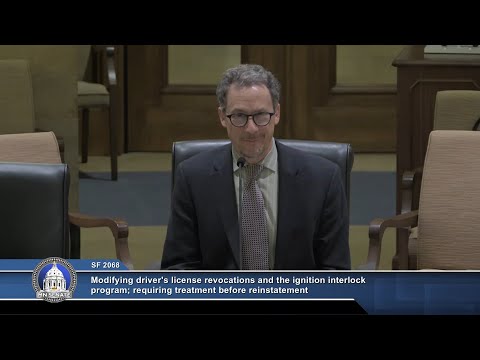
The Senate Judiciary and Public Safety Committee recommended passage of Senate File 2068 on April 28, 2025, after adopting an amendment. The bill, sponsored and introduced in committee by Senator Lats, would lengthen ignition‑interlock requirements for repeat driving‑while‑intoxicated offenders and make other changes to Minnesota's DWI laws.
The measure responds to a fatal crash in St. Louis Park involving a repeat DWI offender, the sponsor said, and aims to reduce recidivism by keeping higher‑risk drivers on interlock devices for longer. "The interlock device is a very effective mechanism for preventing people from driving while drunk," Senator Lats said during committee discussion.
Key provisions in the bill as described at the hearing include: 1) extending interlock durations for repeat offenders (examples discussed at hearing: a single repeat offender low‑level period rising from one to two years; higher repeat counts ramping to six and 10 years for subsequent qualifying offenses); 2) extending the statutory look‑back period for prior DWIs from 10 years to 20 years (and in some cases counting priors for life); 3) adding eligibility for ignition interlock for persons convicted of criminal vehicular homicide (with a 15‑year interlock period for a single prior and lifetime interlock for multiple priors, in alcohol‑related cases); 4) increasing the criminal penalty for tampering with or disabling an interlock device to a gross misdemeanor; 5) expanding the interlock exception to vehicle forfeiture so the exception can apply to any vehicle on which an interlock is installed (not only the vehicle involved in the offense); 6) extending temporary license revocation and plate impoundment timelines from seven to 14 days to allow time to install an interlock device; and 7) allowing staged payment of the $680 license‑reinstatement fee so payment need not be made entirely up front.
Committee counsel and staff described procedural fixes included in the bill: clarifying that out‑of‑state DWI convictions count for the look‑back period, clarifying the start date for the window to appeal Driver and Vehicle Services (DVS) extensions of interlock periods, and restoring explicit judicial review where a court previously found jurisdiction lacking.
Committee members and counsel discussed practical questions about when an offender released from incarceration could enter the interlock program; counsel stated eligibility for interlock is not tied to prison release and that a person can seek to enter the program immediately, although committee members asked the agency to confirm details.
Committee discussion also reviewed the costs of participating in the interlock program. Senator Lass said seven companies are certified in Minnesota; installation costs generally run about $300–$400 and monthly monitoring costs are commonly $125–$175 per month, with additional installation or removal fees and reduced rates for drivers who qualify for indigency discounts.
The bill includes an A14 amendment adopted by voice vote in committee that clarifies that out‑of‑state prior DWI convictions count toward the look‑back period and raises the penalty for driving after revocation while subject to an interlock requirement to a gross misdemeanor. After debate, the committee voted to recommend passage of Senate File 2068 as amended and to refer it to the Senate floor; the committee recorded an affirmative voice vote and the motion prevailed.
The measure will next go to the Senate floor for consideration. The committee's discussion was informational and deliberative; the bill's technical details, effect dates and exact statutory cross‑references remain in the printed bill and amendment language before the committee.