Get Full Government Meeting Transcripts, Videos, & Alerts Forever!
Get email alerts on the Worker Protections Enforcement topic
No spam. Unsubscribe anytime.
Committee holds hearing on 'Power Act' to expand enforcement of Philadelphia worker protections
Summary
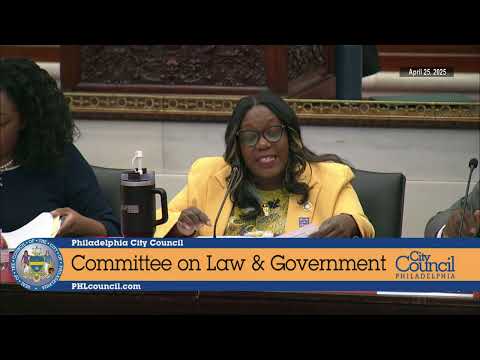
The Committee on Law and Government of the Philadelphia City Council held a public hearing on Bill 250065, the Power Act, to consider adding enforcement tools, retaliation protections and a public bad‑actor list across several worker‑protection chapters of the Philadelphia Code; no vote was taken at the hearing.
The Committee on Law and Government of the Philadelphia City Council held a public hearing on Bill 250065, the so‑called Power Act, examining proposed changes to Title 9 of the Philadelphia Code that would add new enforcement procedures and retaliation protections across the city's worker‑protection ordinances. The hearing included testimony from worker advocates, city officials and business groups and ended with the committee pausing to continue working on amendments; no vote was taken.
The Power Act, as read into the record at the start of the hearing, would amend Title 9 by revising chapters 94100, 94300 and 94500, adding enforcement language (including a new chapter referenced in testimony as 94700/96600) and creating new remedies and administrative tools, including a worker justice fund and an employer “bad actor” list. Vice Chair Councilmember Brooks said the bill is designed to “protect our workers, enforce rights,” and supporters told the committee the city needs stronger enforcement to make existing labor protections meaningful.
Supporters said enforcement gaps leave workers without remedies. Adrianna George, an organizer with the National Domestic Workers Alliance and We Dream in Black Philadelphia, testified that the Domestic Workers Bill of Rights enacted in 2020 “is the best of its kind,” but that “the law means nothing without enforcement,” describing workers who face wrongful termination, blacklisting and threats of deportation when they assert rights. Jen Stowe, executive director of the National Domestic Workers Alliance, told the committee that “without enforcement, those rights have remained out of reach,” and said Philadelphia’s approach could become a national model.
City staff described how enforcement would work in practice and noted limits. Cara Lany, first deputy director at the Department of Labor, described one example calculation under a recently circulated amendment: an employer who hires a nanny for 30 or more workdays could face at least $3,750 in exposure — roughly $3,000 for failing to have a written contract and $750 for failing to provide statutorily required notice — and she cautioned there could be additional exposure for other violations. Lany also advised the committee that portions of the bill relying on the Pennsylvania Minimum Wage Act are legally preempted, saying the city is “foreclosed” from enforcing that state law.
Officials from the Office of Worker Protections described current investigative procedures and capacity constraints. Olive Kyun, assistant compliance director, said a typical complaint sits in the office’s queue for about 90 days before assignment. Once assigned, the office interviews the complainant, requests records from an employer and gives the employer 30 days to respond to a notice of investigation and request for information. Kyun said the office offered mediation as a discretionary tool to resolve violations before a formal determination; mediation is more likely to be denied for repeat similar violations. She reported 23 mediations completed in 2023 and said the office recorded 84 violations that year.
Business groups urged changes to protect employers from what they called excessive litigation risk. Ashley Miskovich of the Chamber of Commerce for Greater Philadelphia and other industry witnesses said the bill's private right of action, as drafted, would allow employees and third parties to sue without administrative exhaustion and that the 15‑day cure window in recent amendments does not provide meaningful notice or time to resolve claims. The chamber said the bill “remains fundamentally stacked against all employers” and urged a task force to build a more balanced framework. The Pennsylvania Restaurant & Lodging Association and the Greater Philadelphia Hotel Association recommended extending cure periods to 30 days, narrowing definitions of “adverse action,” restoring a shorter statute of limitations, eliminating or limiting the bad‑actor list and lowering the rebuttal standard from “clear and convincing” to a preponderance of evidence.
Several technical and policy points drew sustained questioning from committee members. Councilmember Phillips asked how the “bad actor” threshold — which was raised in amendments to three or more violations — would avoid leaving repeated but smaller harms unchecked; city staff replied the database is intended to publicly flag employers who continuously violate the law after orders and appeals. Councilmember Landau asked the law department to provide a legal memo on preemption questions; city staff agreed to coordinate that follow up. Committee members also discussed the bill’s scope: witnesses and members confirmed the enforcement and retaliation changes would apply broadly to employers already covered by Philadelphia’s wage‑theft, paid‑sick‑leave and domestic‑worker laws, not solely to domestic workers.
Public commenters included small business owners who supported the bill and workers who described workplace injuries or retaliation. Alex Bernard, owner of Winsome Barber Shop, said he supports the Power Act to distinguish “good businesses” from bad actors; restaurant owner Jennifer Zavala urged the council to “fund it, enforce it, and stand behind it.” Worker commenters detailed on‑the‑job injuries, retaliation and the need for swift remedies. A union steward from OPEIU Local 32 asked the council to remove an exemption in the city’s healthy family leave rules that he said had allowed one employer to require a doctor's note and limit workers’ access to paid leave.
The committee did not vote and recessed to continue negotiating amendments and to request legal follow‑up on preemption. Council members said they want to balance stronger enforcement for vulnerable workers with due‑process protections for employers and to ensure the Office of Worker Protections has resources to carry out investigations.
If advanced, the bill would expand administrative and civil remedies for violations of Philadelphia’s worker‑protection laws, add record‑keeping and notice requirements for employers, create a pathway for bad‑actor designation and allow for a private right of action alongside city enforcement. Committee members and witnesses said the next steps will include more amendment work, a law‑department memo on preemption concerns and additional follow‑up on the bill’s operational impacts; the hearing record closed with the committee pausing to continue that work.