Get Full Government Meeting Transcripts, Videos, & Alerts Forever!
Get email alerts on the Holocaust Remembrance topic
No spam. Unsubscribe anytime.
Columbus marks 40th annual Holocaust remembrance with survivor testimony and student participation
Summary
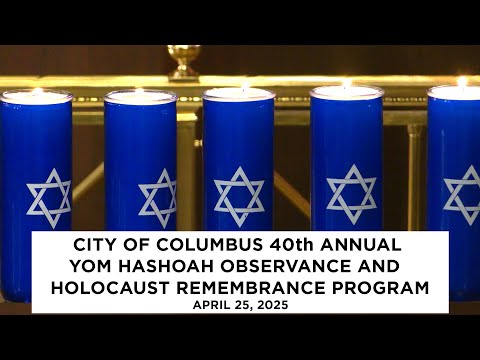
The City of Columbus held its 40th annual Holocaust Remembrance Program in City Hall chambers, bringing together survivors, elected officials, faith leaders and students to honor victims, hear survivor testimony and emphasize Holocaust education.
The City of Columbus held its 40th annual Holocaust Remembrance Program in City Hall chambers, bringing together survivors, elected officials, faith leaders and students to honor victims, hear survivor testimony and emphasize Holocaust education.
The program, presented under the auspices of Mayor Andrew Ginther and sponsored by the Department of Neighborhoods and Columbus City Council in cooperation with Jewish Columbus and the Holocaust Education Committee, featured opening remarks from Columbus City Council President Pro Tem Rob Dorrance, a keynote testimony from Sandy Hackman, a candle-lighting ceremony with six survivors and five representatives for other persecuted groups, and closing observances at the Patel Memorial Park memorial sculpture.
Council President Pro Tem Rob Dorrance opened the remarks in council chambers, calling Holocaust remembrance an active obligation. "The words 'never again' cannot be an idle phrase," Dorrance said, urging attendees and civic leaders to pass on survivors' stories. The program included recognition of students from Central Ohio schools invited to witness and learn from first- and second-generation testimony.
Guest speaker Sandy Hackman, introduced as a child of Holocaust survivors, gave an extended first-person account of her mother's experiences in Trochenbrod, Poland, including life in the ghetto, multiple "aktions" (mass killings), escape attempts, hiding in forests, and time in displaced persons camps after the war. Hackman said her family arrived in the United States in 1947 and described the intergenerational obligation to remember. "We must all learn to get along," she told the audience.
Rabbi Rick Kellner, senior rabbi at Congregation Beth Tikva, led a candle-lighting ceremony in which six survivors were invited to light candles in memory of the approximately 6,000,000 Jewish people murdered during the Holocaust and five candles representing roughly 5,000,000 other victims persecuted for political, ethnic, sexual-orientation or disability-related reasons. Survivors named in the program included Sofia and Edgar Karpovich, Mila Freibert, Tom Saltzman, Avraham Bulkovstein, Linda Zelensky and Professor Gideon Frankel. Representatives who lit candles for other persecuted groups included Mike McGuire (disability), Jose Rodriguez (LGBTQ), Barry Pickett (union workers) and Herbert Greff (liberators and prisoners of war); Debbie Sugarman lit in place of an absent representative for the Roma community.
Program organizers thanked the schools, teachers and organizations that facilitated student attendance and said the event aims to preserve firsthand testimony as survivors age. A speaker noted that remaining Holocaust survivors in the U.S. have a mean age in the upper 80s, and urged students to carry the memory forward. The ceremonial portion concluded with an invitation to place flowers at the Alfred Tibor freedom sculpture at Patel Memorial Park and a performance of "Taps."
No formal municipal actions, votes or policy decisions were recorded during the program; the event was a civic commemoration and educational observance.
The program also included historical context during remarks—references to General Dwight D. Eisenhower's 1945 efforts to document liberated concentration camps and to the 1948 Universal Declaration of Human Rights—framing the event as both memorial and an educational call to vigilance against denial and antisemitism.
The City Department of Neighborhoods and Jewish Columbus were listed as sponsors and organizers; the program acknowledged sign-language interpreters, Kroger for floral support, and Fort Hayes High School color guard and Fire Battalion Chief Michael Vedra for participation. Attendees were directed to move to the adjacent memorial for the concluding ceremony, with accessibility assistance provided.