Get Full Government Meeting Transcripts, Videos, & Alerts Forever!
Get email alerts on the Agriculture topic
No spam. Unsubscribe anytime.
Minnesota House passes agriculture finance bill funding local food, avian-influenza response and farm supports
Summary
The Minnesota House approved House File 2446, an agriculture finance bill that includes local food purchasing grants, farm down-payment assistance, funds for avian influenza testing and worker protections. The bill passed after committee leaders described it as a bipartisan compromise.
The Minnesota House passed House File 2446, the agriculture finance bill, after floor debate and a roll-call vote in which 130 members voted yes and 3 voted no.
The bill combines a range of programs and appropriations intended to support farmers, food programs and animal-health responses. Author and Agriculture Committee co-chair Representative Paul Anderson described the measure as “a pro farming, a pro agriculture bill.”
Members said the package includes programs to help farmers and communities. Representative Rick Hansen, co-chair, summarized priorities including investments to buy food from farmers for schools and underserved communities, expansions in animal-health preparedness related to avian influenza, and research into issues such as PFAS in biosolids. “So money into farmers pockets to help people eat,” Hansen said on the floor.
Key provisions discussed on the floor include: - Minnesota Down Payment Assistance Grant: up to $20,000 to assist qualified farmers purchasing their first farm (amount and eligibility language described on the floor). - Local food purchasing assistance: $2,000,000 in the next biennium to support grants that buy local food, with emphasis noted for socially disadvantaged farmers and distribution to underserved communities. - Farm-to-school and early care program: $2,000,000 to promote locally produced foods in schools and child nutrition settings and encourage nutrition education. - Avian influenza and animal-health funding: members cited an appropriation of $4,000,000 to the Department of Agriculture for avian influenza testing and related activities and a separately funded egg emergency account and avian-influenza mitigation grants for producers. - Worker and consumer protections: $200,000 for mental-health support for farmers and other agricultural workers; $1,700,000 for additional meat and poultry inspection services; and $1,500,000 for county grants to support agricultural inspectors. - Producer grants and investments: $450,000 for grants to help livestock producers install measures to prevent disease transmission; livestock depredation accounts and livestock investment grants were also referenced.
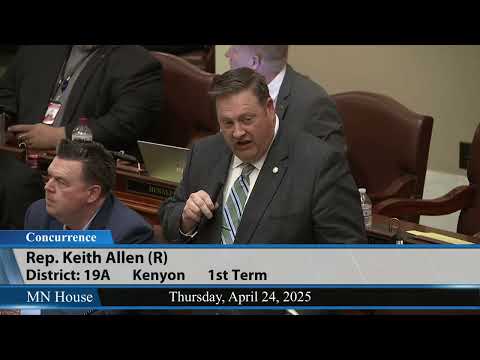
Supporters framed the bill as a bipartisan compromise produced by the evenly split House. Representative Gander (Polk) said he rose “in support of House File 2446 on behalf of the agriculture committee” and highlighted the Agricultural Utilization Research Institute (ARRI) as an example of innovation supported by the bill. Several members noted federal funding cuts that reduced USDA support for local food purchasing and related programs; legislators described the state appropriations in the bill as partial offsets to those federal reductions and emphasized the bill was not a full replacement for lost federal funds.
Debate ranged from programmatic detail to broader remarks about farming’s economic importance. Representative Michael Nelson (remarks on farm economics and production variability) and Representative Harder described tight profit margins facing farmers, and others recounted past outbreaks of avian influenza to underline the need for continued funding and coordination between the Board of Animal Health and the Department of Agriculture.
The House clerk closed the roll with a tally of 130 ayes and 3 nays; the bill was repassed and its title agreed to. The floor discussion recorded no formal amendments at the desk during the third reading.
Why it matters: legislators said the measure aims to preserve and strengthen Minnesota’s agricultural economy, support local-food distribution to schools and underserved populations, and fund animal-health preparedness and inspection services after recent federal funding changes.
Votes at a glance: House File 2446 — Passed, 130–3 (roll-call tally as read on the House floor).