Get Full Government Meeting Transcripts, Videos, & Alerts Forever!
Get email alerts on the Housing And Homelessness topic
No spam. Unsubscribe anytime.
Mesa community services outlines heat-relief, homelessness and housing aid plans as federal voucher risk looms
Summary
Community Services presented budget adjustments and program updates including a $89,800 one-time heat‑relief request, a plan to transition the city shelter from the Windermere to the Sunair property, continued use of ARPA and federal housing vouchers, and early results from a trap‑neuter‑return pilot.
Community Services Director Ruth Giese told the City Council that the department is asking for a set of budget adjustments and is continuing several city programs that address housing stability, heat‑safety and homelessness.
The presentation outlined existing programs and near‑term requests: the homeowner emergency rehab grant (up to $25,000 per household), results from a new trap‑neuter‑return animal program, a one‑time request to support summer heat‑relief services, continued case management and street outreach funding, and a transition plan for the city’s temporary shelter program as a privately owned motel is converted into a longer‑term facility.
The homeowner emergency rehab program is funded with Community Development Block Grant dollars, Giese said, and provides grants “up to $25,000 per household.” She said the department has allocated “over $2,000,000 for 27 projects” to date and that 94% of recipients in the program are elderly and about 45% report a disability.
Why it matters: the items discussed affect residents who are houseless or at risk, elderly homeowners, renters who rely on federal vouchers and neighborhoods that need heat‑safety supports. Several items affect the city budget in 2025–26: personnel and program costs, a $900,000 near‑term general fund impact tied to the shelter transition, and ongoing operating costs that city staff say will be funded in part by previously awarded federal relief (ARPA) and other dedicated grants.
Housing assistance and voucher risk Michelle Durkovic, the department’s senior fiscal analyst, explained that Mesa’s Housing Authority receives federal funds monthly to disburse to landlords. Giese said the department “receive[s] about $2,000,000 in disbursements directly from the federal government” each month for vouchers.
Deputy Director Lindsay Balenke flagged a narrower risk: COVID‑era emergency vouchers issued during the pandemic are time‑limited. Balenke said the emergency voucher funding was scheduled to run through 2030 but is now projected to “spend down its money by 2026.” She said staff are already working with the local HUD representative to seek a waiver that would allow regular housing vouchers to be used if the emergency voucher funding is no longer available.
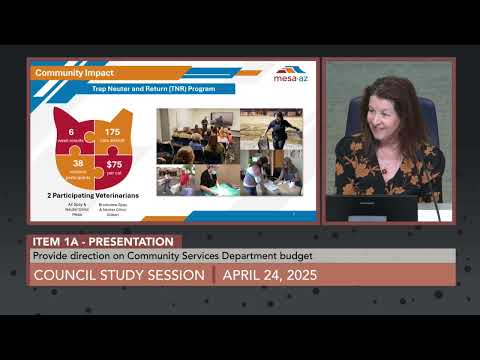
Trap‑neuter‑return and animal services Giese described the new trap‑neuter‑return (TNR) program for community cats, which launched in February. “In 6 weeks, we have altered 75 cats,” she said, and reported 38 resident participants and that the program has added a third participating veterinarian in East Mesa.
Heat relief and portable air‑conditioning loans Balenke described the department’s one‑time budget request of $89,800 to support heat‑safety work next summer. She said the request will fund a mix of services including continued operation of the primary heat‑relief center run in partnership with Maricopa County Public Health Department and Resurrection Street Ministries; a portable air‑conditioning loan program; transportation to cooling sites; outreach materials; and coordination with non‑profits and first responders.
Balenke said the partnership with Maricopa County has funded the primary center and that the site serves mainly people who are unsheltered. The city also intends to continue a portable air‑conditioner loan program; Balenke told council the program “was started last summer and we were able to serve 56 individuals/households” with loaned units. The department said it will sustain weekend coverage and has adjusted the center’s schedule to expand access.
Street outreach navigators Balenke outlined funding for a six‑person street outreach navigator team that operates in Mesa. The total contract amount combines federal CDBG dollars and local funds; staff said the combined total for the contract is $574,806, with CDBG offsetting part of the cost. Balenke said the navigators are dedicated to Mesa, are highly visible in the community with marked vehicles, and work closely with police, park rangers and fire personnel to connect people to services.
Off the Streets shelter transition and capacity Balenke walked council through the city’s “Off the Streets” shelter program. The city currently rents 85 rooms at the Windermere Hotel under a contract that costs about $3.1 million annually. Work is underway to convert the former Grand Hotel (rebranded in the presentation as Sunair) into a smaller, fenced campus with interior‑entry rooms. Staff said the Sunair site will operate more like a controlled campus and restrict admissions to certain vulnerable populations.
Under staff recommendations the Windermere contract would end as Sunair opens. Staff said Sunair would operate 64 rooms with a projected annual cost of $2.5 million and that the first‑year transition would carry a $900,000 impact to the general fund that is expected to be offset by ARPA funds in 2025–26. Beginning in 2026–27 the program operating cost is estimated at $2.5 million and would rely on ongoing general‑fund support once ARPA is exhausted.
Council members pressed staff on who would qualify for Sunair. Staff said the property’s council‑use permit limits the facility to seniors, families and domestic‑violence survivors. Balenke said about 80% of people served at Windermere in 2024 would meet the Sunair criteria and about 20% would not. Staff provided calendar‑year 2024 figures: 820 people served in the program, including 471 family members, 234 children and 84 seniors; staff said 5% of those served—about 37 people—were single women who would not automatically qualify under the current council‑use permit criteria.
Council members asked whether the permit conditions could be changed; staff said changing admissions criteria would require returning to council to amend the council‑use permit. Staff also noted that single men who do not meet the Sunair eligibility could be referred to the East Valley Men’s Center and that the city will continue to coordinate regionally to find placements for people who do not meet Sunair’s criteria.
Budget context and funding sources Michelle Durkovic reviewed the department’s budget profile. Staff said the department’s proposed 2025–26 budget totals about $65.2 million across fund sources, of which under 15% is general fund. In addition to HUD and CDBG funding, the department manages American Rescue Plan Act funds and opioid settlement distributions. Staff said Mesa has received roughly $4.5 million so far from opioid settlement distributions and that the state distributes funds to local governments on a formula basis; staff plan to return to council in the coming month with a community grant program and recommendations for spending those opioid settlement funds.
Discussion vs. decisions Most of the council discussion was informational and preparatory. Staff said they will return to council with more detailed proposals on opioid‑settlement grant criteria and on implementation steps for the Sunair transition. No new binding policy was adopted at the meeting; the formal council actions taken during the session were procedural (receipt of minutes and adjournment).