Get Full Government Meeting Transcripts, Videos, & Alerts Forever!
Get email alerts on the Homelessness topic
No spam. Unsubscribe anytime.
Toledo homelessness board: homelessness rising sharply; calls for expanded shelters, rapid rehousing and coordination
Summary
Julie Embry of the Toledo Lucas County Homelessness Board told the consolidated‑plan hearing that homelessness rose about 30% over four years, described gaps in shelters and ESG funding, and highlighted a $4 million HUD grant intended to reduce barriers to affordable housing production.
Julie Embry, executive director of the Toledo Lucas County Homelessness Board, told the public hearing that homelessness in Toledo has increased sharply in recent years and urged the city and community partners to expand prevention and long‑term housing supports.
“Nearly 3,400 individuals experienced homelessness in 2024 alone,” Embry said, and she told listeners that figure represented a roughly 30% increase over the previous four years. She added that more than half of those counted were experiencing homelessness for the first time and that at the time of her remarks the community had an estimated 1,600 people currently homeless, including 322 families with children.
Embry credited existing local work but said gaps remain. She urged expansion of shelters and rapid‑rehousing programs, increased coordination across agencies and stronger data alignment. She said Emergency Solutions Grant (ESG) services are “sorely underfunded,” and she highlighted a $4,000,000 HUD grant through a housing production or barrier‑removal program (described by the speaker as a HUD pro‑housing grant) intended to support efforts to identify and remove barriers to affordable housing production.
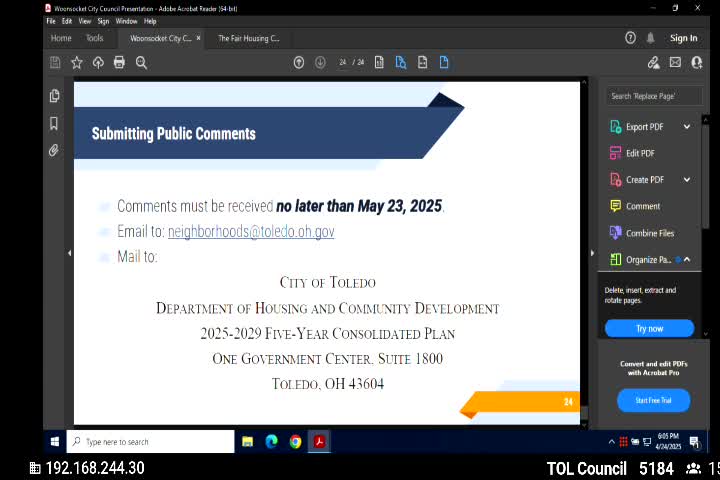
Embry also noted that Lucas Metropolitan Housing operates more than 2,500 affordable units and that the Home for Everyone continuum of care had issued a strategic plan aimed at improved service coordination. She called for communitywide commitments on prevention, supportive services and enforcement against discriminatory housing practices that limit access for vulnerable groups, and urged residents to attend public meetings and submit comments to the consolidated plan process.
The homelessness board’s priorities, as presented, include expanding no‑barrier shelters, scaling rapid rehousing and prevention programming, improving coordination and data sharing among providers, and pursuing policy changes to expand access to housing choice vouchers and other tools. Embry concluded with a call to action: “Housing is not a privilege. It's a right.”