Get Full Government Meeting Transcripts, Videos, & Alerts Forever!
Get email alerts on the Local History topic
No spam. Unsubscribe anytime.
Teacher Randy Hilliard recounts Sea Island cotton history and local planting efforts
Summary
Randy Hilliard, a longtime James Island resident and high school teacher, presented a historical overview of Sea Island cotton at the April James Island meeting, describing its cultural and economic role in the Lowcountry and local replanting efforts in the 1990s.
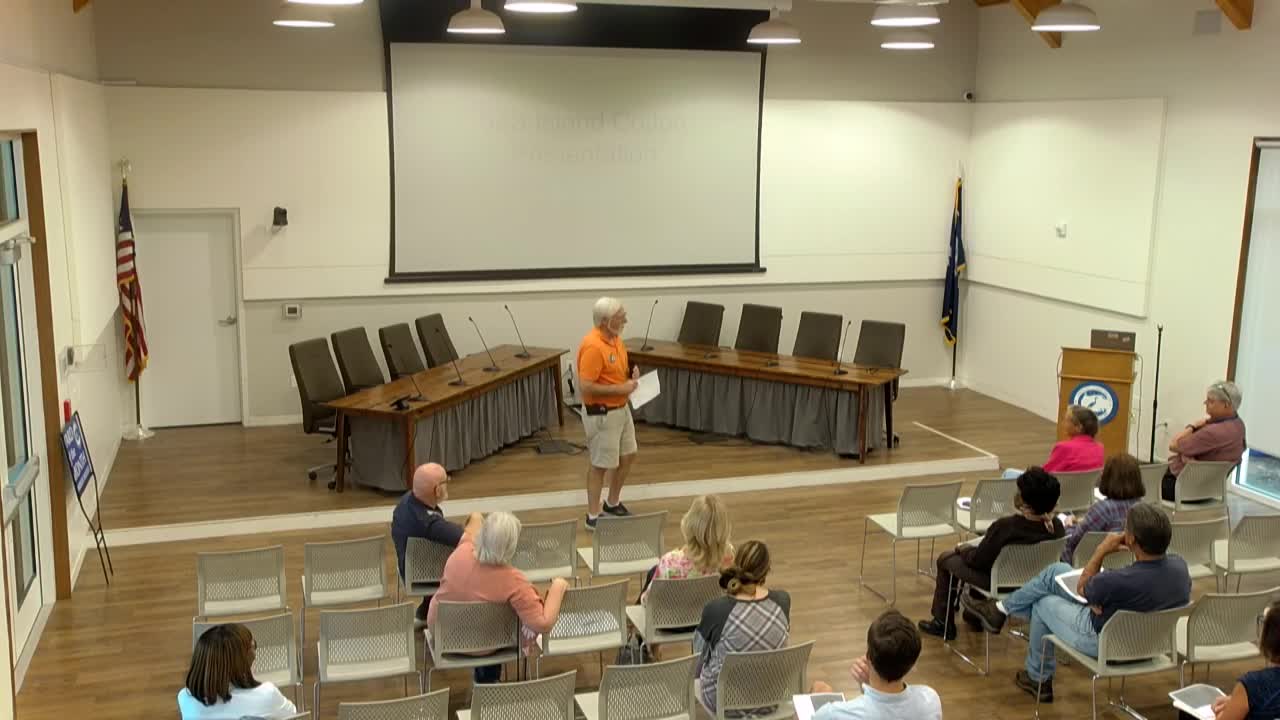
At the April James Island meeting, Randy Hilliard, a longtime James Island resident and high school history teacher, presented a history of Sea Island cotton and its role in the island’s agricultural and social history.
Hilliard traced the crop’s regional importance from its arrival about 1790 through the 19th century and Reconstruction, describing Sea Island cotton as a long‑staple variety that thrived in the Lowcountry’s maritime environment. He explained that the crop required special soil and drainage practices — raised rows, ditches and subsoil drainage — and that farmers used pluff mud and pasture rotation to restore nutrients.
Hilliard recounted post‑Civil War efforts to restart Sea Island cotton on James Island. He cited minutes of the James Island Agricultural Society (meetings in January and July) as a primary source for yields and techniques. Hilliard said younger planters such as William Godfrey Henson and Elias Rivers played key roles in organizing the society and improving yields; he noted the society was white‑only in membership.
Hilliard described how the boll weevil reached James Island and was recorded in agricultural minutes around 1918; he said that insect “wiped it out for James Island” as a viable cash crop. He also described later local shifts to truck farming and dairy as planters adapted.
Hilliard spoke about a local replanting project he led in 1994–95 at McLeod Plantation with high school students. He said the project required a permit from Clemson University Cooperative Extension because of boll weevil concerns; Hilliard described sourcing Sea Island cotton seed from Charleston Landing and supplemental commercial seed when initial germination was poor. He encouraged continued historical research and preservation of local agricultural history.
Hilliard’s presentation included references to named local properties (McLeod Plantation, Dill Plantation, Centerville Plantation, Lawton Plantation, Stiles Henson home) and to the specialized agricultural practices and social arrangements (tenant farming versus sharecropping) that shaped the island’s farming history. He concluded by urging preservation of both Black and white aspects of James Island history and said more archival work could add names and faces to existing records.