Get Full Government Meeting Transcripts, Videos, & Alerts Forever!
Get email alerts on the Enrollment And Facilities topic
No spam. Unsubscribe anytime.
Kyrene committee hears enrollment drop, budget gap and options for closing or repurposing schools
Summary
Kyrene Elementary District officials told a community long‑range planning committee that enrollment has fallen from roughly 16,300 six years ago to about 12,849 this fall and that, under staff projections, the district could shrink to about 11,300 students by 2029–30 — a decline that would create multimillion‑dollar operating shortfalls and force choices about programs and school buildings.
Kyrene Elementary District officials told parents, staff and community volunteers at the district’s third long‑range planning meeting that declining births, expanded school choice and recent policy changes have cut the number of students the district serves and will require choices about programs and facilities.
"We are a declining district," said Dr. Susie Asmeier, director of research and evaluation, as she reviewed the district’s headcount history and projections. She told the committee that Kyrene’s fall headcount has fallen from roughly 16,300 six years ago to 12,849 this year and that the district’s service rate — the share of school‑age children living inside district boundaries who attend Kyrene schools — now sits near 60%.
The district presented two planning scenarios. Using a long‑term trend the staff said is their planning baseline, enrollment could fall to about 11,300 students by the 2029–30 school year. A short‑term trend based on recent larger year‑to‑year drops would produce a steeper decline — nearer to 10,000 students — the staff said. Finance staff then translated those forecasts into dollars: projected operating reductions over five years range from about $7 million on the lower end to roughly $9.3 million if the downswing follows the steeper scenario.
Why it matters: enrollment is the base of Kyrene’s operating revenue. Budget staff told the committee that the district uses a longtime “timeless spending model” that targets roughly 75% of operating dollars for classroom instruction and that maintaining that proportion with fewer students will require changes in how staff and facilities are organized.
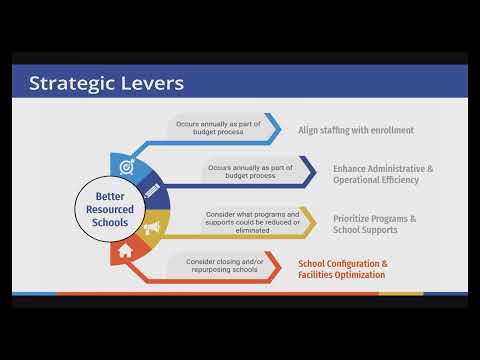
District staff framed four strategic “levers” the district can pull, and where they already have been active: 1) align staffing to enrollment (class‑size ranges and teacher allocation), 2) pursue administrative and operational efficiencies (yearly right‑sizing and contract renegotiations), 3) prioritize or reduce programs and supports (choice programs, electives, counseling and intervention staffing), and 4) optimize facilities (closure, consolidation, reconfiguration or repurposing of school properties).
On staffing and classroom priorities, Dr. Asmeier and other presenters described Kyrene’s approach: staff models start from the district’s fortieth‑day enrollment, roll cohorts forward, and use targeted class‑size ranges that are intentionally smaller in early grades for early‑literacy investment. The district said it currently counts about 200 additional teaching positions that were preserved through the district’s maintenance and operations (M&O) override; those positions would be at risk if that funding were not sustained.
Finance staff (identified in the meeting as Mr. Herman) summarized past reductions and ongoing constraints. "Kyrene has a very rich history for many years of keeping a very high percentage of its overall budget into classroom areas," he said, noting that the district has already reduced positions and expenses by roughly $21 million since the enrollment peak and has limited options remaining in some nonclassroom categories. Staff warned that many plant/operations costs are fixed while buildings remain owned and open.
On facilities, staff presented averaged cost illustrations: an elementary school’s ongoing personnel and day‑to‑day operational costs combined were presented as roughly $800,000 per year on average; a middle school’s combined recurring cost was presented as roughly $1.3 million per year. Capital or infrastructure work averages were shown as long‑term 10‑year averages (roughly $5.6 million per elementary and $12.8 million per middle school over ten years), funded from bonds, capital override or state capital assistance. Staff emphasized that day‑to‑day and capital costs generally remain in the district’s books so long as the district owns and operates the building.
District staff described a range of facility options — from rebranding or programmatic repurposing (for example, early childhood or career/CTE uses) to leasing or selling property — but cautioned that repurposing or leasing does not automatically eliminate operating costs and may require additional capital investment. "If you turn it into a professional development center for the district, there's still a whole lot of costs," a staff presenter said.
Community discussion: participants at multiple tables repeatedly urged the district to combine levers and avoid isolated fixes. A table volunteer summarized a common view: "This is not like a one‑school issue," and several groups urged that program consolidation be considered so signature programs can continue while reducing overall footprint. Multiple table groups asked for clearer legal and procedural answers about what happens to land and buildings if a school is closed and whether the district legally may sell or lease sites.
What the meeting did and did not decide: the committee did not take formal votes. Staff noted the committee had previously reached consensus to recommend placing an M&O override before voters (an outcome from an earlier meeting); tonight’s meeting focused on information, questions and community feedback about longer‑term facility and program choices. Staff said materials and table notes would be collected and synthesized to inform the next meeting, scheduled about a month later.
Ending: staff asked the committee to treat the presentation as context for future brainstorming and returned the group to table work and a follow‑up meeting. "If we continue to operate at 25 schools with declining enrollment and decreased resources, all you're doing is spreading your resources thinner and thinner," said Laura, one of the district presenters, summing the constraint that frames upcoming choices.
Key figures and district estimates cited in the meeting: current fall headcount 12,849; six‑year earlier headcount roughly 16,300; current service rate near 60%; long‑term planning baseline projection ~11,300 students by 2029–30; short‑term steeper scenario nearer 10,000; five‑year operating impact estimated between about $7 million and $9.3 million; roughly 200 teaching positions funded through the existing M&O override that the district said it is already spending.
The committee will reconvene to move from review into option development; district staff said they will compile table notes and follow up with a materials packet ahead of the next session.