Get Full Government Meeting Transcripts, Videos, & Alerts Forever!
Get email alerts on the Agriculture topic
No spam. Unsubscribe anytime.
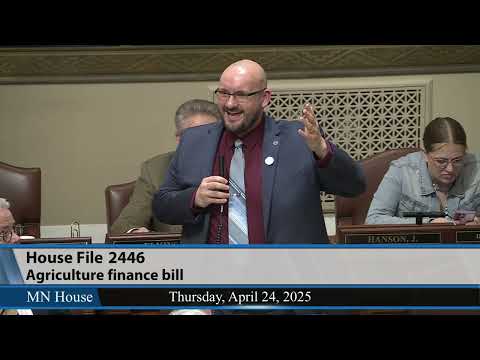
Minnesota House passes Ag Finance Bill (H.F. 2446) funding food programs, avian-flu response and PFAS research
Summary
The Minnesota House gave final passage to House File 2446, the agriculture finance bill, by a 130-3 roll call. Sponsors and supporters said the bill provides targeted funding for farm-to-school purchases, avian influenza response, PFAS and crop research, and small-farmer assistance.
The Minnesota House on a final floor vote approved House File 2446, the agriculture finance bill, by a roll call of 130 yeas and 3 nays. Supporters said the measure directs state appropriations to farm-to-school and local food purchases, avian influenza response and testing, research into PFAS in sewage sludge and crop diversification, and other agriculture priorities.
Representative Paul Anderson, co-chair of the House Agriculture Finance Committee, said the package "is a pro farming, a pro agriculture bill," and credited bipartisan committee work and staff support for producing what he described as a bill members on both sides of the aisle could support. "Each of us on each side of the aisle have provisions in this bill that we feel are very important," Anderson said on the House floor.
Supporters framed the bill as a targeted, relatively small-budget investment intended to shore up state programs as federal funding has been reduced. Representative Rick Hansen, co-chair of the committee, said the bill "provides investments" that both protect existing programs and look to future opportunities for Minnesota agriculture. "These investments are not just protecting what we have, but looking on what we can do," Hansen said.
Key provisions and figures discussed on the floor include:
- Local food and school purchasing: The bill funds a local food purchasing assistance program at $2 million in the next biennium and funds a farm-to-school and early care program at $2 million to promote locally produced foods in schools and child nutrition settings. Members said those appropriations are intended in part to offset federal cuts; representatives on the floor cited letters from the U.S. Department of Agriculture notifying the state of reduced federal support of roughly $3.2 million (local food for schools) and $4.7 million (local food purchasing assistance).
- Farmer entry and investment programs: The bill funds a Minnesota down payment assistance grant offering up to $20,000 for qualified farmers purchasing their first farm, and it includes livestock investment grants and other measures supporters said will help diversify and sustain small and mid-sized farms.
- Avian influenza and animal health: The measure appropriates funding for the Board of Animal Health and the Minnesota Department of Agriculture to respond to highly pathogenic avian influenza, including grants to livestock producers, increased testing, and support for meat and poultry inspection. Floor remarks specified $450,000 in grants to help livestock producers install measures to prevent avian-flu transmission and $4 million to the agriculture department for avian-flu testing; supporters also identified $1.7 million for additional meat and poultry inspection services and $1.5 million for county agricultural inspection grants.
- Worker supports and consumer protections: The bill includes a $200,000 appropriation for mental-health support for farmers, ranchers and other ag workers, and members noted measures aimed at protecting workers in processing facilities and consumers through inspection funding.
- Research and environmental work: The bill funds science- and research-based work on PFAS in sewage sludge, tests and evaluations based on Olmsted County water-quality work, investments in crop research including the ForeverGreen program, and research on prion impacts for crops.
Floor discussion featured multiple representatives from agricultural districts who framed the bill as a compromise needed in an evenly divided chamber. Representative Gander highlighted the Agricultural Utilization Research Institute (ARRI) and said ARRI "plans to generate $500,000,000 in economic activity by 2026," as an example of innovation the bill aims to support. Several members, including Representative Jacob and Representative Smith, described the bill as imperfect but a pragmatic compromise that protects farmers and food systems.
Procedural note: There were no amendments at the desk; the clerk read the bill for third reading and took a roll-call vote. The clerk announced "There being 130 ayes and 3 nays, the bill is passed and its title is agreed to."
Supporters repeatedly referenced recent federal reductions in program funding and presented the state appropriations in the bill as partial backstops to those cuts. Sponsors and multiple members emphasized support for both large and small farmers, increased biosecurity and testing capacity for high-path avian influenza, and continued investment in department operations and staff who provide licensing and certification services.
The House approved H.F. 2446 by recorded vote; the clerk closed the roll after tallying the yeas and nays and declared the bill passed.