Get Full Government Meeting Transcripts, Videos, & Alerts Forever!
Get email alerts on the Homelessness And Social Services topic
No spam. Unsubscribe anytime.
Councilors weigh Transition Wellness Center closure, housing vouchers and a successor cash program
Summary
The Finance Committee heard detailed questions and public comment Tuesday about homelessness supports, emergency housing vouchers and proposals for a successor guaranteed-income program as staff warned of federal funding threats to several services.
The Finance Committee heard detailed questions and public comment Tuesday about homelessness supports, emergency housing vouchers and proposals for a successor guaranteed-income program as staff warned of federal funding threats to several services.
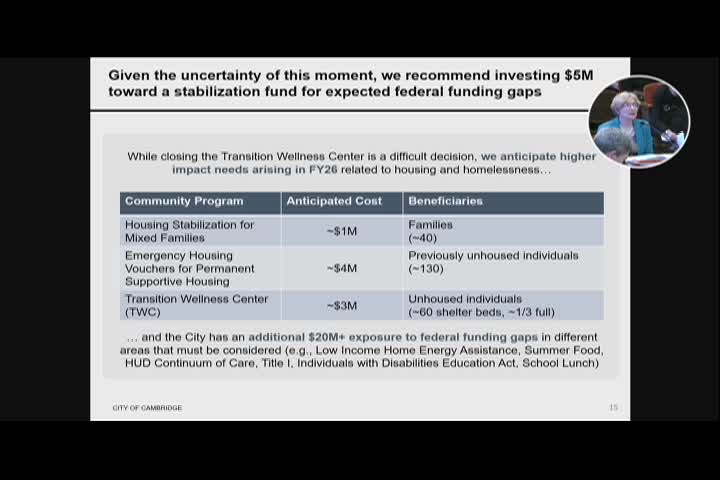
Assistant City Manager Claire Spinner told the committee that city staff expect to need to backfill some federal supports and that the proposed $5 million stabilization fund could be used to shore up programs such as housing stabilization and emergency vouchers. Spinner said slides presented to the committee identified three high-concern areas: housing stabilization for mixed-status families (the presentation estimated about 40 families could be affected), emergency housing vouchers that rely on roughly $4 million in federal funds (about 130 individuals could be affected), and the Transition Wellness Center, which staff have been discussing in recent committee meetings.
On immediate placements, staff said the Spalding-run Transition Wellness Center currently has about 22 people who had not been placed into permanent housing; staff estimated “perhaps 5” could be housed in the next month or two but that “there are likely, at this point, to be, 16, 17, 18 people who are not placed.” City staff warned that seasonal shelters are closing for the summer and that regional shelter capacity is already strained.
Public comment focused on both direct cash assistance and shelter preservation. Geeta Pradhan of the Cambridge Community Foundation urged the council to “prioritize cash for these families,” noting the city’s prior guaranteed-income pilots and the high cost of living for low-income households. Tina Alou of CEOC said tax-season demand for food and services remains high and urged continuation of a Rise Up successor program; Dan Totten urged councilors to find $3 million to keep the wellness center open and said the center “has been one of the most effective shelter programs Cambridge has ever implemented.”
Council discussion included questions about whether the affordable housing trust can be used to fund vouchers; staff said trust funds are legally limited to preservation or building of affordable housing and do not generally cover vouchers. Staff said any use of the proposed stabilization fund would be subject to later appropriation votes by the council.
Ending: Councilors repeatedly pressed staff for clearer numbers and for options that prioritize housing stabilization and prevention. Staff committed to returning with more detailed scoping of trade-offs and to identify how stabilization dollars might be appropriated if the council chooses to do so.