Get Full Government Meeting Transcripts, Videos, & Alerts Forever!
Get email alerts on the Real Estate Tax topic
No spam. Unsubscribe anytime.
Finance committee confirms $1.14 equalized real estate rate; public hearings draw calls for deeper cuts and budget clarity
Summary
Hampton’s finance committee unanimously affirmed an equalized real estate tax rate of $1.14 per $100 of assessed value as the basis for the city manager’s recommended FY 2026 budget. Public hearings opened Tuesday, with residents urging larger tax cuts, better employee pay and clearer financial reporting for the AquaPlex.
The Hampton City Council’s finance committee on Tuesday confirmed an equalized real estate tax rate of $1.14 per $100 of assessed value — the figure used in the city manager’s recommended fiscal 2026 budget — and the council opened public hearings on the budget and tax rate that drew residents calling for larger cuts and more transparency.
Linda Curtis, a retired former commonwealth’s attorney and citizen member of the council finance committee, told council members the committee “voted unanimously to confirm the calculation of the stabilization real estate tax rate at the equalized rate of a dollar 14 per $100 of assessed value per the revenue guideline.” The committee, she said, met April 16 and reviewed the manager’s recommendation and the committee’s application of the city’s revenue guideline.
The recommendation follows a long-standing local policy intended to limit year-to-year real estate revenue growth net of new construction. Curtis said the guideline, established Feb. 8, 2006, compares growth in assessed value with inflation or resident income growth and is meant to give residents clarity if the city deviates from the guideline.
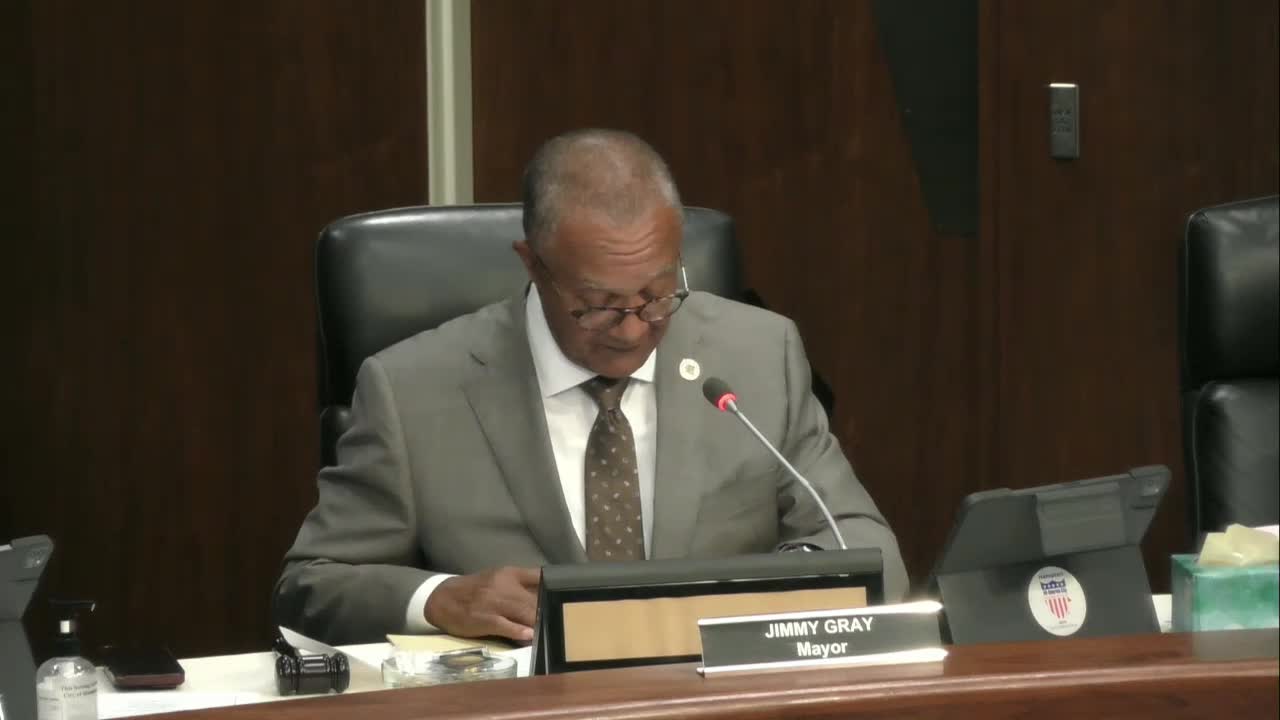
Mayor James A. Gray framed the tax discussion within recent reductions in Hampton’s rate, telling the council that “over the past 3 years, our city council has taken deliberate steps to ease the financial burden on the residents by reducing our real estate tax rate by a total of 9¢. And this year, the manager’s recommending an additional 1¢.” He also cautioned that reductions reduce funds available for services and employee compensation.
The public hearings produced contrasting calls from residents. Aaron Weaver urged council to approve the one-cent reduction from $1.15 to $1.14, saying, “I urge you to lower the tax rate from a dollar 15 to a dollar 14 per a hundred dollars.” Weaver also urged council to pursue pay increases for city staff.
Brenda Marks told the council she still considered $1.14 too high, saying citywide assessments have risen sharply and that she would prefer a lower rate. “I think the dollar 14 real estate tax is still too high,” Marks said, adding that on her home the assessment increase raised her tax bill by $287.50 this year.
City staff also explained why the public notice language can appear contradictory. The clerk and finance staff said state advertising rules require the city to show what the effect on revenue would be under a specified 1% growth calculation, which can make the advertisement read as an “effective real property tax increase” even when the council is proposing to lower the rate. The clerk said the state advertisement for the hearing was published in the Daily Press on April 6 “in accordance with the Code of Virginia 58.13321,” and the city manager noted the city charter requires a published budget synopsis and at least 10 days’ notice before public hearings.
Residents at the hearings also pressed for more transparent financial reporting on enterprise operations. Both Weaver and Marks asked for clearer performance metrics and profit-and-loss information for the AquaPlex; the city manager said the AquaPlex was originally managed by Eastern Sports Management (ESM), which the city later replaced and that some historical attendance metrics were not collected by the contractor but would be recorded going forward under city management.
Next steps: council held these items as public hearings only Tuesday; city staff said budget ordinances will be introduced for first reading on May 7, with final approval of budget ordinances targeted for May 14, 2025.