Get Full Government Meeting Transcripts, Videos, & Alerts Forever!
Get email alerts on the State Budget Jobs topic
No spam. Unsubscribe anytime.
Senate Finance Committee advances jobs/budget bill, adds labor package after debate over paid-family leave funding
Summary
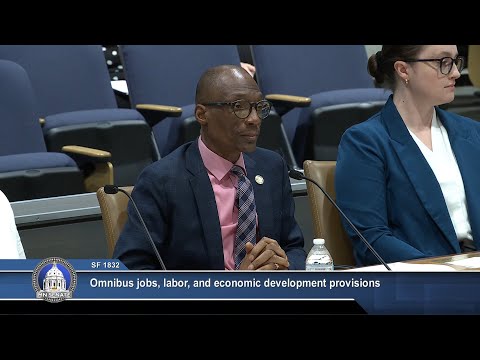
Senator Champion presented Senate File 18-32 to the Senate Finance Committee on April 24 and the committee voted to advance the jobs and budget package and to add the contents of the labor bill (Senate File 2373) into the package.
Senator Champion presented Senate File 18-32 to the Senate Finance Committee on April 24 and the committee voted to advance the jobs and budget package and to add the contents of the labor bill (Senate File 2373) into the package.
The bill is primarily a budget document that authorizes multiple one-time appropriations and transfers for workforce development, community grants and tourism. Champion said the bill was “very intentional about not including any controversial policy provisions” and highlighted new and modified grant programs including changes to the Promise Act and reporting requirements intended to increase transparency for direct appropriations.
Committee fiscal analyst Hannah Grunewald Knollinger walked members through two spreadsheets labeled “change only” that detail fund-by-fund changes. The bill includes, among other items, a $14 million transfer from the 20 First Century Fund to the general fund; a $6.875 million appropriation to Explore Minnesota Tourism in FY 2026-27 and $5 million in one-time funding for the World Junior Hockey Championship; a $4.5 million one-time Promise Act appropriation split among the Minnesota Initiative Foundation and the Neighborhood Development Center; and a variety of one-time workforce settlement fund awards for dozens of community organizations and training programs. Knollinger summarized net general fund changes as increases of about $7.8 million in FY 2026-27 and smaller changes in the later biennium tied to transfer timing.
Several amendments to the bill were offered and adopted by voice vote. Senator Champion moved and the committee approved amendments labeled A16, A23, A28, A30 and A26; sponsors said these corrected prior placeholder transfers, ensured compliance with budget dating rules, adjusted STEM ecosystem language, added funding for Greater Minnesota workforce programs and clarified language for a test program. Where voice votes were recorded, the transcript shows the amendments were ordered adopted; no roll-call tallies were taken for those.
A substantive point of contention during floor discussion was how the bill treats the administrative funding for the state’s paid family and medical leave program. The fiscal spreadsheet reduces direct appropriations from the Family Medical Benefit Insurance (FMBI) account and instead relies on the statutory appropriation authority set out in Minnesota Statutes chapter 268B.02 for the program’s administration. Knollinger explained that the 2023 legislation set direct appropriations in base law and that this year’s author (Senator Champion) chose to rely on the statutory appropriation language for administrative costs rather than reasserting direct appropriations in the omnibus bill.
Senator Pratt and others objected, arguing the committee’s budget rule B.0.6 favors direct appropriations for transparency and periodic legislative review. Pratt offered Amendment A25 to restore the direct appropriations for DEED administration and the small-business assistance portion that were part of the 2023 base; Champion opposed A25 and requested a roll call. The roll call recorded four votes in favor and seven against; the motion failed (4–7). The committee similarly rejected an amendment (A29) to insert paid family and medical leave policy changes into the jobs bill; that motion also failed on a roll call 4–7.
Senator Pratt said he would vote against the final bill because of the committee’s handling of the paid family and medical leave appropriations and because he believed the approach reduced transparency. Senator Champion responded that he had consistently kept paid family and medical leave separate from the jobs omnibus and defended his decision to rely on the statutory appropriation. Other members including Senator Draheim and Senator Frentz urged clearer public transparency but did not change the result.
After debate the committee approved Senator Champion’s motion to incorporate the contents of Senate File 2373 (the labor bill) into Senate File 18-32 and then recommended passage of the combined package, instructing staff to make technical and conforming changes. Both motions were approved by voice vote. The committee recessed to reconvene after floor session to take up a later environment bill.
Votes at a glance - A16 (Sponsor: Senator Champion) — adopted (voice vote). - A23 (Sponsor: Senator Champion) — adopted (voice vote). - A28 (Sponsor: Senator Champion) — adopted (voice vote). - A30 (Sponsor: Senator Mohammed; carried by Champion) — adopted (voice vote). - A26 (Sponsor: Senator Champion) — adopted (voice vote). - A25 (Sponsor: Senator Pratt) — failed on roll call, 4 yes, 7 no (restored direct appropriations to DEED/FMBI) — roll-call recorded votes include Yes: Pratt, Dames, Draheim, Jasinski; No: Marty, Frentz, Champion, Mohammed, Murphy, Pappas, Wicklund. - A29 (Sponsor: Senator Draheim; proposed insertion of paid family and medical leave changes) — failed on roll call, 4 yes, 7 no. - Motion to amend SF 18-32 by adding contents of SF 2373 (labor bill) — adopted (voice vote). - Motion to recommend SF 18-32 as amended be passed and to allow technical/conforming edits — adopted (voice vote).
What it means The committee advanced a package that preserves a large set of one-time workforce and community grants and moves the labor bill into the jobs omnibus. The central unresolved issue among committee members was the procedural choice to rely on a statutory appropriation for paid family and medical leave administration rather than including direct, time-limited appropriations in the omnibus bill — an approach critics said reduces transparency; supporters said it follows the existing statutory framework. The committee instructed staff to make technical edits and will reconvene after session to take up a separate environment bill.
Sources and attribution Quotes and attributions in this article come from the committee hearing transcript: Senator Champion (bill author), Hannah Grunewald Knollinger (fiscal analyst), Senator Pratt, Senator Draheim, Senator Mohammed and other members as recorded in the hearing.
Ending note The committee recessed and said it will give at least a half-hour notice before reconvening to take up Senator Hurst’s environment bill.