Get Full Government Meeting Transcripts, Videos, & Alerts Forever!
Get email alerts on the Homelessness Navigation Center topic
No spam. Unsubscribe anytime.
Vista staff weigh adaptive reuse, modular and hotel options; recommend city-owned 200 Michigan Ave. site for permanent navigation center
Summary
City of Vista staff told the standing committee on homeless that they evaluated adaptive reuse, hotel conversion and modular construction options for a permanent navigation center and recommended using the city-owned property at 200 Michigan Ave. for partial demolition, reconstruction and renovation.
City of Vista staff told the standing committee on homeless that they evaluated adaptive reuse, hotel conversion and modular construction options for a permanent navigation center and recommended using the city-owned property at 200 Michigan Ave. for partial demolition, reconstruction and renovation.
The presentation, led by Jonathan Lung, the city’s homeless services program manager, summarized earlier council direction to explore options after the City Council allocated $4.5 million from year-end fund balance and the city subsequently received an additional $1 million in state funds, bringing the project budget to about $5.5 million. Staff said the city currently operates the Boy to Creek Navigation Center under contracts that run through Dec. 31, 2026, and estimated the combined annual city cost for lease and contracted services at about $1.5 million.
Staff outlined four business-park properties reviewed for adaptive reuse (2630 Business Park Drive; 1205 Avenida Chelsea; 2540 Fortune Way; and 1210 Distribution Way), noting tradeoffs such as distance to transit, parking and client privacy. For example, 2630 Business Park Drive is about 0.8 miles from the nearest bus stop, creating accessibility challenges; 1205 Avenida Chelsea is 0.3 miles from transit but could raise costs if a larger property is chosen; 2540 Fortune Way lacked sufficient parking and expansion space; and 1210 Distribution Way had only first-floor space for sale and a layout that raised privacy concerns for clients using a second floor.
Staff also presented regional adaptive-reuse case studies and their costs and timelines to give context. The ICS Turk Center in Escondido opened in October 2022 after a roughly $15.4 million total investment (purchase $8.4 million; renovations $7.0 million), which staff summarized as about $145,000 per bed. Palm Springs’ congregate navigation center opened in March 2024 with total costs reported at about $13.8 million and a high cost-per-bed figure of roughly $276,000, reflecting a small bed count and a lengthy planning and construction timeline. The San Diego Rescue Mission’s South County Lighthouse in National City was presented as the most cost-efficient example reviewed: about $9.6 million total for 167 beds, or roughly $57,000 per bed. Oceanside’s Rescue Mission North County Lighthouse (opened August 2023) was listed at about $8.8 million total and roughly $88,000 per bed.
Recognizing the high capital costs of adaptive reuse, staff provided a rough-order-of-magnitude (ROM) estimate for converting a 15,000-square-foot warehouse-style building into a permanent, semi-congregate navigation center: between $8.3 million and $15.0 million for construction, delivery, prevailing wages, contingency and soft costs — not including the building purchase price.
Staff also summarized proposals from modular providers. Mobile Modular’s estimate for a permanent foundation design with 24 semi-congregate rooms and associated support spaces was about $3.6 million (roughly $75,000 per bed). LifeArc’s proposal — seen in person by staff at a resource center — was estimated at about $3.8 million ($79,000 per bed) and uses roughly 30% post-consumer recycled plastic; staff noted LifeArc has not completed a multistory project. A Shelter Pro / Infinite Structures estimate, provided more recently and with less detail, ranged roughly $5.5 million to $8.0 million.
Hotel conversion options were limited: staff reported there were currently no completed hotel units available for purchase in the market review; a planned Hilton Garden Inn was listed but had not been built. Staff noted a hotel purchase (if available) would substantially increase bed capacity but availability and price remain constraints.
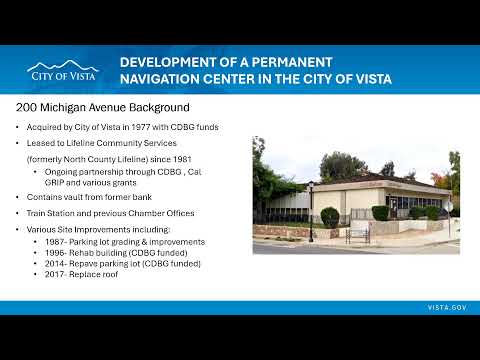
After reviewing options, staff recommended using the city-owned 2-acre parcel at 200 Michigan Ave., which is currently operated by Lifeline Community Services under a long-standing lease, for partial demolition, reconstruction and renovation to create a navigation center. Staff proposed demolishing three older structures to create space for new shelter buildings, converting three other buildings to administrative and case-management use, and using a separate building for kitchen and dining or large meetings. The presentation included a concept to build vertically to reduce parking impacts, modifications to reduce the footprint on existing parking, and the potential relocation of a historic railroad building on the site to free space.
Staff provided some ownership and funding context: the city acquired 200 Michigan Ave. in 1977 with Community Development Block Grant (CDBG) funds and has leased the site to Lifeline Community Services since 1981; rent reported in staff materials has ranged from nominal ($0–$1) historically to the current rate of about $38,291 annually. Staff also noted that the site has received various improvements over the years and that the city and Lifeline have partnered on multiple grants, including CDBG and CalGRIP (California Gang Reduction, Intervention, and Prevention) funds.
Committee members did not take a formal vote on a navigation-center site during the segment covered in the transcript excerpt. The only formal action recorded in the excerpt was a procedural approval of minutes; the transcript does not record the mover, seconder or a tallied roll-call vote. Staff said they will continue to refine concepts, costs and site plans and return with additional details for committee and council consideration.
For clarity: budget figures, case-study costs and per-bed calculations were presented by staff as part of the ROMs and provider estimates; exact purchase prices, final renovation budgets, construction timelines and funding sources for a future project would require further council direction and any necessary procurement or grant approvals.