Leesburg BAR defers decision on porch alterations at 243 West Market Street to May 5 work session
Loading...
Summary
The Board of Architectural Review deferred action on a proposal to alter the front porch of the contributing bungalow at 243 West Market Street after extended discussion over retaining original Tuscan columns, acceptable porch materials and under-porch screening. The applicant was asked to return with revised drawings and clear material samples.
The Leesburg Board of Architectural Review deferred consideration of a front-porch renovation at 243 West Market Street to a May 5 work session after a lengthy debate about whether modern materials and design changes would harm the building’s historic character.
Staff presented the application for a circa-1915 bungalow and recommended deferral for further design work. Ashley, a planning staff member, told the board that “the guidelines also offer a more specific statement regarding the inappropriate treatment for porches and doors, where it says do not strip porches and steps of original materials and architectural features such as handrails, balusters, columns, brackets, and roof decorations.”
The proposed work would replace porch flooring and ceiling, swap existing columns for new trapezoidal columns (applicant’s Option 1), replace vinyl railings with new wood railings, remove concrete steps for wood steps, and replace under-porch box lattice with painted horizontal slats. Staff said porch flooring should be replaced with wood where possible, that replacement of the porch ceiling in kind was acceptable, and that replacing original Tuscan columns with trapezoidal columns would “compromise its integrity.”
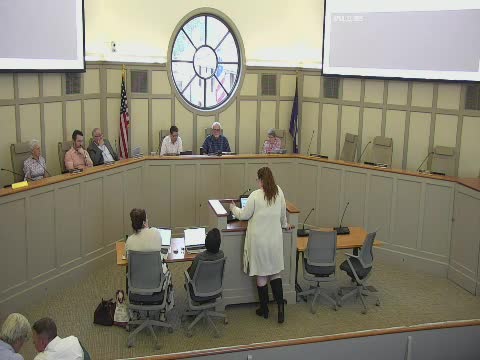
Owner Stan Schnippel, who identified himself as the owner of 243 West Market Street, said he moved to Leesburg last March and is trying to reduce long-term maintenance costs. “I’m looking for the least amount of maintenance that I can with also in keeping it with the integrity of the historic district,” Schnippel said, while showing samples of thermally modified wood, IPE and a composite product called Aratus as possible porch-floor options.
Board members pushed back on composite alternatives for a contributing property. Helen Aikman, vice chair, said living in a historic district requires ongoing upkeep and that she would not approve a “non wood alternative to the floors, the ceilings, or the railing.” Multiple board members said Tuscan columns are significant to Virginia architecture and should be retained if they are in sound condition.
Discussion covered several specific items the board wants clarified before formal approval: confirmation of existing column condition and whether they can be retained; samples and cut sheets for any proposed non-wood alternatives (thermally modified wood, IPE, Aratus or similar); a substitution for the proposed modern horizontal slats with traditional boxed lattice for the under-porch screening; and a clearer drawing of how any new railing would relate to the existing concrete steps or to a revised stair configuration.
The board and staff also discussed the condition and historic status of the concrete steps. Staff noted the 1999 architectural survey documented concrete steps at the time of the survey but could not verify whether the concrete was original. Several members said they could accept either repaired/repainted concrete, flagstone veneer over the walkway, or a replacement stair built in a traditional material, depending on how the applicant documents and illustrates the detail.
Julie Pastor moved — and Don Schurman seconded — to defer TLHPBR2025-0011 (243 West Market Street) to the May 5 work session and to include the evening’s discussion items (columns, porch materials, under-porch screening, ceiling, steps and railing design) in the direction to the applicant. The motion passed 6-0-1. The board asked staff to provide a written summary of requested revisions for the applicant.
Next steps: the applicant will revise the application package with material samples and updated drawings showing proposed rail and stair details and return to the BAR at the May 5 work session. Staff will prepare a summary of the board’s requested changes and circulate it to the applicant.
A work-session deferral preserves the board’s ability to require retention of original fabric for a contributing property, while giving the applicant an opportunity to present alternatives and samples that respond to the board’s concerns.