Get Full Government Meeting Transcripts, Videos, & Alerts Forever!
Get email alerts on the Wildfire Resilience Funding topic
No spam. Unsubscribe anytime.
Assembly hearing urges focus on home hardening and coordinated funding to curb wildfire losses
Summary
Assembly Budget Committee convened an informational hearing where state and local wildfire leaders pressed for prioritizing home hardening, clearer metrics and coordinated funding after lawmakers, the LAO and Cal Fire described large recent investments that remain largely one‑time.
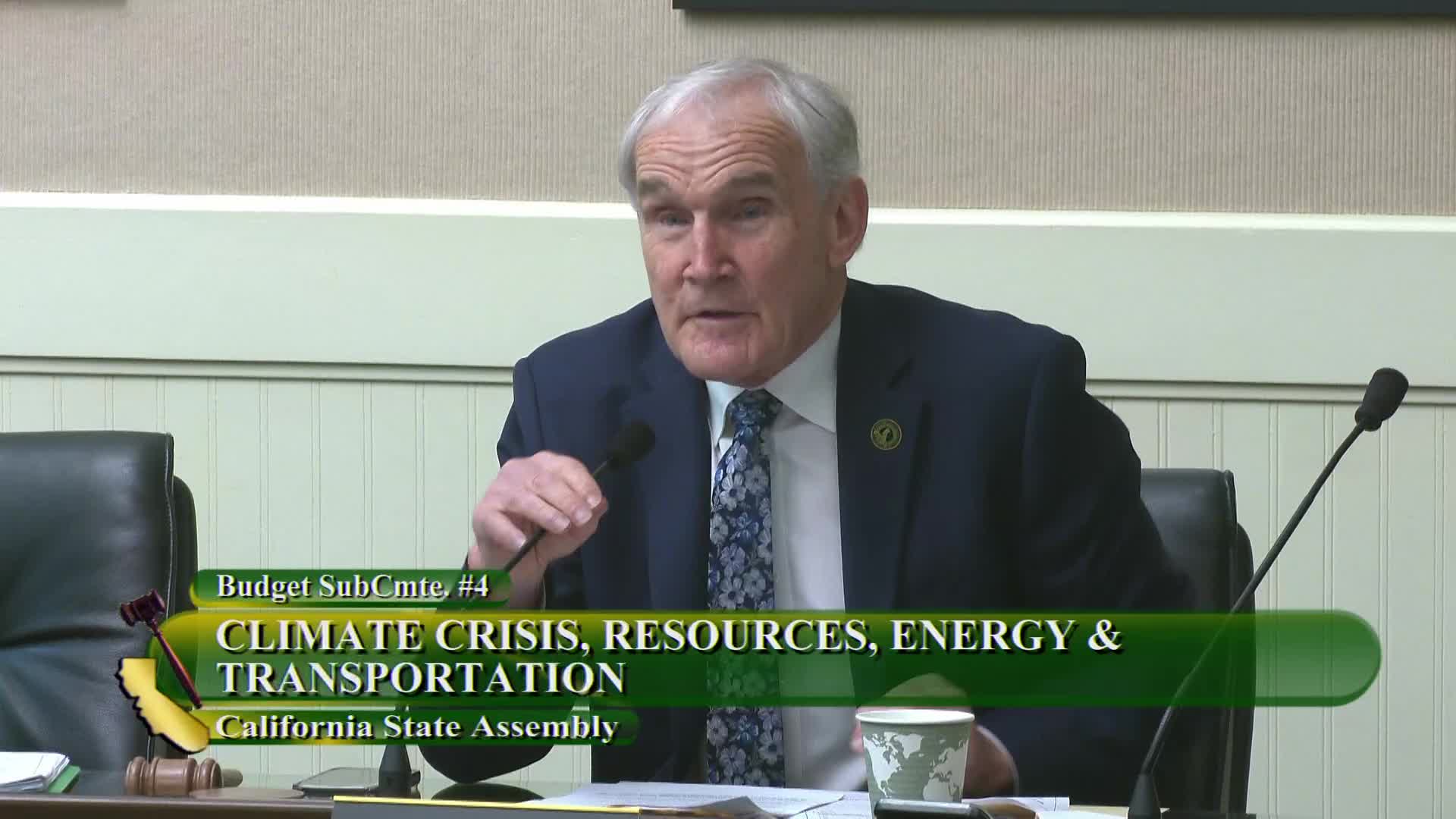
Chair Bennett convened an informational hearing of the California State Assembly Budget Committee on wildfire resilience, where legislators, agency leaders and conservation and insurance experts agreed the state must prioritize preventing home losses as climate‑driven fires grow costlier and more frequent. The hearing was informational only; no votes were taken.
Lawmakers and witnesses said they want policymakers to emphasize home hardening and defensible‑space work that makes houses less likely to ignite, while maintaining funding and capacity for landscape and response needs. Rachel Ehlers of the Legislative Analyst's Office told the committee that state wildfire spending has grown sharply but is mostly one‑time: recent increases include roughly $3.6 billion in wildfire resilience spending identified in the LAO’s review for 2021 through planned out‑years, with a surface commitment of about $200 million annually from the state’s greenhouse gas reduction fund to 2029. Ehlers added the state should weigh trade‑offs between response and resilience and set priorities across differing regional needs.
Ken Pimlott, retired CAL FIRE director, said the state must invest where partnerships and projects demonstrate results rather than dispersing limited dollars in “random acts of restoration.” “The state cannot solve this problem by itself,” Pimlott said, stressing the need to fund community‑level projects that bring local fire districts, resource conservation districts and nonprofit partners together. CAL FIRE Director and State Fire Chief Joe Tyler told the committee that California’s varied climates require a “one‑size‑does‑not‑fit‑all” approach and that improved data and dashboards, including an interagency treatment tracker and the Fuels Treatment Effectiveness Program, are being developed to measure how well projects reduce risk.
Michael O’Connell, president and CEO of Irvine Ranch Conservancy, urged the committee to recognize regional differences: “Fire in Southern California is different,” he said, noting that wind‑driven ember exposure, not broad landscape fuels, causes most structural losses there and that large‑scale clearing can unintentionally increase risk in shrubland systems.
Assemblymembers pressed witnesses for practical prioritization guidance. Chair Bennett said lawmakers are angling to focus limited state resources on actions that most directly reduce home and community losses and floated incentives tied to certified home hardening that could lower insurance costs and property‑market risk. Assemblymember Connolly and others asked how the state will move pilot programs and federal matches into broader, accessible programs for communities across California.
State officials described ongoing efforts and constraints. Daniel Berlant, state fire marshal, said new building standards since 2008 have made newer homes more resilient but noted that “90% of homes in wildfire‑prone areas were built before this code.” The committee heard about pilot work to retrofit at‑risk homes through the California Wildfire Mitigation Program (CWMP), and Cal OES said federal matches and FEMA rules shape how quickly those pilots can scale.
Panelists repeatedly called for improved, shared metrics to track whether investments reduce losses. Cal OES and CWMP pilot data presented to the committee showed high per‑home costs for comprehensive retrofits — preliminary averages in the pilot communities were roughly $44,500 for home hardening and $14,000 for defensible‑space work, though costs varied by site — and an aggregate expected benefit‑cost ratio of about 4.88 for the pilot portfolio. Witnesses said those figures justify scaling but underscored the need for efficient grant and reimbursement processes, more local capacity, streamlined permitting, and incentives to leverage private and ratepayer dollars.
The hearing also reviewed funding sources. Ehlers noted that utility ratepayer investments and federal programs dwarf state budget line items in some categories, that FEMA mitigation programs are changing, and that the November ballot measure (Proposition 4) provides a new $1.5 billion pool for wildfire resilience activities. Committee members asked staff to produce a practical checklist of actions the legislature and administration can take — from tax or insurance incentives to inspection regimes and local block grants — so lawmakers can weigh specific tradeoffs in the June budget and beyond.
The committee said it will pursue follow‑up hearings and seek detailed policy proposals that combine state funding, local capacity building and insurance incentives so that more homes and communities can be made resilient with limited dollars.