Get Full Government Meeting Transcripts, Videos, & Alerts Forever!
Get email alerts on the Lead Service Lines topic
No spam. Unsubscribe anytime.
DPU outlines lead service‑line inventory and pivots to block‑by‑block replacement to meet upcoming federal requirements
Summary
Richmond’s Department of Public Utilities updated the Government Operations Committee on the city’s lead service‑line program, regulatory deadlines and a plan to shift from customer‑initiated replacements to targeted block‑by‑block work because of new Buy America and funding restrictions.
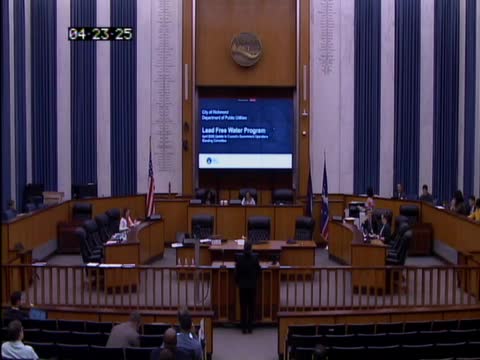
The Department of Public Utilities told the Government Operations Standing Committee that Richmond is accelerating work to identify and remove lead service lines and will pivot to a pilot block‑by‑block replacement strategy as federal and state regulatory changes tighten requirements and grant rules.
Laura Bender Nagel, deputy director of DPU, briefed the committee on the program’s regulatory drivers, inventory status, outreach efforts and funding constraints. She said DPU’s corrosion‑control program treats water at the plant to reduce lead leaching and that Richmond’s water leaves the treatment plant without lead; the primary concern is lead in buried service lines between the main and private plumbing. Under the lead and copper rule revisions (LCRR) and anticipated lead and copper rule improvements (LCRI), water systems must develop inventories and remove lead service lines under waterworks control; the committee heard that LCRI requires expanded work, new sampling, and a lower action level (from 15 parts per billion to 10 parts per billion) beginning with regulatory phases in 2027 and removal completion by 2037.
Bender Nagel said DPU has approximately 2,000 service lines definitively identified as lead but roughly 13,691 properties confirmed non‑lead on both sides; a much larger set — about 66,000 service lines on private property — remains unknown and must be identified before replacements can be scheduled. DPU described a mix of approaches to fill unknowns: a customer survey portal, a list of trained participating plumbers who will perform no‑cost inspections for qualifying single‑family properties and a predictive model informed by existing data. The utility also said it will use field crews and test pits as part of a block‑by‑block pilot that staff expect to be more efficient than one‑off customer‑initiated replacements.
Staff explained the primary challenges: (1) legal authorization to work on private property requires documented outreach and written consent from each property owner (the rule requires a minimum of four documented contact attempts); (2) funding limits: DPU cannot use enterprise ratepayer funds for private‑side work and must rely on grants to cover customer‑side costs, but recent funding phases include loan components and Buy America (BABA) procurement requirements that complicate eligible expenditures; and (3) scale — identifying and authorizing replacements across tens of thousands of properties.
DPU said it will submit two Virginia Department of Health (VDH) funding applications in early May, finalize a spending plan for the upcoming funding phase (phase 5), roll out the block‑by‑block pilot, issue two IFBs to support construction, and hold expanded lead sampling (50–100 properties) in June to verify corrosion control efficacy. Staff asked council members to encourage constituents to complete the online service‑line survey or use the plumber program and reiterated that ratepayer funds cannot pay for private‑side replacements.
Scott Morris, DPU director, updated the committee on audit activity and other program operational items; he confirmed recent closures of two audit items and described follow‑up work to close several warehouse‑related audit recommendations tied to inventory and materials management.
Committee members asked about customer financing options for private‑side work. DPU said it would explore whether a billing‑based financing approach — where the utility coordinates replacement and customers repay via periodic bills — could be feasible provided the customer ultimately pays (DPU reiterated that ratepayer funds may not be used for private‑side work). The committee requested a follow‑up on financing options at a future meeting. Staff also noted DPU is applying for additional phases of state and federal funding and that the customer‑initiated grant program from earlier phases is paused while staff reconfigure programs to meet Buy America procurement rules.
What changed and why it matters DPU described a strategic shift from individual customer grants toward a block‑by‑block model intended to increase efficiency and improve grant compliance under new procurement rules; the move responds to stricter federal/state funding conditions and the need to identify large numbers of unknown service lines before replacements can proceed at scale.
Decisions and follow up requested The committee did not vote on policy in this session. DPU committed to submit two VDH grant applications, finalize a phase‑5 spending plan, roll out the block‑by‑block pilot, issue IFBs for construction, and report back (including a requested staff update on potential on‑bill financing options).