Get Full Government Meeting Transcripts, Videos, & Alerts Forever!
Get email alerts on the Wildfire Response Package topic
No spam. Unsubscribe anytime.
Senate committee advances wildfire response package: measures on rental gouging, looting, firefighter workforce and expungements
Summary
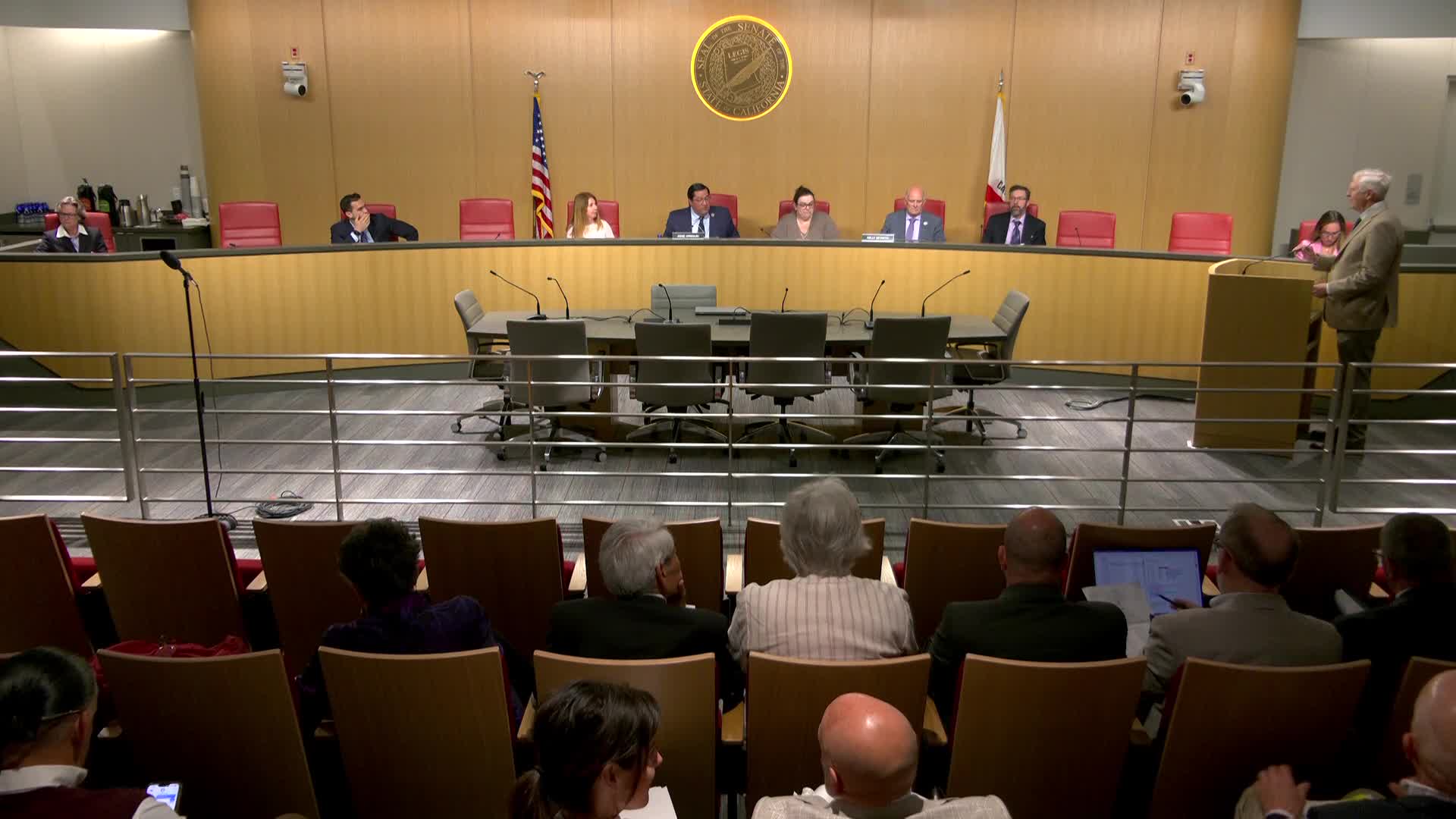
The California State Senate Committee on Public Safety spent its special-order session Tuesday taking up five wildfire-related bills, advancing measures aimed at protecting disaster victims and supporting the wildfire response workforce.
The California State Senate Committee on Public Safety spent its special-order session Tuesday taking up five wildfire-related bills, advancing measures aimed at protecting disaster victims and supporting the wildfire response workforce.
Senators and witnesses debated expanding price-gouging enforcement on online rental platforms (SB 36), stiffening penalties for looting and impersonating first responders (SB 571), creating workforce pathways and credentialing for incarcerated firefighters (SB 423), and automating post‑release expungements for fire‑camp participants (SB 245). Committee members postponed final votes pending quorum at several points but recorded motions to pass most measures to later committees for fiscal review.
SB 36: rental-price gouging and platform reporting
Sen. Umberg presented SB 36, a response to reports that some landlords and rental platforms raised prices after recent Southern California wildfires. The bill would extend price‑gouging protections to counties within a 50‑mile radius of an affected county, strengthen civil penalties, allow private actions by victims, and require online housing-listing platforms to notify law enforcement and provide a way for users to report suspect listings. Sameeta Tacker of the Consumer Attorneys of California and Christopher Sanchez of the Consumer Federation of California testified in support, saying the measure closes a loophole used by some owners who list properties in adjacent counties where an emergency was not declared.
Opponents focused narrowly on one provision that would expand warrant authority for enforcement. Marco George of the California Public Defenders Association urged removing or narrowing the search‑warrant language, saying investigators already have existing remedies and that the change risked overreach. Sen. Umberg said staff would consider amendments; the committee recorded a motion to move SB 36 forward (motion moved by Sen. Caballero) and left the bill on call while votes were completed.
SB 571: looting, impersonation of first responders
Sen. Archuleta and coauthors presented SB 571 to increase criminal penalties for looting, aggravated arson, and impersonating first responders during declared emergencies. Witnesses from the Los Angeles County District Attorney’s Office and the California Police Chiefs Association described cases in which impersonators used fake uniforms and decommissioned vehicles to access evacuated areas, commit theft, and endanger victims and responders. The author said the bill removes certain judicial discretion to reduce sentences for looting and would make first‑responder impersonation a more serious offense.
Civil‑rights and criminal‑justice groups, including ACLU California Action and several community organizers, opposed aspects of the bill, arguing increased sentencing will not deter crime and risks disproportionate impacts on communities of color. The committee accepted the bill presentation and recorded a motion to pass SB 571 to the Senate Appropriations Committee.
SB 423 and SB 245: firefighter workforce and expungement streamlining
Sen. Small‑Cuevas presented SB 423, the Enhancing Workforce Development for Incarcerated Firefighters Act. The bill would standardize training and credentialing for incarcerated firefighters, create pathways to employment after release (including apprenticeship and pilot programs), and require reporting on program outcomes. Dozens of witnesses representing formerly incarcerated firefighters, reentry organizations, and community groups spoke in support; several firefighter unions and professional associations said they were continuing technical discussions with the author. Committee staff and the author said agreed‑to amendments will be taken in the next committee (Senate Natural Resources) to clarify apprenticeship alignment and to remove a controversial “preference bonus point” provision for applicant hiring.
SB 245, presented on behalf of Sen. Reyes, would streamline and automate the post‑release certification and expungement paperwork for people who complete California Conservation Camp, institutional firehouse, or county incarcerated hand crew programs. Witnesses from the Anti‑Recidivism Coalition and Californians for Safety and Justice described delays many program graduates face obtaining expungements and said SB 245 would shift initial filing responsibilities to state agencies to reduce bureaucratic barriers. The committee recorded a motion moving SB 245 to the Senate Appropriations Committee.
How the committee handled outcomes
Committee members frequently noted quorum and scheduling issues and said several bills would be amended in successive committees. For SB 423, the author agreed to strike the proposed reinvestment fund and preference‑point language before the next hearing. For SB 36 and SB 571, authors and opponents signaled willingness to negotiate on search‑warrant and sentencing provisions.
Why this package matters
The bills respond to two recurring wildfire fallout problems: opportunistic exploitation of displaced people in housing markets, and the need for an expanded, trained wildfire workforce. Supporters argued the bills close legal loopholes and convert on‑the‑ground firefighting experience into careers, while opponents warned against expanding warrant powers and increasing criminal penalties without clear evidence of effectiveness.
What’s next
Committee members moved the bills to committees that handle fiscal issues and policy refinements, and several authors pledged further amendments in upcoming hearings. Lawmakers and advocates said they will continue negotiating technical fixes to align apprenticeship rules, clarify enforcement authority, and protect civil‑rights safeguards for low‑income and impacted residents.
Ending note
The committee’s special order drew dozens of witnesses—victims, local prosecutors, union representatives, reentry advocates and formerly incarcerated firefighters—highlighting broad public attention to wildfire recovery policy. Several measures advanced to appropriations or the next policy committee with amendments and with additional stakeholder meetings expected before any final votes on the Senate floor.