Get Full Government Meeting Transcripts, Videos, & Alerts Forever!
Get email alerts on the Economic Development Medc Work Projects topic
No spam. Unsubscribe anytime.
MEDC, Michigan Strategic Fund outline FY25 work-project spending, programs and reporting
Summary
Michigan Economic Development Corporation and Michigan Strategic Fund staff told the House Committee on Labor and Economic Opportunity that FY25 work projects remain active across business attraction, community revitalization, small-business support and site readiness, and outlined spending status, grant reporting and compliance safeguards.
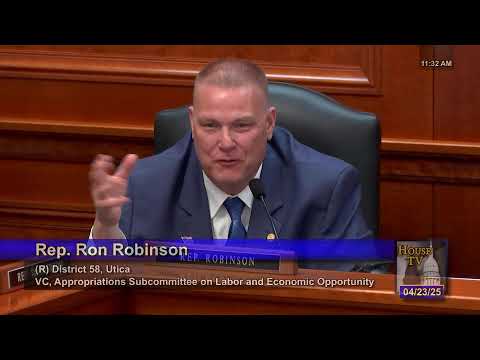
LANSING — Senior leaders from the Michigan Economic Development Corporation (MEDC) and the Michigan Strategic Fund (MSF) briefed the House Committee on Labor and Economic Opportunity on the status of FY25 work projects, defining how the state classifies and manages multi-year grant and incentive funding.
According to Jill Trepkoski, senior vice president and chief financial and procurement officer at MEDC, “According to MCL 18.145, a work project is a one-time, nonrecurring effort designed to achieve specific goals.” She told the committee work projects remain available until finished or until 48 months after the fiscal year of the original appropriation, after which any remaining balance reverts to the State.
The update covered how work projects are tracked and categorized, MEDC reporting on major line items and active programs, and how expenditures, obligations and commitments are recorded and disbursed. Trepkoski said MEDC distinguishes between funds that have been expended (paid to recipients under executed agreements), outstanding obligations (funds on executed agreements not yet paid), committed (approved offers without fully executed agreements) and unobligated balances.
Why it matters: the committee heard that the state uses work projects to manage long-term economic development investments ranging from small-business supports to multi‑billion-dollar site-ready and attraction projects. Committee members pressed staff on carryforward balances, timelines for expenditure and oversight controls.
MEDC presented activity and performance numbers for its major legislatively authorized line items, including the Business Attraction and Community Revitalization (BACR) line, the Revitalization and Placemaking (RAP/RAMP) program, the Small Business Support Hubs, and legislative-directed grants. Highlights provided by MEDC staff included: 68 approved Michigan Business Development Program projects committed to create about 7,200 jobs and leverage roughly $2.7 billion in private investment across 54 communities; FY2024 Community Revitalization Program investments of $30.1 million that leveraged about $213.1 million in private investment; and RAMP (RAP) investments in FY2024 of $116.5 million that leveraged $762.4 million in private investment across 63 communities.
On small-business supports, staff said the Small Business Support Hubs were launched using $75 million in American Rescue Plan Act dollars and operate through a statewide network of 27 hub locations. MEDC reported the network has engaged over 5,500 businesses, supported roughly 976 new business starts and catalyzed about $155 million in follow-on funding; staff said 48% of businesses served were described as underserved and 72% were first-time users of ecosystem partners.
MEDC also provided a status update on legislative-directed grants: for FY24 MEDC reported 87 one-time grants with a 100% execution rate and 59% of funds dispersed; for FY25 it reported 62 one-time grants, 92% of legislative packets received, 68% executed and 16% of funds dispersed. The department posted a report of FY25 legislative-directed grants on its website and said the report will be updated twice yearly, no later than June 15 and Sept. 15, to show recipient, purpose, location, status of funds and legislative sponsor.
On federal funding and other fiscal context, MEDC staff said federal funds account for about 2.4% of MSF’s ongoing budget and summarized current federal awards: a Department of Interior Historic Preservation Fund award (most recent $4.8 million with a 40% state match requirement), a National Endowment for the Arts partnership (roughly $1.999 million; reported match requirements), and a Small Business Administration State Trade Expansion Program award (about $900,000 with a 25% state match requirement).
MEDC provided internal staffing and oversight numbers: the agency reported roughly 342 full-time equivalent positions (125 civil-service state employees and 217 corporate employees, including limited-term roles), and said it maintains field-based staff in the state’s 10 prosperity regions. Staff reiterated that state incentive payments are performance-based; agreements require executed contracts and milestone verification before funds are disbursed and include clawback provisions for failure to meet measurable outcomes.
Committee members asked why older work-project years retain balances and whether the $100 million BACR line is excessive; MEDC responded that multi-year obligations and milestone timing explain multi-year carryforwards and that the pipeline supports continued demand for that funding. On where lapsed or reduced project dollars are routed, MEDC explained funds remain in the originating work project until lapse (up to 48 months) and, depending on program rules and any legislative transfers, can be available for other projects or revert to program or fund accounts.
Votes at a glance: the committee approved the minutes of the April 16 meeting and approved a motion to excuse absent members; both motions passed by unanimous consent.
Discussion and next steps: MEDC said it will continue regular reporting on legislative-directed grants and work projects, and staff offered to provide the committee additional detail on subgrants and re‑granting partner flows on request.