Get Full Government Meeting Transcripts, Videos, & Alerts Forever!
Get email alerts on the Zoning Code Amendment Rcm topic
No spam. Unsubscribe anytime.
Planning commission backs zoning change to allow retail commercial manufacturing at Suntana property
Summary
The Springville City Planning Commission voted to recommend that the City Council adopt an amendment to add a retail commercial manufacturing (RCM) use to the city's regional retail commercial (RRC) zone and recommended approval of a development agreement for the Suntana property, where Sunpro/Clyde Companies proposes a millwork and materials operation.
The Springville City Planning Commission voted to recommend that the City Council adopt an amendment to the Springville City Code to add a new retail commercial manufacturing (RCM) use to the city's regional retail commercial (RRC) zone and recommended approval of a development agreement tied to the Suntana property, where a Sunpro/Clyde Companies project is proposed.
The recommended code changes would add RCM as an allowed use in the RRC zone, add a definition in Title 11, Chapter 3, Article 402, amend the Land Use Matrix in Title 11, Chapter 4, Article 301, and add supplementary regulations in Title 11, Chapter 6, Article 7. Commissioners voted by voice to send the code amendment and the development agreement recommendation to the City Council.
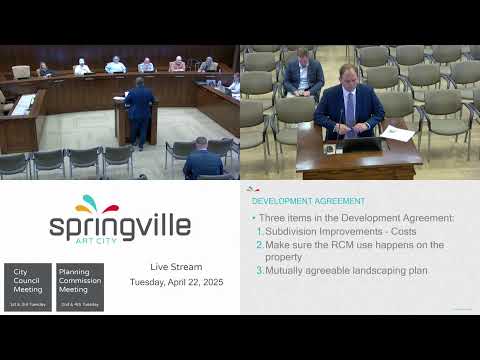
Why it matters: city staff said the proposed RCM use would generate local sales tax by selling tangible products (lumber packages, prehung doors and millwork) to building contractors with the point of sale in Springville. The development agreement contains timing and performance provisions intended to ensure the use materializes on the property and a landscaping plan that staff and the prospective owner have tentatively agreed upon.
John, a Springville Community Development staff member who presented the item, said the ordinance as drafted would limit the RCM use to lots entirely located at least 350 feet south of the south right-of-way boundary line of 1600 South to keep storage and industrial activity set back from the highway corridor. He also summarized proposed standards that would require RCM to be the primary use on a lot while allowing up to 70% of lot area for outdoor storage of retail products and up to 15% for office buildings.
The presenter said the lot being discussed in the Suntana area is roughly 28 acres and showed examples of similar buildings in Spanish Fork and St. George. He described screening measures in the draft development plan: a three-foot wall along the front, a six-foot wall along the northern property line, a minimum 10% landscaping requirement under Title 11, and a 15-foot landscape buffer adjacent to neighboring lots. He said the plan places office-type buildings and other uses closer to 1600 South with storage and millwork buildings farther back, roughly 500'740 feet from the right-of-way, depending on the element shown.
Bill Gammell, a representative of Clyde Companies and Sunpro, addressed the commission during the public comment period to clarify how sales and use taxes would apply to the operation. "The items that we sell, we will collect sales tax at that place no matter what," Gammell said, explaining that products sold as tangible goods (lumber packages, prehung doors) would be taxed at point of sale in Springville, while certain installed items (garage doors and insulation) involve a use tax that is only collected if the installation occurs in Utah.
Commissioners also discussed technical standards in the draft, including a proposed change to the city's cul-de-sac regulation. The current city regulation sets a maximum cul-de-sac length of 400 feet. Under the proposed amendment the planning code would be amended to allow cul-de-sacs up to 500 feet for this development; staff said the change would move the primary operations farther south on the parcel and away from 1600 South.
After questions and a brief public comment, a commissioner moved "to recommend the city council adoption of the proposed amendment to Springville City Code, Title 11, Chapter 3, Article 402 definitions, and Title 11, Chapter 4, Article 301, Land Use Matrix to include retail commercial manufacturing, RCM, as an allowed use in the RRC zone and Title 11 Chapter 6 supplementary regulations to include Article 7 retail commercial manufacturing reviews within the RRC zone." A second was offered and the motion passed by voice vote. The commission then voted to recommend approval of the development agreement (including a 30-month performance window for establishing the RCM use and a buyback clause giving the city options if performance milestones are not met), again by voice vote.
The recommendations now go to the Springville City Council for final action; the commission noted that the development agreement allows 30 months for the RCM use to be established and provides that, if the development obligations are not met, the city could repurchase the property at the original sale price under terms in the agreement.
Votes at a glance: - Motion to recommend City Council adopt code amendments to add retail commercial manufacturing (RCM) as an allowed use in the RRC zone ' Motion text quoted above. Outcome: recommendation approved by voice vote; roll-call tally not specified in the record. - Motion to recommend approval of the development agreement for the Suntana property (includes 30-month timing for the RCM use, a city repurchase option if milestones are not met, and a mutually agreed landscaping plan) ' Motion text: "I motion to recommend the approval of the development agreement to the city council with any revisions the planning commission may want to see." Outcome: recommendation approved by voice vote; roll-call tally not specified in the record.
What remains open: the City Council will consider the code amendment and development agreement at a future meeting. If the sale and development proceed under the agreement, the project proponent indicated building materials would be stored and shipped regionally and that the proposed buildings would use insulated metal panel construction similar to buildings shown in the presentation. The applicant also said final landscaping, screening walls and any railroad spur would be subject to conditions in the development agreement and subsequent permits.