Get Full Government Meeting Transcripts, Videos, & Alerts Forever!
Get email alerts on the Capital Improvements topic
No spam. Unsubscribe anytime.
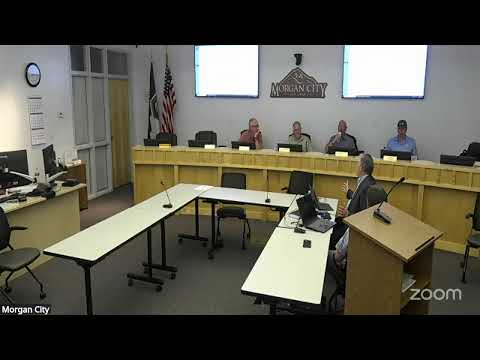
Morgan City Council adopts 2025–2035 capital improvement list after funding discussion
Summary
The Morgan City Council voted to adopt its capital improvement project list covering 2025–2035 after a lengthy discussion about project priorities, financing and a proposed municipal energy tax to support capital needs.
Morgan City Council voted to adopt the city’s 2025–2035 capital improvement project list following a detailed staff presentation and council discussion about priorities and financing.
The council adopted the list at its April 22 meeting. Ty, a city staff member leading the budget discussion, told the council that adopting the list does not appropriate funds but places projects in the city’s planning and budget process and forwards the list to the Council of Governments (COG) for regional consideration. "The adopting the list does a couple things. 1, it’ll be incorporated in next year's budget for the projects that are 2025. And then this list also goes to the COG and is combined with the county's list," Ty said.
Why this matters: council members pressed staff on how feasible high-priority projects are to complete given limited cash on hand and possible borrowing. Council members focused on the city’s largest projects — notably a planned natural-gas-fired backup generator and a proposed public works building — and asked whether those items should remain labeled "high priority" if financing is uncertain.
Staff said several high-priority items are already underway or closer to construction than they may appear on paper. Ty explained that the power-generation project would be financed through UAMPS as a municipal ownership share and that the generator would help the city manage exposure to volatile wholesale power prices. "The financing would actually come through UAMPS," Ty said. "It would just become part of our power rate... the idea is that when power prices go totally out of control, then we run our own generator." Ty also said the city is acquiring land from UDOT for the project and that construction would take about a year once the pieces come together.
Council members asked for clarity on overall cost and borrowing capacity. Ty summarized that the nine projects listed as "high" priority total roughly $21 million on paper, with about $5.2 million expected from the city's own funds and $1.3 million from COG; remaining funding would come from grants or borrowing. "We don't have $5,000,000 in the bank for sure," Ty said, noting that the city would likely phase or finance large projects over time.
On the public works building, staff described a parcel acquisition from UDOT and estimated a $5 million building cost. Council members debated whether that item should stay a high priority if outside funding is not available; Ty said the project could be financed over 10 years and departments could share debt service cost based on floor area. "We have about $1,200,000 so far. So it'd just be a finance project. We'll just finance it over 10 years and make it part of the operational budget at that point," Ty said.
Councilmember discussion also covered ongoing smaller projects — meter replacements, sidewalk and storm drainage work, cemetery sprinkler system repairs, SCADA upgrades and an alleyway plaza funded in part from park impact fees. Ty explained the alleyway plaza will use impact fee fund balance, which will make next year’s budget appear larger but is a timing issue.
As part of the conversation about capital funding, Ty proposed implementing a municipal energy tax and dedicating proceeds to the capital improvements fund to reduce reliance on property taxes. "I'm proposing that it goes straight into the capital improvements, and we don't use it for daily operations," Ty said. The council did not adopt tax changes at the meeting; the tax proposal was presented as a future budget option.
After discussion, a council member moved to adopt the capital improvement list for 2025–2035 and another member seconded the motion. The council voted to adopt the list. The adoption is procedural: no specific project appropriations were made at the meeting.
Ending: Staff will incorporate the adopted list into the next budget cycle and forward the list to the COG. Council members asked staff to continue refining financing assumptions and to return to the council with budget-level scenarios if the city pursues bonding or new dedicated revenue.