Get Full Government Meeting Transcripts, Videos, & Alerts Forever!
Get email alerts on the Operating Budget 2025 26 topic
No spam. Unsubscribe anytime.
Wake County board weighs tradeoffs to restore dental coverage, maintenance funds and protect school positions in 2025‑26 budget
Summary
During a lengthy work session, trustees reviewed staff Q&A and proposals on the superintendent’s 2025‑26 proposed operating budget and discussed options to restore a dropped dental employer contribution, reverse reductions in maintenance and operations, and avoid cutting coordinating teachers and school resources.
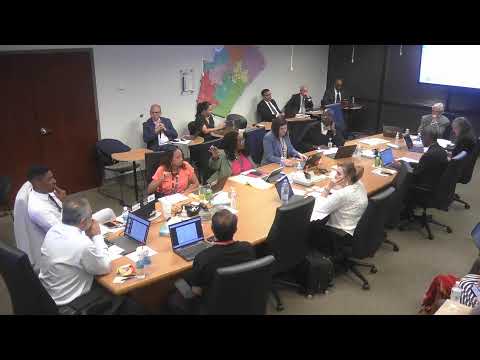
Trustees at Wake County Schools’ April 22 work session reviewed staff responses to board budget questions, considered alternatives to the superintendent’s proposed 2025‑26 operating budget, and debated several tradeoffs for preserving staff and school services.
Terry Penzio and David (staff leads for finance) summarized a long question‑and‑answer packet posted online. The staff Q&A clarified that a modest adjustment to restart school funding and school supplies would not fully offset a proposal to reinstate the employer contribution for dental insurance. "If we were to reduce the funding for the restart schools from $5,000,000 to $4,000,000 and decrease the supplies budget for schools from $60 to $55 per student, that would be $1,800,000 and short of the $2,500,000 needed to reinstate employer dental contributions," staff said.
Board members explored multiple combinations of restorations and repurposing to keep the county appropriation request at $40,300,000. Staff offered a menu of possible offsets: identify alternate funding sources for roughly 15 coordinating‑teacher positions (estimated savings about $1,800,000), adjust district HVAC set points by one degree (estimated $500,000), and repurpose $1,000,000 from the community‑use carryover balance to backfill local budget needs (including volunteer background checks and school utility costs).
Mr. Nieder (budget staff) told trustees the net effect of reinstating both the dental premium and certain maintenance and grounds allocations would require roughly $3,100,000 in repurposed funds. "If the board is desirous of keeping the increased county appropriation at $40,300,000, we have to identify $3.1 million of budget repurposing," he said.
Several trustees strongly opposed cutting positions or resources that directly support instruction. "I'm in complete opposition of the 15 positions," said Ms. Rice, board member, referring to the proposed coordinating‑teacher reductions. Others urged caution about touching restart funding because it supports historically underperforming schools. Ms. Gordon, board member, said positions that "closely impact students are nonnegotiables," and asked the board to prioritize preserving staff who work directly with students.
Supporters of targeted repurposing pointed to the district’s central‑office ratios and the need to balance school resources with central supports. Finance staff noted that central services represent about 6% of the operating budget but account for 38% of proposed reductions in the superintendent’s draft. Staff also emphasized that some vacancies do not translate directly into savings in a system where positions are hard to fill or are converted to contract dollars.
Trustees discussed the local supplemental pay (the local supplement) that the district pays on top of the state salary schedule. Staff explained the proposed budget assumed a 3% supplement increase tied to expected state salary action; the board could opt to reduce or defer the supplement increase, but this would have compensation and recruitment implications. Board members also noted that the final state budget remains uncertain and could alter local funding needs.
The board identified several near‑term process steps: trustees may continue to submit written questions (with a tight turnaround for the next meeting), staff will present an Infinite Campus update on May 20, and the board will aim to reach consensus at the April 29 finance committee/work session so that a proposed budget can be adopted on May 6 and submitted to the county by the May 15 statutory deadline.
Why this matters: The board must balance competing priorities — employee compensation, school‑level services that directly affect students, facilities and central‑office capacity — while complying with statutory timelines and awaiting an uncertain state funding outcome. Choices this spring will determine whether the district restores dental contributions, how the district funds maintenance and operations, and whether school staff positions are preserved.
Board next steps: Staff will compile the scenarios requested by trustees and distribute them to the board; trustees will continue public outreach with a regional hearing scheduled and will seek to reach consensus by the April 29 work session ahead of a May 6 proposed‑budget adoption.