Get Full Government Meeting Transcripts, Videos, & Alerts Forever!
Senate Finance Committee advances 2025 legacy omnibus after heated debate over priority grants and admin caps
Summary
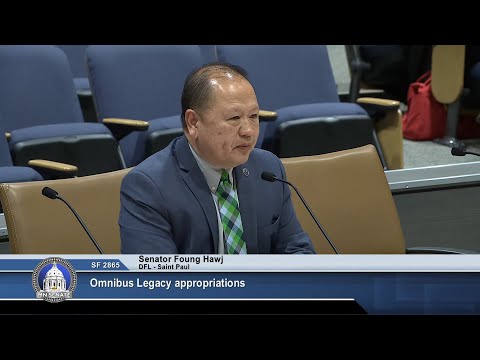
The Minnesota Senate Finance Committee on April 22 advanced Senate File 2865, the 2025 legacy omnibus appropriation bill, approving the A31 amendment after a roll-call vote and later passing the bill in committee by a 6–5 margin.
The Minnesota Senate Finance Committee on April 22 advanced Senate File 2865, the 2025 legacy omnibus appropriation bill, approving the A31 amendment after a roll-call vote and later passing the bill in committee by a 6–5 margin. Committee members and staff spent most of the hearing reviewing allocations across the four legacy funds (Outdoor Heritage, Clean Water, Parks and Trails, and Arts and Cultural Heritage) and disputing the A31 amendment’s move from many named grants toward competitive grant programs while designating a subset of organizations as “priority” recipients.
The A31 amendment, as explained by Mr. Mueller, a legislative staff member who walked the committee through the spreadsheet, shifts many previously named, fixed-dollar grants into competitive grant programs and lists some organizations as priority applicants within those programs. “There now there's about total of $20,500,000 of competitive grant programs,” Mr. Mueller said while describing the revised distribution under A31. The amendment also contains language directing that a large share of grant awards be small grants: A31 specifies that 80% of funds for certain competitive grant programs must fund grants under $200,000.
Why it matters: The bill implements appropriations from the 2008 Legacy Amendment to the Minnesota Constitution across four constitutionally created legacy funds and will determine grant-making approach and funding levels for conservation, water quality, parks, and arts/culture projects statewide. The committee debate highlighted competing goals: making funds more competitive to increase fairness versus preserving predictable, named funding for institutions and community groups that previously received direct appropriations.
Funding…
Already have an account? Log in
Subscribe to keep reading
Unlock the rest of this article — and every article on Citizen Portal.
- Unlimited articles
- AI-powered breakdowns of topics, speakers, decisions, and budgets
- Instant alerts when your location has a new meeting
- Follow topics and more locations
- 1,000 AI Insights / month, plus AI Chat