Get Full Government Meeting Transcripts, Videos, & Alerts Forever!
Get email alerts on the Legacy Omnibus Appropriations topic
No spam. Unsubscribe anytime.
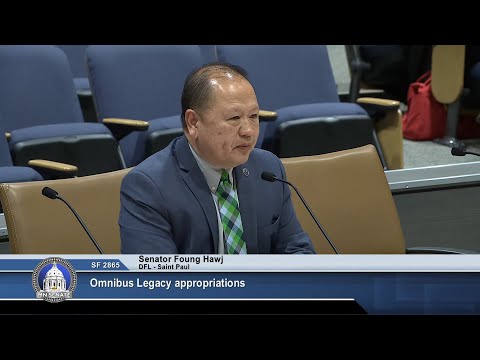
Senate Finance Committee advances 2025 legacy omnibus after heated debate over priority grants and admin caps
Summary
The Minnesota Senate Finance Committee on April 22 advanced Senate File 2865, the 2025 legacy omnibus appropriation bill, approving the A31 amendment after a roll-call vote and later passing the bill in committee by a 6–5 margin.
The Minnesota Senate Finance Committee on April 22 advanced Senate File 2865, the 2025 legacy omnibus appropriation bill, approving the A31 amendment after a roll-call vote and later passing the bill in committee by a 6–5 margin. Committee members and staff spent most of the hearing reviewing allocations across the four legacy funds (Outdoor Heritage, Clean Water, Parks and Trails, and Arts and Cultural Heritage) and disputing the A31 amendment’s move from many named grants toward competitive grant programs while designating a subset of organizations as “priority” recipients.
The A31 amendment, as explained by Mr. Mueller, a legislative staff member who walked the committee through the spreadsheet, shifts many previously named, fixed-dollar grants into competitive grant programs and lists some organizations as priority applicants within those programs. “There now there's about total of $20,500,000 of competitive grant programs,” Mr. Mueller said while describing the revised distribution under A31. The amendment also contains language directing that a large share of grant awards be small grants: A31 specifies that 80% of funds for certain competitive grant programs must fund grants under $200,000.
Why it matters: The bill implements appropriations from the 2008 Legacy Amendment to the Minnesota Constitution across four constitutionally created legacy funds and will determine grant-making approach and funding levels for conservation, water quality, parks, and arts/culture projects statewide. The committee debate highlighted competing goals: making funds more competitive to increase fairness versus preserving predictable, named funding for institutions and community groups that previously received direct appropriations.
Funding and program details: Committee staff reported the headline amounts and adjustments included in the amendment. For the Outdoor Heritage Fund, the bill proposes a first-year appropriation of $162,900,000 (with a second-year recommendation to follow next year); Lessard-Sams Outdoor Heritage Council made proportional reductions totaling about $6,400,000 from original project recommendations. Committee staff said a February forecast correction at Minnesota Management and Budget reduced legacy balances by about $31,700,000 overall.
Clean Water Fund line items discussed included component totals described by staff: Pollution Control Agency programs at $49,200,000; Department of Natural Resources programs at $28,800,000; Board of Water and Soil Resources programs at $139,300,000; Department of Health at $30,100,000; Metropolitan Council at roughly $4,000,000; University of Minnesota at $2,400,000; and the Public Facilities Authority at $16,500,000. Staff also reported the Clean Water Council trimmed about $6,800,000 from its original recommendations in the February forecast.
Parks and Trails Fund program splits preserve the historical division among state parks, regional parks/trails and metro parks: state parks were shown at $51,500,000, regional parks and trails at $25,800,000, and metro parks and trails at $51,500,000 in the spreadsheet reviewed by staff; the article of the bill includes the conventional 5% fund-balance set‑aside required in statute.
Arts and Cultural Heritage Fund changes under A31 were a principal focus. The Arts Board remains set to receive 47% of the fund (stated by staff as $84,550,000, the statutorily required share). The Minnesota Historical Society would receive a total of $33,760,000 under the amendment (an increase staff described as $682,000 relative to the file’s prior numbers). The amendment replaces many individually named grants with competitive grant programs for museums/collections ($4,000,000), arts and cultural festivals ($6,400,000), and educational/recreational programming ($7,200,000). Ethnic media grants were listed separately at $250,000 per year; a program for underrepresented groups and cultural studies was listed at $500,000. Several organizations that had been named with set dollar amounts in the original bill are instead listed as “priority organizations” under these competitive programs in A31; A31 retains a few named grants (for example, one continuation to a veterans/families program shown as $125,000 per year in the amendment).
Committee debate and concerns: Several senators voiced that listing organizations as “priority” effectively functions like an earmark. Senator Pratt said, “These competitive grants, are not competitive. Once we name an organization, they're going to get funded.” Multiple members urged that truly competitive grants should be on an equal playing field without priority lists; others, including the bill’s sponsor, argued the priority language is intended to help smaller groups with less administrative capacity to learn about and apply for grants and not to guarantee full funding.
Administrative costs and A35: Committee counsel and staff explained a technical amendment (A35) clarifying that administrative caps specified in the amendment, in most cases lower than the general statute, control for these programs. Under current statute cited in committee (Minn. Stat. §16B.98, subd. 14), agencies may retain 5% or 10% for administration depending on program type; the A35 language clarifies that the lower, program‑specific caps in A31 (typically 5% where noted) supersede the statute’s larger default administrative allowance for the programs affected. Counsel confirmed the bill language, as amended, would cap certain program administrative costs at the lower percentage specified in the amendment.
Committee action and votes: The committee first approved the A31 amendment after a roll-call reconsideration, 7 ayes to 5 nays (ayes: Marty; Friends; Champion; Mohammed; Murphy; Pappas; Wicklund; nays: Pratt; James; Draheim; Howe; Jasinski). The committee approved two technical amendments (A32 and A35) by voice votes. On final passage in committee of Senate File 2865 as amended, the roll-call vote recorded 6 ayes and 5 nays and the motion prevailed.
Outcome and next steps: With committee passage, the amended SF 2865 moves toward the next steps in the legislative process (committee to report the measure to the Senate floor). Staff noted the bill’s totals bring the two‑year appropriation in the current draft to $776,900,000 and that, cumulatively since the Legacy Amendment’s passage, the committee’s running totals of appropriations approach previously stated historic totals (staff cited about $6.3 billion appropriated since the amendment’s adoption). Committeemembers requested continued refinement on prioritization language and administrative caps as the bill proceeds.
Ending: Committee members requested additional work on the bill’s priority language and outreach to smaller cultural organizations; supporters said A31 represents a move toward equitable grantmaking, while critics argued priority listings undermine true competition. The committee adjourned with a divided vote but with the bill approved in committee for further action.