Get Full Government Meeting Transcripts, Videos, & Alerts Forever!
Get email alerts on the Education Cec Elections topic
No spam. Unsubscribe anytime.
Community Board 2 hosts CEC candidate forum; speakers decry low turnout, election problems and politicization
Summary
A Community Board 2 School of Education forum in April focused on forthcoming Community Education Council elections, low voter turnout, administrative barriers to voting and debates over a CEC 2 resolution on transgender students. Candidates and advocates urged outreach, NYCSA account sign‑ups and rules to improve conduct and fairness.
Community Board 2 convened a School of Education forum in April to discuss the upcoming Community Education Council (CEC) elections and barriers that organizers say are suppressing turnout and skewing results.
The meeting, chaired by Patricia Laria of Community Board 2, opened with what Laria described as “the topic for tonight's meeting is ... public school parents, leadership roles and how to get involved.” Parents, candidates and citywide council members used the forum to press for more outreach, to explain how to vote and to criticize recent conduct on CEC 2.
Why it matters: Community Education Councils advise New York City Public Schools leadership on district policy, zoning and superintendent evaluations. Council seats are unpaid; winners serve two‑year terms and the Panel for Educational Policy handles citywide votes on contracts, co‑locations and budgets. Speakers said poor turnout and administrative confusion mean a small, organized cohort can shape advisory policy for thousands of students.
At the meeting, several candidates and current CEC members described sharp partisan conflict on CEC 2. Aaron Karr, a District 2 parent and candidate, said a central concern motivating his run is conduct and representation on the council: “One of the things that I believe is that the student rep on the CEC council should have a vote.” Tamira Reed, who identified herself as a Citywide Council on Special Education member and a public‑advocate appointee, described long‑standing barriers for families seeking special‑education services and said CCSE work “is the light of my life.” Gavin, a current CEC 2 member, said a top goal is to make the council a welcoming forum: “I would like every family in the district to feel, like, welcome.”
Turnout, dates and mechanics: Several speakers cited published deadlines and mechanics for the elections: application windows reportedly closed Feb. 27; organizers said voting opens April 25 and closes May 13, and winners’ two‑year terms typically begin in July (candidates and officials at the meeting said NYCPS sometimes posts exact dates later). Organizers urged parents to register and vote through the New York City Schools Account (NYCSA) and to request a school‑issued code from their parent coordinator if they lack one. Meeting participants emphasized that families can request a paper ballot through their school if they cannot use NYCSA.
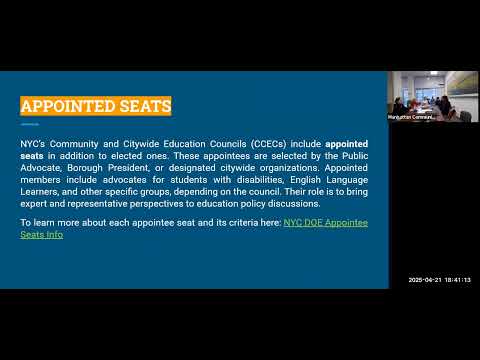
Speakers cited several quantitative details discussed at the meeting: CEC 2 covers roughly 25,000 students and turnout in the 2023 CEC elections was described repeatedly as about 5 percent of eligible families (roughly 1,250 ballots in District 2, by the speakers’ estimate). Participants also said CEC 2 had roughly 64 active candidates listed at the time of the forum and that CEC membership totals about 12 seats (discussed as roughly 10 elected seats plus two appointed positions, with some variations noted for student seats).
Election administration and oversight: Multiple speakers described past irregularities and called for better administration. The group referenced a recent city comptroller’s review (presented at the meeting as a report into the prior election cycle) and an Elections Working Group formed afterward; Gavin and other participants said the working group is trying to tighten rules and improve the process. Several attendees said they would prefer a stronger role for the city’s Board of Elections or for DOE Family and Community Engagement (FACE) staff to manage administration and outreach more consistently.
Barriers and privacy concerns: Parents and advocates detailed practical barriers to participation: lack of clear email notices from NYCPS/Face, difficulties obtaining NYCSA codes from parent coordinators, language and translation gaps, and fear among some families about sharing data or immigration status. One speaker said student data breaches by the Department of Education in prior years have increased mistrust and hesitation to use online accounts.
Policy disputes and conduct on CEC 2: Forum speakers repeatedly raised concerns about politicized agendas on CEC 2, including a now‑noted advisory resolution identified in the meeting as “resolution 248” that challenged NYCPS gender guidelines. Speakers described episodes in which parents and students giving testimony were mocked or treated disrespectfully; Tamira Reed and others said that conduct has driven some families and student speakers away from council meetings. Several participants urged a code of conduct for CEC members and for the council to rescind advisory actions that they said have harmed marginalized students.
Special populations highlighted: Participants said the councils should prioritize students with disabilities, English language learners, students in temporary housing and LGBTQ+ students. Presenters urged that CECs and the DOE improve outreach for families in shelters, expand bilingual and special‑education supports, and end screened admissions that they argued produce de facto privatization.
Next steps discussed: Attendees said Community Board 2 will blast reminders and post links ahead of the voting window and that they expect candidates and local groups to distribute flyers and QR codes. Several forum participants proposed drafting formal resolutions asking NYCPS to improve outreach, to publish clearer voting instructions, to improve NYCSA access and to adopt a CEC member code of conduct. Organizers also encouraged boosted community engagement in the months between elections, and participants described ongoing grassroots get‑out‑the‑vote plans.
What was not decided: The forum was informational and preparatory; no formal votes or council decisions were taken. Multiple speakers said formal CEC rules—such as how ties are resolved under the “same‑school” rule and how many votes a family may cast per child—are set by city or state policy and not by the community board.
Reporting note: The forum included a mix of current CEC members, Citywide Council participants and candidates speaking about ongoing elections and past council conduct. Several names and precise procedural details were discussed during the meeting; where the meeting gave conflicting descriptions, this report uses the participants’ statements and notes uncertainties (for example: the city’s precise timetable for certifying winners and the DOE’s internal calendar). The meeting also referenced a comptroller review and an Elections Working Group that attendees said had formed after the prior cycle.