Get Full Government Meeting Transcripts, Videos, & Alerts Forever!
Get email alerts on the Municipal Budget Fire Fee Referendum topic
No spam. Unsubscribe anytime.
Eugene council debates alternatives to fire fee after referendum petition; sets follow-up work sessions
Summary
The Eugene City Council spent the bulk of its April 21 work session weighing alternatives to the proposed fire fee after a referendum petition referred the measure to voters, discussed possible sunset and oversight options, deadlines for an August or November election and use of one-time reserves, and directed staff to return with draft options.
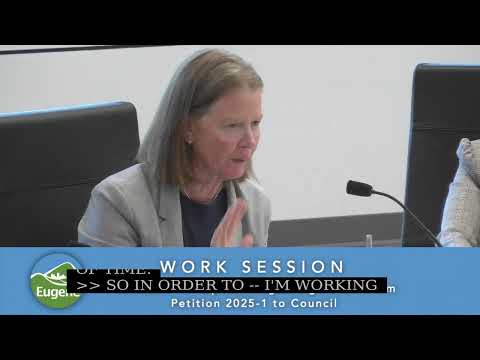
The Eugene City Council on April 21 continued a wide-ranging work-session discussion about options in response to Referendum Petition 2025-1, the citizen referral of the council-approved fire fee. Councilors debated whether to keep the fee as an ongoing revenue source, adopt a time-limited (“sunset”) version, broaden how revenue could be used, or repeal the ordinance and seek a different funding approach. City staff were directed to return with draft alternatives and the council set follow-up work sessions for April 28 and May 14.
City Manager (unnamed) framed the discussion as a council-led exploration of “what an alternative path might look like,” noting council had previously requested additional time to consider options. The city manager said staff could present ordinance drafts or decision-point outlines on the requested timeline but cautioned that fully vetted financial modeling would be limited by ongoing budget work.
Why it matters: The fee was intended to close a near-term gap in the city’s general fund and to support fire services; referral by voters means the measure will appear on a future ballot unless the council repeals the ordinance before the legal filing deadlines. Councilors said the decision affects immediate budget choices, reserve usage and whether the city will cut services if new revenue is not secured.
Councilors offered a range of views. Councilor Kaczynski said she was “very uncomfortable with the repeal” and favored retaining short-term revenue to avoid deep cuts to services. Councilor Yeh said a sunset “around” six years—or shorter—could be acceptable and suggested renaming or broadening the fee might improve public understanding. Councilor Groves urged the council to identify clear priorities and to avoid indefinite delay: “It’s time to separate the chaff from the wheat and get to work on this.” Councilor Clark emphasized the need for long-term policy choices to grow the city’s permanent revenue base rather than rely on repeated short-term fixes.
Councilors and staff discussed implementation timelines and election logistics. The city manager said emergency paperwork for an August special election would need to be filed with Lane County by July 10. The manager also said that if the council did not repeal the ordinance by Sept. 3, she would file to place the measure on the November ballot. Staff estimated the cost of a special election at more than $250,000 if the city must bear the expense alone; costs may be shared if other measures are on the November ballot.
Reserve and budget implications were raised repeatedly. The city manager said staff had identified one-time dollars that could be used as a bridge but warned that spending reserves without a durable revenue solution would be irresponsible. Councilor Evans asked whether tapping reserves would jeopardize the city’s credit rating; staff said fuller answers would come as part of the upcoming budget presentation or a follow-up work session.
Several councilors pressed for specific design features to be included in any alternative: a sunset (variously proposed in discussions as between two and ten years, with several councilors citing four to six years as a practical middle ground), clearer naming and purpose for the fee, and accountability measures such as oversight committees or reporting similar to the city’s bond/levy practices. Councilor Keating said he could accept a mayoral-appointed oversight committee with council representation; others said the council itself could serve as oversight.
Council members differed on how much to accommodate community requests that had driven the referendum. Councilor Clark and others cautioned against short-circuiting the referendum process after citizens petitioned for a vote. Several councilors said they were open to seeking common ground to reduce community division and avoid a costly special election.
Action: The council voted 8-0 to direct the city manager to schedule follow-up work sessions on April 28 and May 14 to continue developing alternatives and options. Staff said these sessions could be used to present ordinance drafts or decision outlines intended to let the council choose next steps in time for any required public hearings and filing deadlines.
What’s next: Staff will return with options and draft language for council consideration on the requested timeline; any ordinance the council adopts would still be subject to voter referral unless adopted with a clause that makes it immediately effective and therefore not referable. The council also signaled willingness from some members to hold additional special meetings if needed to finalize a path forward.