Get Full Government Meeting Transcripts, Videos, & Alerts Forever!
Get email alerts on the Municipal Utility Districts topic
No spam. Unsubscribe anytime.
Collin County to revise policy on opposing municipal utility and management districts after questions on roads and services
Summary
Commissioners discussed formalizing the county’s historical practice on opposing or not opposing municipal utility districts (MUDs) and municipal management districts (MMDs). Commissioners asked for revised language to address road maintenance and to bring the item back next week.
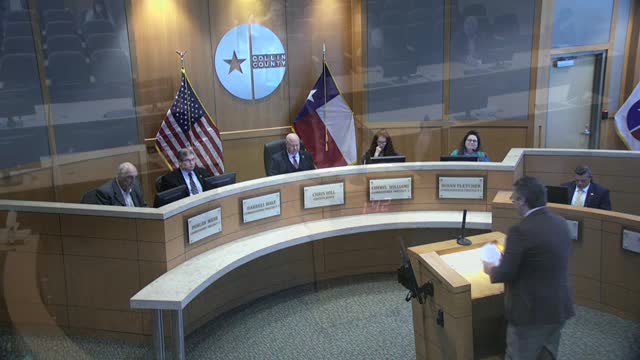
Collin County Commissioners Court discussed a proposed resolution that would formalize how the court decides whether to oppose or not oppose municipal utility districts (MUDs) and municipal management districts (MMDs). Court staff said the draft policy would restate historical practice and add administrative monitoring of districts created through state agencies such as the Texas Commission on Environmental Quality (TCEQ).
Russell Schauffner, identified in the packet as Deputy County Administrator, presented the draft. He said the policy would require supplemental contracts for services — specifically police, fire, emergency services and animal control — when the district seeks county non‑opposition. Schauffner also said the county would begin tracking MUDs created through administrative (TCEQ) processes and present those to the court for consideration of non‑opposition or opposition.
Several commissioners questioned specific draft language and the scope of county expectations. One commissioner urged adding roads and streets to the list of services the county expects a district to maintain, citing increasing numbers of roads developed to concrete standards that the county’s public-works department is not positioned to maintain. The court discussed the concept of “road powers” — a district’s statutory or legislative authority to construct and maintain roads — and the practical effect of districts retaining their own roads versus dedicating them to the county for maintenance.
Commissioners also discussed performance-bond and warranty expectations for roads (a two‑year warranty period was mentioned during the discussion). Court members asked whether adopting a policy that opposes districts that will not assume road responsibility could preclude legislative sponsors from filing bills; staff replied that few new districts are being created in the legislature and that an opposition resolution is unlikely to cause legal trouble but could affect local legislative support.
After discussion, the court agreed to pull the item for one week to revise the language requested by commissioners and return with updated draft language for further consideration. No final resolution or vote on the draft policy was taken at the meeting.
The discussion covered administrative monitoring of TCEQ-created districts and the court’s longstanding practice of conditioning non‑opposition on supplemental service agreements, but commissioners asked staff to clarify language and consequences before formal adoption.