Get Full Government Meeting Transcripts, Videos, & Alerts Forever!
Get email alerts on the Conservation Easement topic
No spam. Unsubscribe anytime.
Carson City staff say proposed home and road at Horse Creek Ranch comply with conservation easement; monitoring finds forest and stream concerns
Summary
City staff told the Open Space Advisory Committee that a homeowner's planned dwelling, accessory unit and road improvements fall outside the protected portion of Horse Creek Ranch but monitoring shows forest-health problems, stream incision and invasive plants that need work and funding.
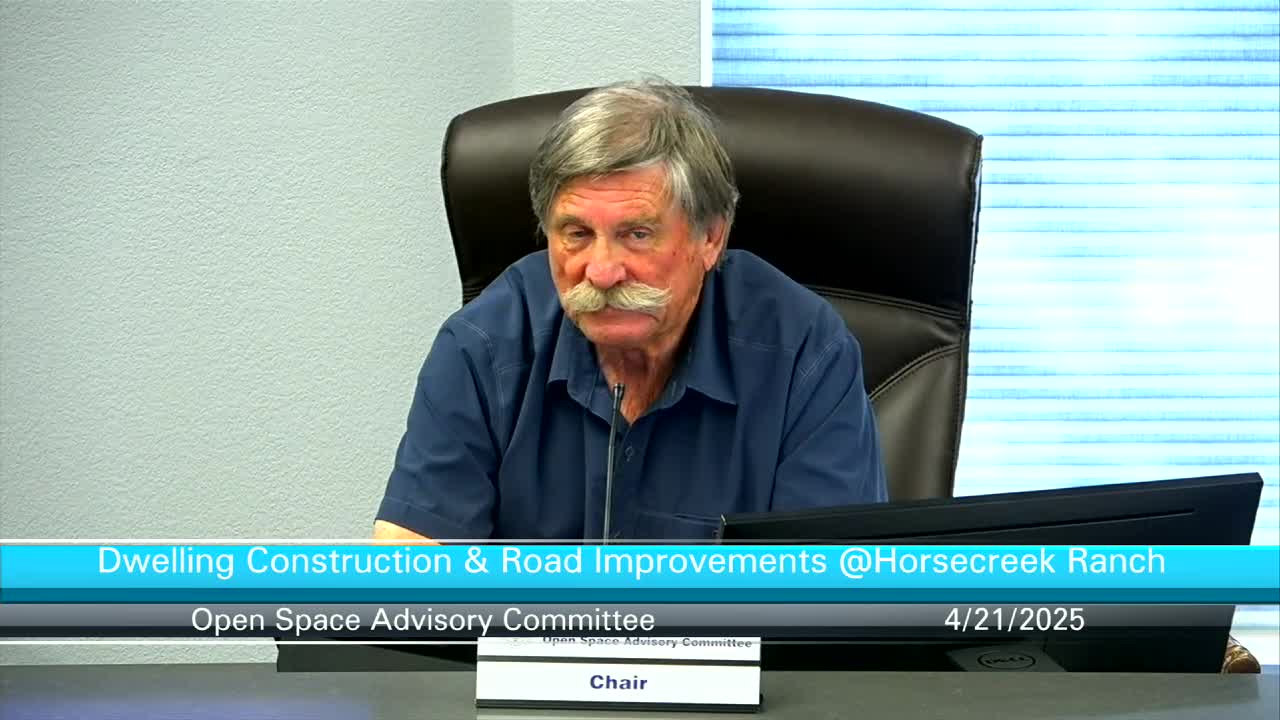
Carson City open-space staff briefed the Open Space Advisory Committee on proposed residential improvements at Horse Creek Ranch and on the property's 2024 annual monitoring report, saying the construction and road work are located outside the conserved parcel but that several natural-resource concerns will require active management.
Lindsay Boyer, an open-space staff member, told the committee that the conservation easement "is basically a restriction that is placed on a property to protect its resources" and that the easement recorded when the city purchased the rights in 2009 left a roughly 25-acre area excluded where a landowner may build. Boyer said the planning commission approved a special-use permit for a house, garage and accessory dwelling on the excluded area and that the applicant and city are working on road standards so the access road meets Carson City's residential road requirements.
The nut graf: the committee was asked to comment but took no formal action; staff said the proposed buildings and access improvements are, as presented, consistent with the easement's permitting language but that annual monitoring identified natural-resource issues that will require treatment, partner support and funds.
City staff said the roadway work largely falls outside the easement's meadow and must meet two easement conditions: avoid construction in the irrigated meadow and give the easement holder 45 days' written notice before construction so the city can confirm compliance. Boyer said the planning commission amended its conditions to allow the road to meet specifications for a "rural access road," including permeable surfacing rather than paving, and that the homeowner is coordinating with the city engineer and fire department on final specifications.
Marina Lovejoy, senior natural resource specialist, presented the 2024 annual monitoring report. Lovejoy said field work on Oct. 1 found the landowner in compliance with the easement but identified several natural-resource concerns: high tree density and dwarf mistletoe (a forest-health issue), stream-channel incision and head-cutting in meadows likely linked to cattle access, and an abundance of invasive pasture species such as bull thistle and common mullein. Lovejoy said staff met with Natural Resources Conservation Service (NRCS) technicians last fall who recommended thinning for forest health, exclusion fencing to restrict cattle access to streams, and installation of beaver-dam analogs to arrest channel incision.
"The landowners are in compliance and are very interested in addressing these natural resource concerns, especially the forest health concerns," Lovejoy said, adding that Nevada Division of Forestry (NDF) has expressed interest and a tentative site visit was scheduled for later this summer.
Public commenters asked the committee to press for clearer baseline data and more frequent monitoring. Denny Frank, a Carson City resident, said he was troubled that the monitoring report lacks baseline soil and water tests and urged the city to require them. "If there's no baseline," Frank said, "how can we know there's any changes or deterioration?" He also urged care in removing diseased trees to avoid spreading pests.
Staff noted funding and partnerships available for treatment. Lovejoy said the stewardship account associated with the easement contains about $40,000 to $50,000 and that staff will pursue partner support and grant opportunities. Volunteers have already helped with thistle removal; staff also cited the possible role of NRCS and NDF in prescribing and carrying out forest and meadow treatments.
Committee members discussed whether a separate written approval from the Open Space Advisory Committee was required under the planning commission condition. Boyer said the conservation easement requires written approval from Carson City for disturbance in the easement; the planning commission condition was added so the project would come before OSAC, but the written approval itself would be a city-issued letter (not an OSAC-only permit).
Outcome and next steps: the committee did not take formal action on the items. Staff will continue monitoring during construction, work with NRCS and NDF to refine prescriptions (thinning, fencing, beaver-dam analogs) and will use stewardship funds or pursue grants to support treatments. Staff also said they will provide written approval when the road plans meet easement terms and city standards.
Ending: staff encouraged public involvement in volunteer weed pulls and noted upcoming partner site visits and further technical reports to inform treatment planning.