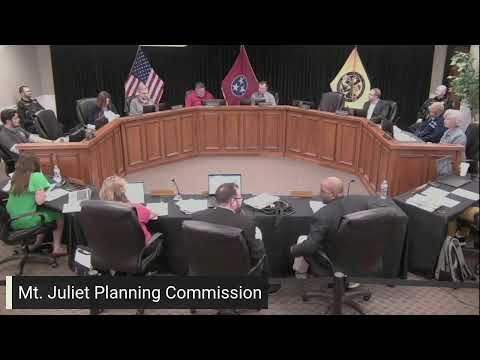
Commissioners discuss codifying tree‑buffer protections in subdivision rules; no vote taken
Summary
Planning commissioners debated adding explicit protections — including a physical barrier — to subdivision and mass‑grading rules so a required buffer remains intact during construction. Staff and commissioners raised enforceability and erosion‑control concerns and asked staff to draft text for later review.
Mount Juliet planning commissioners on April 17 discussed changes to subdivision regulations and mass‑grading requirements aimed at protecting required tree buffers during site work, but they took no formal vote and asked staff to draft proposed language.
Commissioner David Rast proposed that any protected buffer distance (for example, 15 feet) be interpreted as a minimum that must be preserved in full; if any part of a tree falls within that buffer the entire tree should be treated as protected. He suggested a temporary physical barrier, such as a fence, to make the buffer explicit on active sites.
Staff and public‑works representatives cautioned that construction sites already install erosion‑control measures and that the city needs rules that are enforceable. One staff member observed that developers sometimes clear vegetation before applying for permits and that the city’s regulatory reach is limited until grading or certain construction activities commence. Public‑works staff said a temporary perimeter fence or erosion control barrier could serve as a visible “do‑not‑cross” line on sites but emphasized management and inspection will be necessary.
Commissioners asked staff to draft code language that could require a temporary, durable barrier (for example, perimeter fence or protected‑area fencing) that must be in place before mass grading begins and to clarify whether erosion‑control devices should be counted as the protective barrier. The commission also discussed whether the code should reference an external manual (for example, TDOT or city standards) so standards can be updated without amending the ordinance.
Why this matters: buffer protections affect tree preservation, neighborhood character and stormwater control. Clear rules and a visible, enforceable buffer help ensure required green space is not lost during early site work.
What’s next: staff will draft proposed amendments and return them to the Planning Commission for review at a future meeting.
AI generated
The text on this page is AI generated. Summaries, highlights, analysis, and video transcripts are all produced from the original source material.
AI can make mistakes, so if you spot one, and we will fix it for everyone.
Note: the source content is unaltered by us. Any content source we link to, be it a video, an audio recording, or a document, is presented exactly as its publisher released it. That publisher is usually a government body, sometimes an individual official or another organisation.