Get Full Government Meeting Transcripts, Videos, & Alerts Forever!
Get email alerts on the K12 Budget topic
No spam. Unsubscribe anytime.
Laredo ISD reviews 2025–26 budget scenarios as state funding, staffing and pay remain unresolved
Summary
At an April budget workshop the Laredo ISD Board heard a legislative update and district budget models showing a roughly $9.4 million baseline shortfall, staffing realignments that have freed salary savings, and options if pending state funding materializes.
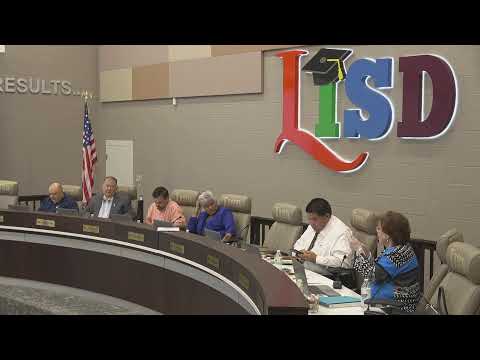
Laredo ISD trustees and staff on April 23 held a budget workshop to review state legislative developments, district revenue scenarios for the 2025–26 school year and staffing changes the district has already made while planning possible pay increases for employees.
The discussion centered on two developments that will determine how aggressive the district can be on raises: whether the Texas Legislature reconciles House and Senate funding proposals and how much of the district’s own tax capacity the board chooses to use. The board heard models showing a baseline deficit in the general fund and a possible improvement if the House funding plan is enacted.
Why it matters: the presentation combined a legislative update with district modeling to show how uncertain state aid, local tax options and internal staffing changes affect whether the district can raise starting pay for hourly positions (currently discussed at roughly $9 per hour for some roles), expand raises across classifications, or keep the budget balanced.
Miss Ayala, representing Laredo ISD finance staff, led the board through a side-by-side summary of House and Senate proposals for the Foundation School Program and other education appropriations. The house proposals would increase state funding more than the senate’s current draft, with the presentation citing house figures that include large increases for tax compression and program allotments. The presentation to trustees included itemized proposed state amounts referenced in the session, including: $3,000,000,000 cited for tax compression, $800,000,000 for a “golden penny” allocation, and additional sums for average daily attendance and program allotments discussed in both chambers. House proposals mentioned in the workshop included dedicated funding for college and career programs and for early literacy; the senate proposals at the time of the workshop emphasized teacher pay increases.
The district’s baseline model — described to trustees as the projection “as if no new money was coming in” — showed roughly $210.5 million in revenues and $209.9 million in expenditures and a remaining deficit cited in the presentation as about $9.4 million. Under a House-based funding scenario presented by staff, the district model showed that the additional state aid in year one could reduce the shortfall and produce an estimated $1.0 million in excess revenues in that scenario. Staff said their modeling currently uses a conservative assumption of $10,000,000 per year in new state aid; the presenters noted outside consultant runs (from Moke and Casey) suggested somewhat larger numbers that still require validation.
Trustees discussed local tax options during the workshop. Staff explained the district’s existing “golden pennies” and “copper pennies” tax capacity and the legal steps to access additional pennies: an efficiency audit followed by a voter election. Staff noted a single golden penny was estimated in the presentation to generate roughly $10,000,000 for the district if approved by voters, and that three golden pennies were discussed as generating roughly $8,000,000 in one mention (staff cautioned there are different calculations and the board must validate exact figures before action). Trustees and staff also reviewed the district’s current maintenance-and-operations tax rate assumptions and the calendar for publication and adoption of the district budget, including the required 10-day public notice period before adoption.
Staff and trustees also spent substantial time on positions and payroll. Human Resources staff reported several rounds of position reviews and attrition-based reductions. "As of today, we've eliminated 82 positions through attrition resulting in a 3,900,000.0 cut in salary and benefits," said the Human Resources presenter. Trustees asked for and were promised more detailed breakdowns before the district’s next budget workshop, including: counts of vacancies filled since lifting the hiring freeze, how many closed positions were custodial vs. administrative vs. instructional, and the payroll savings by category.
Trustees repeatedly pressed staff for concrete scenarios tying incremental pay increases to specific revenue scenarios. Several trustees said they want clear cost estimates for raising starting hourly pay (examples discussed included hypothetical targets such as $11–$13 per hour) and for moving different pay groups “closer to market.” Staff said they will present multiple scenarios at a follow-up workshop scheduled for May 15 at noon and another May workshop at 5:30 p.m.; trustees were told the budget still must be formally adopted in June after the Legislature’s final actions and the required public notice.
Other program- and compliance-related items covered during the workshop included: - Special education and dyslexia funding: staff reminded trustees that certain programs are subject to maintenance-of-effort rules and that dyslexia services are being reflected under special education in funding discussions; trustees raised concerns about communicating changes to parents. - Career and Technical Education (CTE) allotment flexibility: staff explained the state allotment for CTE (presented in the packet as roughly $9.5 million in generated funding) and that statutory rules require minimum program spending but allow districts to use a portion for indirect costs; trustees discussed using part of that flexibility for robotics and other school programs while cautioning against cutting program payroll that would reduce future allotments. - Substitute staffing and hiring: HR staff previewed an upcoming job fair to fill summer and substitute positions (food service, bus drivers, custodians, security) and reported steps taken to post and promote internal promotional opportunities.
Board chair Dr. Rafael Rios told trustees, "there will be an opportunity for you to ask questions right after the legislative update," as staff walked through the models and assumptions. Multiple trustees asked for more granular clarifications (per-student allotment amounts; the split of any new compensation dollars required by state rules; and exact counts and dollar savings from closed positions) and requested those details for the May 15 workshop.
No formal votes or final budget decisions were taken at the workshop. Staff emphasized the timeline constraints: the board can adopt a budget in late June, but the final numbers and the district’s options will depend on the Legislature’s reconciled appropriations and on any voter decisions about local pennies.
Next steps: staff will return May 15 with detailed scenarios showing the fiscal impact of specified pay increases under different combinations of state aid and local tax options; staff also scheduled a May 29 workshop and reminded trustees the formal public hearing and adoption window is in mid-to-late June pending final state actions.
Ending note: trustees and staff repeatedly framed the budget work as an exercise in balancing stewardship of public funds with the district’s goal of bringing pay closer to market for lower-paid employees; staff cautioned that some state aid increases carry statutory restrictions on how much must be spent on compensation and how those dollars are allocated.