Get email alerts on the Land Use topic
No spam. Unsubscribe anytime.
Clark County planning commission reviews biannual code amendments, including ADU, forest-practices and impact-fee changes
Summary
At an April 17 work session, Clark County planning staff summarized a package of development-code amendments to align local rules with state law and clarify procedures, including changes to ADU rules, forest-practices permitting, impact-fee timing, temporary hardship dwellings and rural lighting standards.
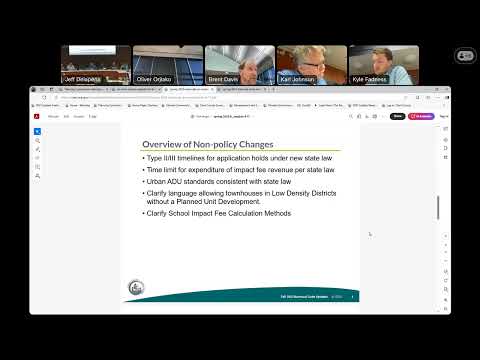
On April 17, 2025, the Clark County Planning Commission heard a presentation on proposed biannual amendments to the county development code that would align local rules with state statute and clarify procedures for accessory dwelling units, forest-practices permitting, impact-fee spending timelines, temporary hardship dwellings and rural lighting standards.
The amendments are scheduled for a public hearing May 15 and a Clark County Council hearing on July 1; staff said the package includes SEPA documents and that they filed the 60-day notice of intent with the state Department of Commerce. "What I have for you tonight is, what we call our biannual code updates," said Brent Davis, land use review manager in the Department of Community Development.
Why it matters: the package touches several substantive issues affecting housing, forestry and public infrastructure funding. Several changes are driven by state law and by requests from county departments and external partners, staff said. The commission used the work session to ask substantive questions and request clarifications ahead of the public hearing.
Key proposals and discussion points
Accessory dwelling units (ADUs): Staff proposed multiple changes to conform to a state statute that limits local restrictions on ADUs. The draft would: add ADUs to use tables for residential and office-residential zones that allow existing single-family housing; allow up to two ADUs per lot where single-family housing is allowed; permit ADUs in the urban holding district; and remove ADU-specific setback and design standards that are not applied to primary residences. "The state statute says we have to allow 2 detached ADUs," Davis said. Commissioners asked whether the changes would let ADUs be placed close to property centers; Davis replied that base zoning setbacks still apply and the county cannot impose additional ADU-only setbacks under the state rule.
Forest-practices code: County Public Works staff described what they characterized as the package's most substantial change—updates to align county code with the Forest Practices Act and state implementing rules. "We focused on developing, clarifying, and developing provisions for what we call class 1 nonexempt permits," said Kevin Tyler of Clark County Public Works. Hunter Decker, county forester, and Tyler explained that class 1 permits generally cover harvests on forested properties of two acres or less and that the draft adds clear exemptions and processing rules the code currently lacks. Commissioners asked about "backdoor conversions," where applicants harvest under a state permit and later pursue development that could avoid county critical-area protections; staff said the updates aim to clarify jurisdiction and require conversion processes that maintain county protections.
Impact-fee expenditure timeline: The draft would change the county's allowable spending window for impact-fee revenue from six years to 10 years to match a state statute and to give Public Works more time to plan and deliver capital projects. "Public works planning and project development and permitting often that cycle is longer than 6 years," Davis said. Commissioners raised concerns about inflation eroding fee value over a longer horizon and asked staff to provide a Public Works response at the hearing.
Temporary hardship dwellings: The code currently limits temporary hardship units to manufactured homes in many cases. Staff proposed allowing an existing permanent residence on a property to be used temporarily for hardship housing when an owner builds a new primary dwelling, provided the owner records a covenant to decommission or convert the old structure to a nondwelling when the hardship ends.
Townhomes and low-density wording: Staff said they will clarify county language about how many attached townhome units are allowed per structure without requiring a planned unit development; the intent is a four-unit-per-structure limit to avoid unintended density increases.
Guest parking and sidewalks: With new middle-housing standards triggering more guest-parking requirements, staff proposed a safety-oriented change when head-in parking adjoins the public right of way: sidewalks should wrap around head-in stalls so pedestrians are not forced to pass behind parked cars.
Rural lighting: Council asked staff to draft simple standards to reduce intrusive lighting from new development in rural areas. April Firth, director of Community Development, said the aim is to prevent bright lights from being aimed into neighboring properties; she acknowledged enforcement will be difficult and indicated staff may reword provisions to focus on "shielded" lighting.
School-impact fees: School districts asked for clarifications to the student-factor calculation and for the ability to propose alternate methodologies for student generation in multifamily housing types; staff proposed removing an annual recalculation requirement and keeping a scheduled review interval. Oliver Jack, community planning director, said the code would set a four-year interval for school capital-facilities updates and impact-fee recalculation, with districts staggered by timing.
Process and next steps: Davis said staff will run the draft ordinance through legal review and release SEPA documentation before the May 15 public hearing; the council hearing is scheduled for July 1. Commissioners asked staff to return with additional information on impact-fee inflation risk and enforcement implications for the lighting language.
Ending: The planning commission did not take any formal action at the work session; commissioners directed staff to bring clarifications and requested responses for the public hearing and council review.
AI generated
The text on this page is AI generated. Summaries, highlights, analysis, and video transcripts are all produced from the original source material.
AI can make mistakes, so if you spot one, and we will fix it for everyone.
Note: the source content is unaltered by us. Any content source we link to, be it a video, an audio recording, or a document, is presented exactly as its publisher released it. That publisher is usually a government body, sometimes an individual official or another organisation.