Get Full Government Meeting Transcripts, Videos, & Alerts Forever!
Get email alerts on the City Budget topic
No spam. Unsubscribe anytime.
Eugene manager presents amended 2025–27 budget with $11.5 million shortfall; cuts to libraries, pools, animal services and staff proposed
Summary
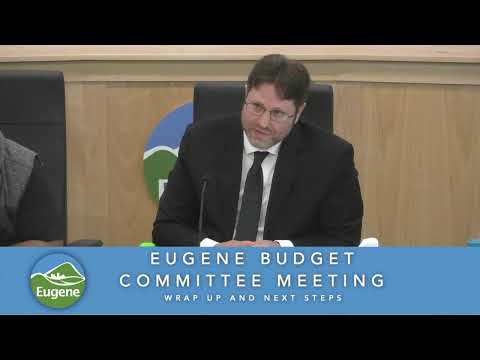
City Manager Sarah Medary and Chief Financial Officer Twyla Miller presented the City of Eugene’s amended proposed 2025–27 biennial budget to the Eugene Budget Committee on May 7, laying out an $11.5 million structural gap and a set of reductions and one‑time investments intended to stabilize reserves and balance the two‑year plan.
City Manager Sarah Medary and Chief Financial Officer Twyla Miller presented the City of Eugene’s amended proposed 2025–27 biennial budget to the Eugene Budget Committee on May 7, laying out an $11.5 million structural gap and a set of reductions and one‑time investments intended to stabilize reserves and balance the two‑year plan.
The presentation said the full amended proposed budget across all city funds is about $1.6 billion (two years), with a general fund budget of $446.5 million. Medary and Miller told the committee that property tax, EWEB’s contribution in lieu of taxes (SILT) and service charges make up roughly 85% of general fund revenue, with property taxes alone representing about 71% of that revenue stream.
Why it matters: Eugene’s general fund revenues are not keeping pace with escalating expenses—driven by inflation, rising PERS (Public Employees’ Retirement System) employer costs, and growing service demand—forcing further reductions after more than a decade of cost‑cutting. The amended proposal retains some one‑time savings to shore up reserves but would reduce ongoing service capacity across multiple departments if adopted.
Most important details
- Size and gap: The amended proposal shows an $11.5 million shortfall for the 2025–27 biennium after earlier reductions and proposed ongoing additions the Council asked staff to consider. The city previously implemented about $91 million in budget adjustments since 2020. Twyla Miller said, “property taxes, EWEB’s SILT, and service charges, are our top 3 revenue sources in our general fund.”
- Major program and service impacts: The amended draft reduces or eliminates programs across departments. Highlights include elimination of the city animal services contract with Greenhill (the contract was restored one‑time in the prior biennium), closure of Amazon Pool beginning Oct. 1 (with seasonal staffing impacts), Sunday and Monday closure of the downtown library (with Sunday hours added at Bethel and Sheldon branches), reassignment or elimination of some community engagement positions in Police, cuts in homeless services coordination pending state funding and county coordination, reductions in parks maintenance positions, and reductions in Office of Equity and Community Engagement staffing to three FTE.
- Personnel and FTE: The city manager said the largest single reductions are in temporary employees and vacant positions; overall FTE per thousand population in the general fund would fall further, to roughly 4.3 FTE per thousand under the amended budget, about 26% below pre‑recession levels.
- PERS and other long‑term cost drivers: The presentation emphasized PERS employer rate increases as a major pressure. The city budgets a $4.8 million increase in general‑fund PERS costs in FY26 (a 21% increase over FY25). The city previously used the Employer Incentive Fund (EIF, created by state law) to make a $5 million lump‑sum deposit that generated state matching funds and produced an estimated long‑term reduction in PERS costs; staff said the city currently lacks capacity to participate in another EIF round.
- Funds to watch: Finance staff flagged several funds at risk: Ambulance Transport Fund (ATF) — expenses outpacing revenue despite some recovery and one‑time general fund support of just over $1 million in the biennium; Parking Enterprise — slow revenue recovery and deferred maintenance; Telecom Fund — revenue stabilization after federal regulatory changes; PSAP (9‑1‑1) Fund — flat state 9‑1‑1 tax distributions vs. rising personnel costs; Road Fund — projected need to reduce operating expenditures by ~8% beginning FY28 without state fixes.
- Reserves and credit: The city’s reserve target for the biennial cycle is 4% of biennial expenditures (about $17 million per biennium); the amended budget would budget reserves at about 4.3% in the 2025–27 biennium and trend down before recovering. Moody’s currently rates Eugene AA1 and staff emphasized that sustained low reserves or failure to respond to economic changes could put the rating at risk.
Budget choices and rationale
Medary said department leaders were instructed to “protect the core of the core” — that is, safeguard essential, legally required, or difficult‑to‑replace services — while identifying other reductions and efficiencies. She described the exercise that produced the amended budget as a combination of preserving critical services where possible and using one‑time savings to smooth the transition. Medary used the phrase “get back up and begin again” to describe the long cycle of budget adjustments the city faces as revenue drivers and mandates change.
Next steps and public process
Budget committee members were told the committee will continue deliberations over three more meetings, including a public hearing and public comment on May 14 and May 21 and a hybrid public hearing May 28. Medary and Miller said the timeline is tight; Council workshops on potential alternate revenue solutions are expected in mid‑June. The budget committee will forward a recommendation to the City Council after its review.
Votes at a glance (recorded at the committee meeting)
- Motion to extend the meeting by 15 minutes — motion passed by voice vote (all in favor; one second recorded by Councillor Keating). (Procedural; not a policy decision.) - Motion to extend the meeting by 10 minutes later in the evening — motion passed by voice vote (procedural). (Transcript records a second; specific mover/second not fully identified.) - Motion to approve minutes from the Feb. 12 meeting — moved by Councillor Clark, seconded by Councillor Evans; approved by voice vote.
What the committee and community asked about
Committee members pressed staff on: the functional impacts of proposed closures (Amazon Pool, downtown library Sundays); the city’s ability to replace or contract services (pools, animal sheltering); the length and projected peak of PERS employer costs; the size and timing of property tax revenue (including the effect of change‑in‑ratio assessments and exemptions such as the University of Oregon’s exempt assessed value); and the stability of various enterprise funds. Staff deferred some operational specifics for follow‑up and scheduled a focused presentation on alternative response and emergency system design for the May 14 meeting.
Ending
Committee members and the manager repeatedly described the proposals as difficult and the work ahead as “sobering”; staff emphasized the amended budget is a point‑in‑time plan that relies on assumptions (inflation, PERS rates, state revenue sharing, EWEB projections) and said updating those assumptions remains part of the next phases of deliberation.