Get Full Government Meeting Transcripts, Videos, & Alerts Forever!
Get email alerts on the Police Overtime topic
No spam. Unsubscribe anytime.
Supervisors hear BLA audit alleging widespread SFPD overtime problems; committee shifts salary savings into overtime
Summary
The Board of Supervisors' Budget and Appropriations Committee on April 30 heard a Budget and Legislative Analyst (BLA) performance audit that found widespread overtime-policy violations and management gaps at the San Francisco Police Department and approved an ordinance reallocating salary and fringe savings to cover projected overtime for both the Police and Sheriff’s departments.
The Board of Supervisors' Budget and Appropriations Committee on April 30 heard a Budget and Legislative Analyst (BLA) performance audit that found widespread overtime-policy violations and management gaps at the San Francisco Police Department and approved an ordinance reallocating salary and fringe savings to cover projected overtime for both the Police and Sheriff’s departments.
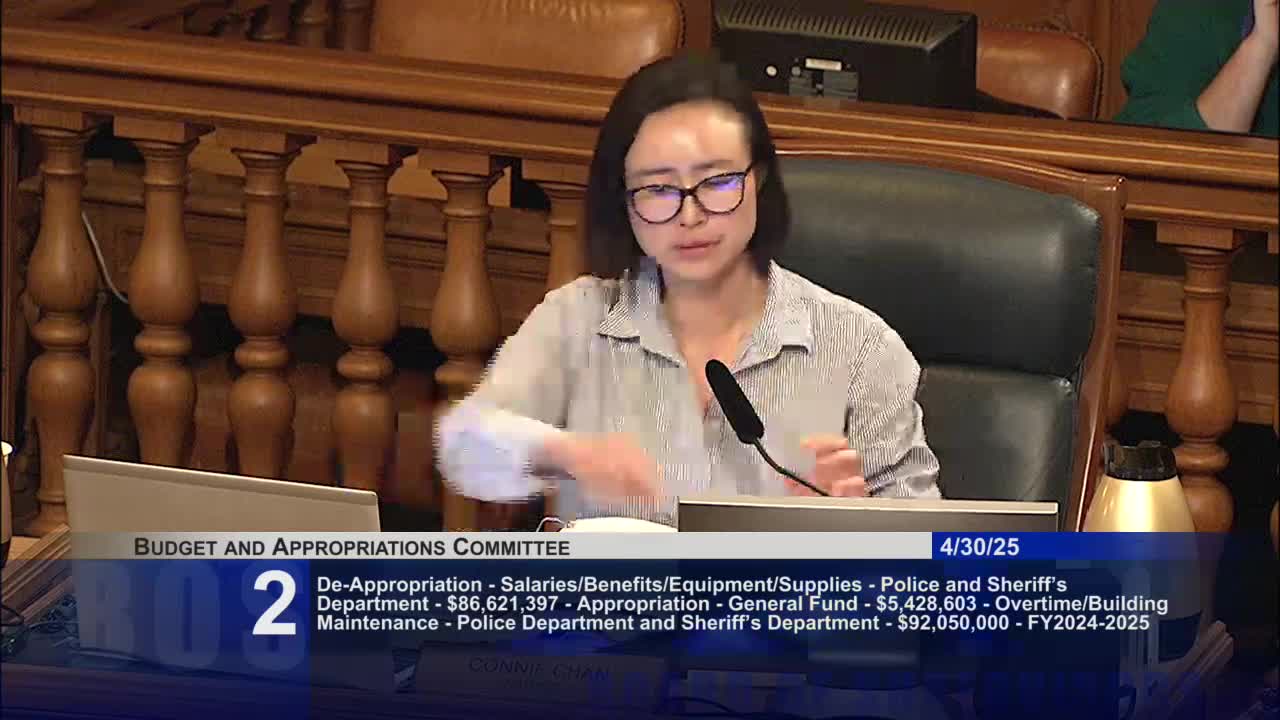
The audit, covering July 2018 through June 2023, concluded the department’s overtime tripled during the review period and identified a set of problems the BLA says drove that rise. "We have 29 recommendations. Implementing them will reduce overtime at the police department," BLA audit lead Nick Menard told supervisors. The committee then voted to move an ordinance (items 1 and 2 taken together) forwarding a request to deappropriate roughly $86.6 million in salary, fringe and other savings and reappropriate most of that funding to overtime (about $61 million for SFPD and $30 million for the Sheriff), plus a $5.4 million draw from the general reserve to cover current-year needs; the ordinance was amended and forwarded to the full Board without recommendation.
Why it matters: the audit tied overtime growth to a roughly 21% drop in sworn staffing during the period, increased sick leave, and large special initiatives paid on overtime. That combination created fiscal pressure and raised accountability concerns for tens of millions of general‑fund dollars. The BLA recommended changes intended to improve monitoring, enforce existing overtime and absenteeism rules, and better align special-initiative staffing with measurable goals.
Report highlights and department response The audit found that in fiscal 2022–23 SFPD reported about $108.4 million in overtime and that about 12% of officers accounted for roughly one‑third of all overtime hours. Sick and injury-related leave rose about 77% across the five-year audit window; the BLA identified patterns it said were "consistent with potential abuse," including repeated sick-call patterns coinciding with voluntary 10(b) (private-pay) assignments. The audit found 51,206 hours of 10(b) overtime that, according to the BLA's review, should not have been authorized under the MOU eligibility rules in place at the time. A review of 559 overtime cards found a 13% error rate (missing or duplicate signatures and instances where an approving signature was the same person who worked the hours). The audit also said three targeted special initiatives (Union Square safe shopper, Tenderloin/Triangle, and a tourism deployment) cost about $30.8 million during the audit period and lacked clear, consistently applied performance metrics.
SFPD leadership said the department has begun implementing many of the BLA recommendations since the audit period closed and disputed some of the audit's conclusions. Assistant Chief David Lazar described new oversight tools and steps taken since fiscal 2023, saying the department "formed an overtime compliance unit" and launched an "overtime dashboard" that tracks data on shorter cycles. SFPD officials said they agreed in whole or in part with most recommendations (26 of 29 by SFPD's count) and urged that staffing shortages — not the absence of policy — were a principal driver of overtime. Director of Policy and Public Affairs Diana Rocha and Assistant Chief Lazar repeatedly told supervisors the department has invested in monitoring and that some recommendations will require collective‑bargaining changes.
Points of debate in the hearing Supervisors pressed SFPD on specific accountability gaps the BLA identified. Supervisor Shimon Walton, who introduced the hearing, said the audit's findings "demand answers" about fiscal controls and absenteeism policy enforcement. Supervisor Jackie Fielder pressed the department on the private‑pay 10(b) program, arguing that officers should be available to all San Franciscans rather than deployed at the direction of private payers and raising the BLA finding that many 10(b) hours were worked by officers who, per the BLA's eligibility review, should have been ineligible. BLA lead Menard clarified the audit did not assess every staffing tradeoff (for example, whether a given 10[b] hour directly pulled an officer from a neighborhood shift), but he tied the program to sick‑time patterns and backfill overtime that increased general‑fund costs.
SFPD leaders said the 10(b) program is privately funded and argued the program places uniformed officers in public spaces where their presence can prevent crime. The department also described operational reforms it said are already under way: centralized monthly or biweekly review of overtime allocations, new departmental notices codifying enforcement steps, pre‑scheduling of some backfill overtime, and greater justification by captains when overtime budgets are exceeded. SFPD said some recommendations that would change eligibility or staffing rules will need changes in the MOU with the Police Officers Association and therefore will be negotiated in 2026.
Committee action During the meeting the committee took two formal actions tied to the audit and to a related ordinance: (1) on item 1 (the BLA hearing) the committee voted to hear and file the audit (motion moved by Supervisor Walton, seconded by Chair Connie Chan; vote recorded as 5 ayes); (2) on item 2 the committee considered an ordinance to reallocate roughly $86.6 million in salary/fringe/nonpersonnel savings and $5.4 million from the general reserve to cover projected overtime for the Police and Sheriff’s departments (including a proposed revised overtime appropriation for SFPD of about $102 million). Vice Chair Matt Dorsey offered technical amendments to the ordinance; the committee approved the amendments and then voted to forward the ordinance to the full Board without recommendation (both motions passed by recorded votes of 5 ayes).
What supervisors and auditors asked to see next Supervisors said they expect the department to return with demonstrable, measurable progress. Multiple supervisors asked for real‑time or near‑real‑time monitoring, stricter enforcement of absenteeism rules, and evidence that special initiatives produce measurable public‑safety benefits that justify overtime costs. The BLA recommended annual public check‑ins on audit implementation and that the Board consider tightening oversight during the budget process.
The committee’s action sends the ordinance to the full Board of Supervisors for final consideration. The BLA also recommended the Board require periodic public reporting on the department’s progress implementing the audit recommendations and on overtime trends and eligibility enforcement.
Ending note The committee hearing combined fiscal scrutiny with operational oversight: the BLA audit flagged policy and monitoring gaps that auditors say drove tens of millions in overtime spending, while SFPD leaders argued staffing shortfalls drove the need and described new oversight tools they say are already in use. The full Board will now consider the ordinance to cover current‑year overtime; supervisors signaled they will follow the department’s implementation of the audit recommendations closely.