Get Full Government Meeting Transcripts, Videos, & Alerts Forever!
Get email alerts on the Federal Election Legislation topic
No spam. Unsubscribe anytime.
Clerk warns federal proof‑of‑citizenship proposals could penalize local election workers
Summary
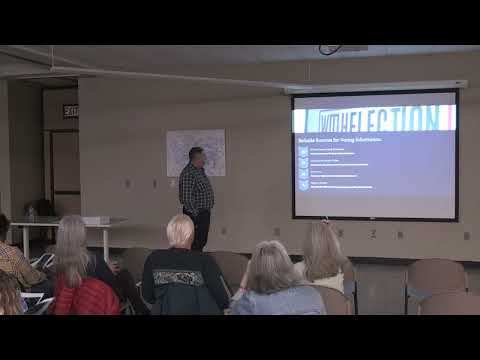
El Paso County Clerk and Recorder Steve Schleicher used a public meeting at the Citizen Service Center to explain how pending federal proposals could affect local election administration and volunteers.
El Paso County Clerk and Recorder Steve Schleicher used a public meeting at the Citizen Service Center to explain how pending federal proposals could affect local election administration and volunteers.
Schleicher described HR22 (referred to in the briefing as the Safeguard American Voter Eligibility Act) as a House‑passed bill addressing proof‑of‑citizenship for voter registration. "It passed the House and is now on to the Senate," he said. He and attendees discussed an accompanying presidential executive order and separate proposals (referenced as the "Mesa Act") that would address tabulation equipment.
Why it matters: Schleicher said the proposals, as written or contemplated, could impose documentary proof requirements for new registrants (for example, a passport or Real ID showing citizenship) and create criminal or civil penalties for clerks and election judges who certify or process registrations that later prove to be noncitizen registrations. Because El Paso County has five major military installations and many transient military households, Schleicher and attendees raised specific concerns about whether military IDs and other commonly used forms of identification would satisfy federal requirements.
Key points from the briefing
- Scope and status: Schleicher said HR22 passed the House with bipartisan support and was under consideration in the Senate; he noted that to overcome Senate rules a supermajority is typically required for significant changes. He also said the executive order and the House bill are separate measures that could overlap in practice.
- Forms of identification: Meeting participants discussed the Real ID Act and whether state Real IDs show citizenship; Schleicher and others noted only a small number of states include citizenship on Real IDs. They also discussed passports, military IDs, birth certificates and tribal IDs as possible documentary proof types; multiple speakers said the draft federal language and executive guidance were not yet finalized and were a source of confusion.
- Penalties and volunteer impact: Schleicher warned that penalties for noncompliance could deter people from serving as election judges: "There is no judge that I know that I have met over the last 2 and a half years... none of them will take on that responsibility," he said, arguing that the risk of criminal exposure could shrink the pool of bipartisan volunteer judges who run in‑person processes.
- State‑level differences: Several participants noted Colorado is a "self‑affirmation" registration state in which most registrants attest they are U.S. citizens; the county runs multiple database checks (including SAVE/immigration checks and Department of Revenue checks) and referred one prosecution where a noncitizen both registered and voted.
Office response and advocacy
Schleicher said he is working with county attorneys, federal lobbyists and state legislators to seek amendments that would preserve access while addressing potential fraud. He urged residents to contact federal lawmakers and described ongoing county outreach to the state's congressional delegation and the U.S. House and Senate offices.
Quotes and attendee concerns
"If Steve Schleicher makes a mistake and I register an individual who is a noncitizen as a citizen, I could get fined and go to jail," Schleicher said, summarizing provisions in draft language that worried local election officials. An attendee summarized the public concern: restricting acceptable IDs without careful substitution risks disenfranchising eligible voters who lack passports or other documents.
Ending
Schleicher said the clerk's office will continue to brief community groups and to work with legislators and lobbyists on amendments. He urged residents to participate in the civic process and to contact elected representatives about specific provisions they find problematic or potentially disenfranchising.