Get Full Government Meeting Transcripts, Videos, & Alerts Forever!
Get email alerts on the Advanced Clean Fleets topic
No spam. Unsubscribe anytime.
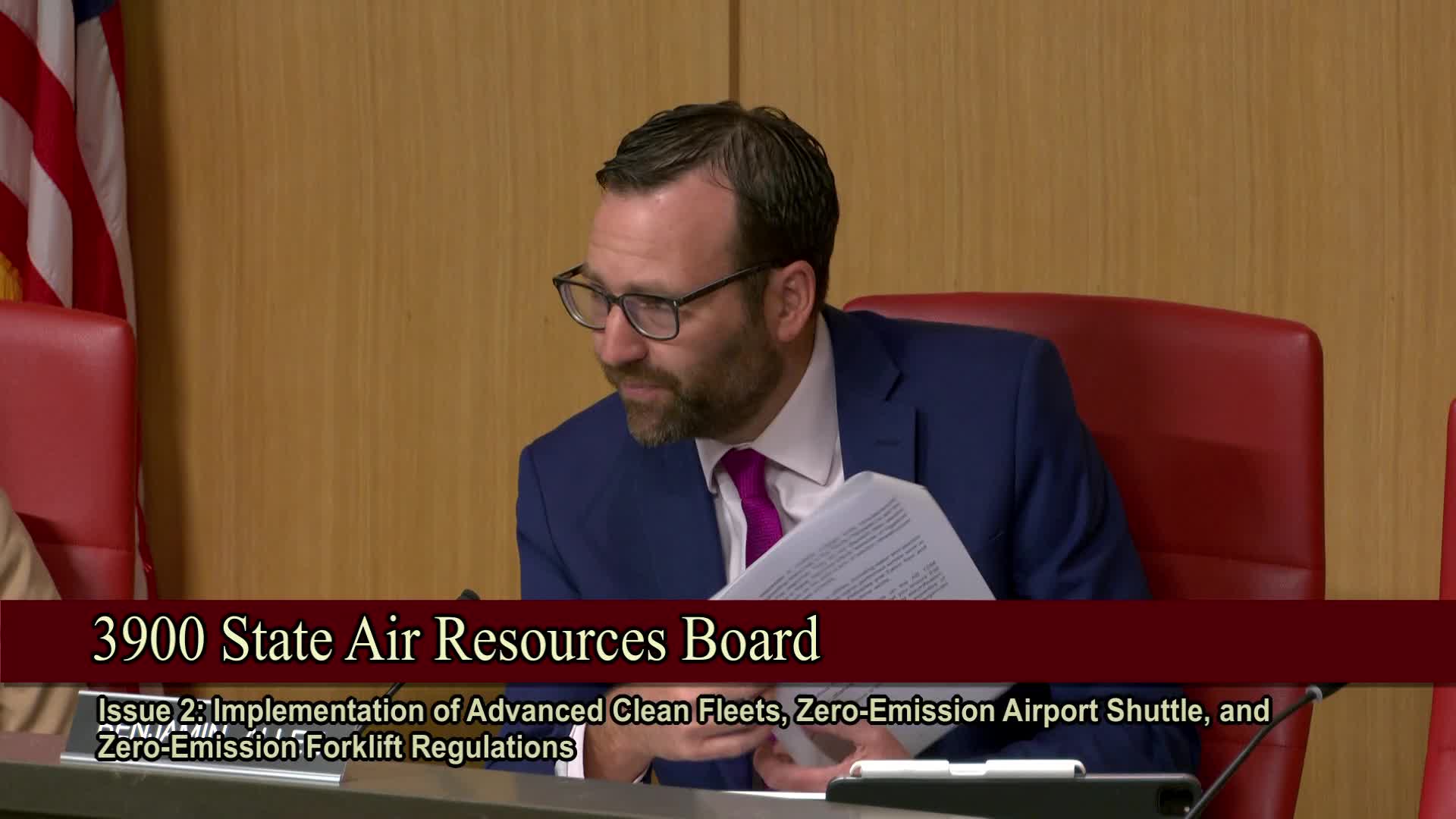
CARB tells Senate panel federal uncertainty complicates Advanced Clean Fleets, zero-emission forklifts; LAO questions staffing request
Summary
California Air Resources Board witnesses told a Senate subcommittee they are revising parts of Advanced Clean Fleets and related rules because of federal waiver uncertainty; CARB requested positions to implement and enforce rules, while the LAO and several senators urged caution given likely limits on enforceability.
California Air Resources Board (CARB) staff told the Senate Budget Subcommittee No. 2 on May 1 that federal actions and uncertainty about U.S. EPA waivers have forced CARB to adjust parts of the Advanced Clean Fleets (ACF) regulation and to postpone seeking authorization for the zero-emission forklift rule. CARB sought funding and permanent positions to implement portions of the regulatory package the agency still expects to carry out.
Courtney Smith, CARB's principal deputy, said the agency withdrew certain waiver requests after consulting with U.S. EPA, and is repealing the ACF high-priority and drayage fleet provisions while preserving state and local-government requirements and the airport-shuttle rule for which CARB still had waiver authority. Smith described the Clean Truck Partnership, a 2023 agreement with truck manufacturers that represent roughly 90% of the California market, as a source of market certainty but said additional flexibilities will be needed and proposed as amendments this summer.
CARB requested resources to implement several rules, including the zero-emission forklift regulation and parts of ACF, for which the Legislative Analyst's Office said the request would fund about 50 positions and roughly $9 million annually. The LAO cautioned the committee that much of CARB's proposed enforcement work cannot be carried out absent federal waivers, recommending the Legislature weigh whether the requested resources are the best use of limited funds.
Why it matters: the ACF and related rules are central to California's strategy to reduce nitrogen oxides and other-smog-forming pollutants from medium- and heavy-duty vehicles. Several senators and stakeholders expressed concern about reduced enforceability, the need for flexibility for utilities and farms, and the effect of staffing choices on CARB's ability to move quickly and efficiently.
What lawmakers and analysts said
- LAO: The Advanced Clean Fleets and forklift implementation request would support about 50 positions and $9 million annually; the LAO recommended the Legislature consider limited-term authority or ask for more detailed justification because some enforcement tasks may be legally blocked without federal authorization.
- CARB: The agency plans to pursue regulatory amendments this summer to provide flexibilities in light of market and federal uncertainties and to focus implementation resources on provisions CARB can administer, including state and local government fleets and airport-shuttle requirements. CARB officials said some positions have already been filled on a limited-term basis and converting those positions to permanent hires preserves institutional expertise.
- Stakeholders: Farm and agricultural representatives asked for leeway and noted that the forklift regulation contains exemptions and extensions for agricultural uses; CARB witnesses said the agency intends to use the current period to conduct outreach and refine provisions.
Ending note
The subcommittee did not act on CARB's staffing request. LAO and some senators signaled skepticism about creating permanent positions for rules that might be unenforceable without federal waivers, while CARB argued permanency preserves expertise and allows quicker implementation of the provisions it can currently administer. Members said they will continue review and follow up at future hearings.