Get Full Government Meeting Transcripts, Videos, & Alerts Forever!
Get email alerts on the Cap And Trade topic
No spam. Unsubscribe anytime.
Senate subcommittee reviews cap-and-trade spending plan as auction revenues fall; short-term shift to Motor Vehicle Account proposed
Summary
Finance and the Legislative Analyst's Office told the Senate Budget Subcommittee No. 2 that cap-and-trade auction revenues are down from prior estimates and the governor's budget proposes modest transfers and largely keeps the prior spending plan; staff and analysts urged close monitoring ahead of the May revision.
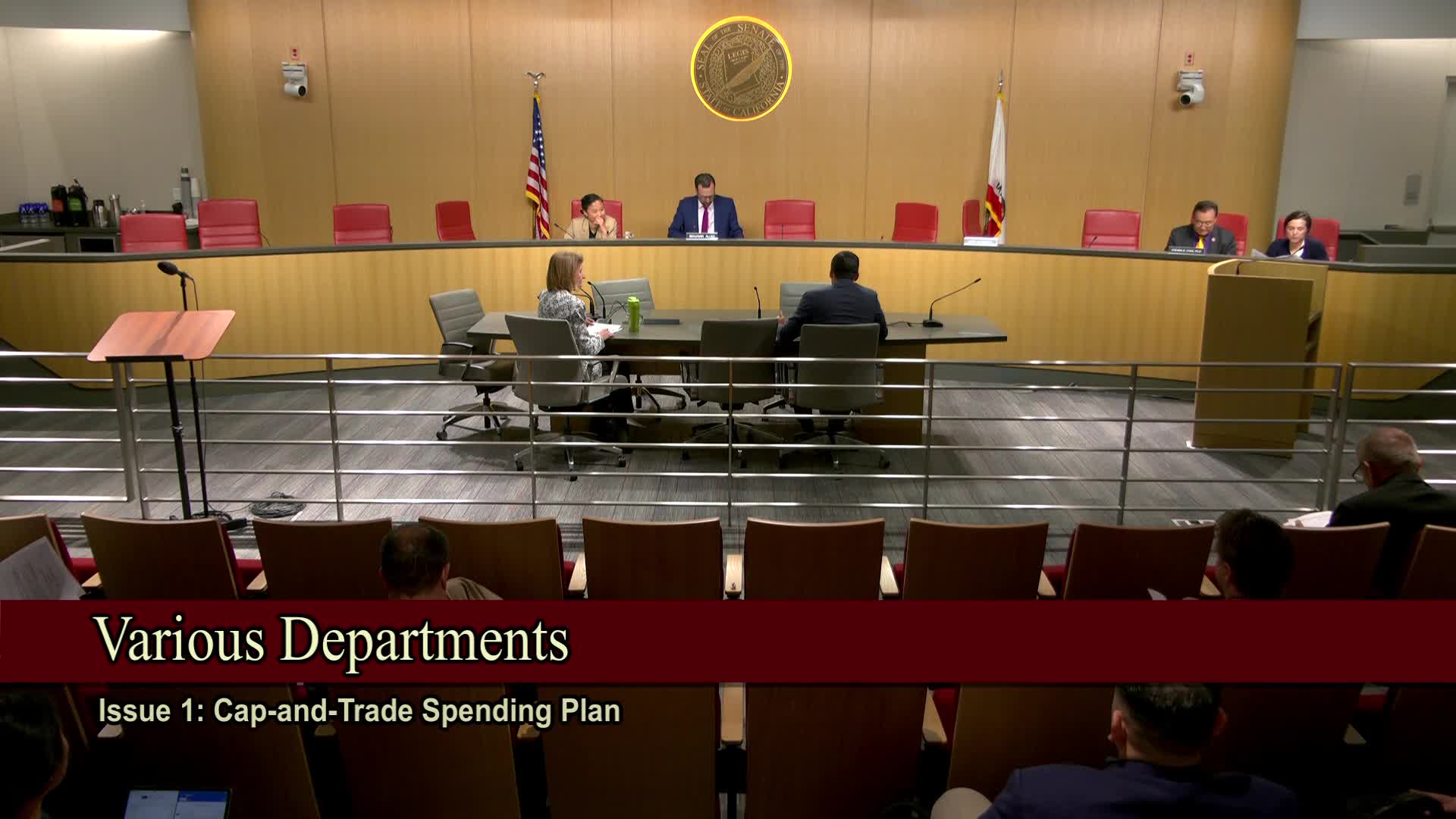
The Senate Budget Subcommittee No. 2 on May 1 heard presentations from the Department of Finance and the Legislative Analyst's Office on the governor's cap-and-trade spending plan, including a one-time transfer from the Greenhouse Gas Reduction Fund (GGRF) to the Motor Vehicle Account (MVA) and updates on auction revenue projections.
The subcommittee was told that, under the governor's budget, fiscal-year 2024—25 auction revenues were estimated at about $4.1 billion, roughly $600 million lower than estimates at the 2024 budget act, while interest earnings are exceeding earlier projections. Brandon Merritt of the Department of Finance said the February 2025 auction netted about $851 million, below the $1.02 billion per-auction estimate used in the governor's budget.
The Legislative Analyst's Office (LAO) advised the committee that the proposed spending plan largely follows the plan approved in last year's budget act, with small changes intended to support the state's medium- and long-term priorities, but warned that revenue softness in recent auctions creates uncertainty for multi-year commitments. The LAO highlighted a proposed $32 million shift from GGRF to a Proposition 4 account and noted $81.2 million proposed to transfer from GGRF to the Motor Vehicle Account.
Why it matters: the GGRF is the primary discretionary fund for many climate and pollution-reduction programs. Commitments made now constrain future legislative choices; if allowance prices or auction outcomes remain low, the LAO said, budget-year spending may need to be revised. The Department of Finance and the LAO urged lawmakers to monitor upcoming auctions and the general fund as the May revision approaches.
Key details presented to the committee
- Department of Finance estimates: 2024—25 auction revenues ~ $4.1 billion (down ~$600 million versus 2024 budget act estimates); 2025—26 projected auction revenues ~ $4.2 billion. (Brandon Merritt, Department of Finance)
- Interest earnings from the State Money Investment Fund were projected at about $650 million for the current year, roughly $250 million above earlier projections. (Department of Finance)
- The governor's budget proposed discretionary 2025—26 cap-and-trade spending of about $1.8 billion, generally the same plan as the 2024 budget act with modest adjustments. One change is a transfer of $81.2 million from GGRF to the Motor Vehicle Account. (Department of Finance)
- The LAO recommended continued close monitoring of auction outcomes and warned that if allowance prices remain near recent low levels, planned budget-year expenditures might need modification. The LAO noted unallocated GGRF in the budget that could be redeployed but stressed the trade-offs. (Legislative Analyst's Office)
Committee questions and related issues
Members pressed Finance about the MVA's structural deficit and whether the proposed transfer is a short-term fix or part of longer-term thinking. Finance staff said the MVA faces operational shortfalls and is monitored each budget cycle; the transfer maintains solvency in the short term but a longer-term solution will be considered in future budget proposals. The committee also discussed the control section of the budget act (cited during the hearing as control section 15.14(b)), which limits departments to 75% spending of their appropriations until May auctions conclude and Finance makes final determinations about the remaining allowances.
High-speed rail allocation
Senators asked how the 25% allocation of cap-and-trade revenues to high-speed rail translates into dollar terms. Finance staff said the cap-and-trade contribution to high-speed rail previously amounted to roughly $2 billion in 2023—24 but is expected to be notably lower in 2024—25 (likely under $1 billion) given lower auction receipts; members noted concerns about the project's overall cost and schedule.
Public and stakeholder comments at the hearing urged continued funding for a range of GGRF programs including incentives for zero-emission trucks and transit, the Clean Cars for All program, and nature-based and community air-protection programs. Several local and regional agencies and environmental groups urged that funding remain available for programs aimed at disadvantaged communities.
Ending note
Finance and the LAO signaled that the May revision will show whether auction trends persist and that the Legislature should be prepared to weigh trade-offs among competing priorities if revenues remain lower than prior expectations. The subcommittee did not take a formal vote on the spending plan during the hearing.