Get Full Government Meeting Transcripts, Videos, & Alerts Forever!
Get email alerts on the Zoning Ordinance Rewrite topic
No spam. Unsubscribe anytime.
Leesburg planning commission continues Article 3 rewrite, debates use permissions for schools, short‑term rentals and telecom testing
Summary
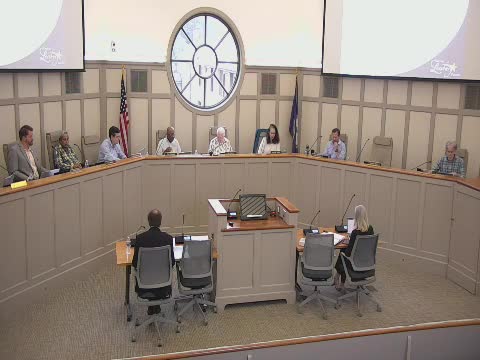
At a Leesburg Planning Commission work session on April 24, 2025, commissioners and staff continued their review of Article 3 (use regulations) of the zoning ordinance rewrite, discussing which uses should be permitted by right, limited, or require special exception review.
At a Leesburg Planning Commission work session on April 24, 2025, commissioners and staff continued their line‑by‑line review of Article 3 (use regulations) of the town's zoning ordinance rewrite, discussing which land uses should be permitted by right, limited, or require special exception review and flagging sections for a deeper follow‑up.
The drafting team described a three‑tiered permissibility approach in the proposed use tables (P = permitted by right, L = limited use with codified standards, M = minor special exception, S = special exception) and asked commissioners to identify items that should be moved, clarified, or removed. Staff said the broader rewrite began in summer 2023, the commission's in‑depth review started in February 2025, and a 60‑day public comment period opened March 6 and is scheduled to close May 5.
Why it matters: changes to use tables and use standards determine where schools, care facilities, short‑term rentals, retail, industrial and other activities can locate in Leesburg. Those determinations affect neighborhood character, permitting timelines and whether expansions or new facilities would require higher levels of public review.
Staff overview and process
Bridal Boucher of the Department of Community Development and other staff walked commissioners through Division 10 (use tables) and explained the L category's intent: uses labeled L remain by right but must meet additional, codified use standards so the zoning administrator can approve them administratively if all standards are satisfied. Boucher said earlier divisions and placeholders (for example, Crescent District, sign regulations and attainable housing) will receive a full 60‑day review period when that text is ready.
Public comments and school district concerns
Morgan Hadlock, an associate with Curata Partners and a Leesburg resident, urged staff to "streamline that thought process" and offered the firm's assistance on the mixed‑use center designation, saying the current draft could "preclude the Village at Leesburg from continuing to adapt and attract the uses that it's seeking to bring into the town." Hadlock asked staff for a deep dive on that zoning designation.
A representative from Loudoun County Public Schools, identified in the session as the Planning and GIS services director for LCPS, said, "The draft ordinance proposes to rezone all existing public school properties to the Government Center District." The speaker asked the commission to "respectfully request that public schools remain by right," and raised two technical concerns: the draft proposes a single parking ratio of 3 spaces per 1,000 square feet for all educational facilities and LCPS requested a tiered parking approach (different ratios for elementary, middle and high schools) and different bicycle parking standards by school type. The LCPS representative also asked for additional detail on sign standards and outdoor lighting for educational uses in the Government Center district.
Major policy questions and examples discussed
- Family day homes: Commissioners reviewed the "L" approach using family day homes as an example. Staff explained the draft points applicants to use‑specific standards (e.g., Section 13.2) and noted state childcare code is referenced for staffing and licensing requirements. Staff said lots under 2,000 square feet with higher capacity (near the 6–12 child limit) could trigger special exception review.
- Congregate housing versus group homes: Commissioners discussed new definitions that separate "congregate housing facilities" (used, for example, for homeless shelters or transitional housing) from state‑defined group homes. Staff said congregate housing was placed in mixed‑use and Crescent districts as a minor special exception following recent commission recommendations, while state‑defined group homes remain permitted in many residential districts.
- Short‑term residential rentals (Airbnb‑type): Staff pointed to use standards that require owner‑occupancy, a registration process and limits intended to mitigate neighborhood impacts. The draft limits length of stay by referencing state code (maximum stay for a single guest capped at less than 30 days). Commissioners and staff said downtown currently has about 20 permitted short‑term residential rentals under the existing ordinance; some commissioners asked whether the draft makes it harder or easier to operate such rentals. Commissioners also suggested revisiting residency and ownership rules and asked the town attorney to review recent legal developments relevant to residency ownership requirements.
- Veterinary services and legal nonconforming uses: Commissioners noted veterinary hospitals and dog daycares currently located in downtown and other districts could become nonconforming under the draft tables. Staff confirmed existing uses would generally remain as legal nonconforming uses but expansions could be restricted; commissioners asked staff to consider whether some existing, long‑standing uses should remain permitted or be handled differently.
- Temporary mobile land‑based telecom testing facilities: Commissioners questioned why a temporary telecom testing facility was listed as permitted in some residential districts. Staff explained much of the town's telecommunications rules reflect federal and state law that limits local authority; staff said the telecom provisions were carried forward from the prior code and that the town employs outside telecom counsel to review the regulations. Staff committed to return with a clearer explanation of whether the town is required to allow those facilities and, if not, why the draft treats them as permitted.
- Kennels and catteries: Commissioners flagged inconsistent treatment of kennels and catteries across districts (for example, some districts list catteries but not kennels). Staff explained outdoor dog runs and barking are common reasons jurisdictions limit kennels and said they would align the tables and use standards for consistency.
- Mixed use (MU) vs. Innovation Center (IC): Commissioners and staff debated the practical difference between MU and IC districts. Staff described IC as targeting employment‑first development with research, lab or corporate headquarters uses and MU as a broader, more residential‑oriented mixed‑use district. Several commissioners noted the two districts looked similar in the draft and asked staff to run test scenarios, compare proportions of housing vs. commercial uses, and consider whether the two should be merged or be more clearly differentiated.
Staff direction and follow‑up items
Commissioners and staff recorded a number of follow‑up items for the "dive list." Staff said they will:
- Fix hyperlink targets in the online draft so links go to the specific use standards referenced in the tables. Commissioners noted several links currently land only at broad section headers. - Return with a legal review and clearer justification for why temporary mobile telecom testing facilities are permitted where shown (including whether federal or state law requires permissibility). - Provide data on how many short‑term residential rentals are currently registered in town (staff reported roughly 20 downtown permits under the current rules but said they do not actively scan third‑party platforms for every unregistered listing). - Revisit whether public schools should remain permitted by right in their current zoning rather than being moved to Government Center, and whether codified use standards (parking, lighting, noise limits) could address expansion impacts without requiring special exception review. - Align treatment of animal‑related uses (kennel/cattery/veterinary) across zoning districts and consider standards to address nuisance concerns such as noise.
Next steps
The commission added several items to its deeper review list and scheduled continued work sessions to review use‑specific standards (Divisions 11–16) at future meetings. Commissioners said they would submit written comments through the EncodePlus comment platform or directly to staff; staff asked petitioners and stakeholders to send written responses by the upcoming Monday deadline so staff can compile them ahead of the next session. The Shenandoah Square special exception (drive‑through) application was noted as an agenda item for a future meeting.
Quotes
"Our firm has a number of applications currently processing in the town. I am also a Leesburg resident," Morgan Hadlock said, asking the commission to consider how the draft might affect the Village at Leesburg.
"The draft ordinance proposes to rezone all existing public school properties to the Government Center District," the Loudoun County Public Schools Planning and GIS services director said, and added, "We would respectfully request that public schools remain by right."
"There is a 60 day public comment period that started March 6 and that's closing May 5," Bridal Boucher said while outlining the process and timeline for the rewrite.
Ending
Staff and the commission agreed to reconvene on remaining portions of Article 3, prioritize the dive‑list items flagged during the session, and return with clarifications on hyperlinks, telecom constraints, and the specific items LCPS and other stakeholders requested in writing. Commissioners said they would continue issuing targeted questions and expect a revised public draft once the team has processed the dive‑list and major clarifications.
(Reporting based on the Planning Commission work session transcript; quotes and attributions are taken from meeting remarks.)