Get email alerts on the Comprehensive Plan topic
No spam. Unsubscribe anytime.
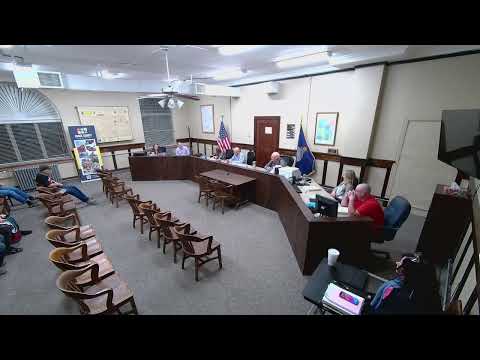
Osage County planning commission reviews comprehensive plan changes, tables final approval
Summary
The Osage County Planning Commission spent its meeting reviewing extensive edits to the county comprehensive plan and ultimately moved to table final action until a later meeting.
The Osage County Planning Commission spent its meeting reviewing extensive edits to the county comprehensive plan and ultimately moved to table final action until a later meeting.
Commission members and staff worked through changes that touched the plan’s legal role in zoning cases, capital improvements, population projections, water and wastewater capacity, housing types and short-term rentals, road and bridge policy, and treatment of large special land uses such as quarries and renewable-energy projects.
The planned update, which staff said draws on input from county staff and two consultants, was described as important to the county’s ability to defend zoning decisions in court. “The courts look at the comprehensive plans, goals, and objectives to form a foundation for our decision making,” one staff member said during the discussion, urging a clearer statement of the plan’s legal basis.
Commissioners and staff reviewed a long list of line edits and policy choices. On infrastructure and growth, the commission discussed Wichita State projections cited in the document that show the city of Melbourne with a current census population shown as 357 and a projected population decline out to the plan horizon; staff noted the forecasted percent change is reported in the draft. Commissioners flagged capacity constraints for municipal sewer and water systems in many small towns and emphasized that future subdivisions will likely need engineering and cost assessments. The draft calls for mapping unincorporated villages and identifying creeks, lakes and watershed features more clearly.
The commission addressed housing and building-code issues at length. Members discussed how the plan treats manufactured and modular housing, clarifying that modular units are treated as site-built and that the plan should distinguish manufactured and older mobile homes. Tricia, a staff member, proposed a procedural alternative to full county inspection staffing: “I propose that we do an affidavit of code compliance,” she said, describing an affidavit used in Shawnee County that requires property owners, contractors or developers to sign and notarize a promise that construction meets the adopted code. Staff described the affidavit as a lower-cost starting point that shifts some responsibility to the builder and homeowner and could reduce county inspection workload while preserving a contractual remedy if construction is deficient.
Short-term rentals around the county’s lakes drew sustained attention. Staff reported there are short-term rental properties that function as one-bedroom units yet advertise sleeping capacity for many guests, raising wastewater, parking and safety concerns. Commissioners discussed possible limits on short-term rentals per owner—citing examples in other counties—and the need to tie any policy to wastewater capacity and local permit requirements.
The draft also includes extensive text on special land uses. Commissioners debated whether to delete, tighten or rewrite a section on large-scale renewable energy systems (wind and solar), which the commission said the county currently prohibits by moratorium. Multiple commissioners urged stronger, clearer language that signals the county’s stance on renewable projects, quarries, salvage yards and hazardous-material processing rather than leaving the topic vague. One commissioner said, “Renewable energy systems. Hard no,” during the discussion; others pressed for language that would put projects under high scrutiny and define procedural expectations so the county and applicants know the standards that would be applied.
Transportation policy items discussed included KDOT access constraints (state highway access can limit where development may have driveway access), road classification and maintenance responsibilities (county township road system vs. county-maintained systems), and an idea raised by staff about evaluating very low-volume roads for possible vacation to reduce the county’s maintenance burden. The draft’s nonmotorized-transportation section (trails) drew mixed comments; some members said bicycle networks are unlikely to be major transportation assets in a rural county, and others noted trails can support tourism.
Commissioners also reviewed goal-and-objective language on economic development and grant assistance. Several members asked for clearer statements about who would pay for countywide grant-writing and program administration and urged the document to distinguish countywide priorities (for example, county recreation or ball-field projects) from city-focused grant programs.
After lengthy review and multiple rounds of suggested edits, a motion was made and seconded to table the plan until the commission’s next meeting. The transcript records the motion to table and a second but does not record a roll-call vote tally in the provided excerpt.
How the commission proceeds: staff said they would rework the flagged sections—special land uses, building-code language, short-term rental language, the maps and implementation steps—and circulate a revised draft before the next meeting. One staff member noted the comprehensive plan should be treated as a living document that can be updated after adoption.
Votes at a glance: the transcript records routine procedural approvals earlier in the meeting (agenda and minutes were moved and seconded and recorded as approved by voice), the motion to table the comprehensive plan (moved and seconded; transcript does not show a recorded roll-call tally in the excerpt), and the adjournment motion (moved and seconded and approved by voice).
AI generated
The text on this page is AI generated. Summaries, highlights, analysis, and video transcripts are all produced from the original source material.
AI can make mistakes, so if you spot one, and we will fix it for everyone.
Note: the source content is unaltered by us. Any content source we link to, be it a video, an audio recording, or a document, is presented exactly as its publisher released it. That publisher is usually a government body, sometimes an individual official or another organisation.