Get Full Government Meeting Transcripts, Videos, & Alerts Forever!
Get email alerts on the Comprehensive Plan topic
No spam. Unsubscribe anytime.
Miramar staff outline broad comprehensive‑plan amendments, commission presses for more community outreach
Summary
City staff presented proposed evaluation-and-appraisal amendments to Miramar’s comprehensive plan, focusing on growth horizons, mobility, climate resilience and affordable housing. Commissioners pressed staff on public participation, state preemption (the "Live Local" law), impact fees and implementation steps ahead of a May 7 packet and a May 9,
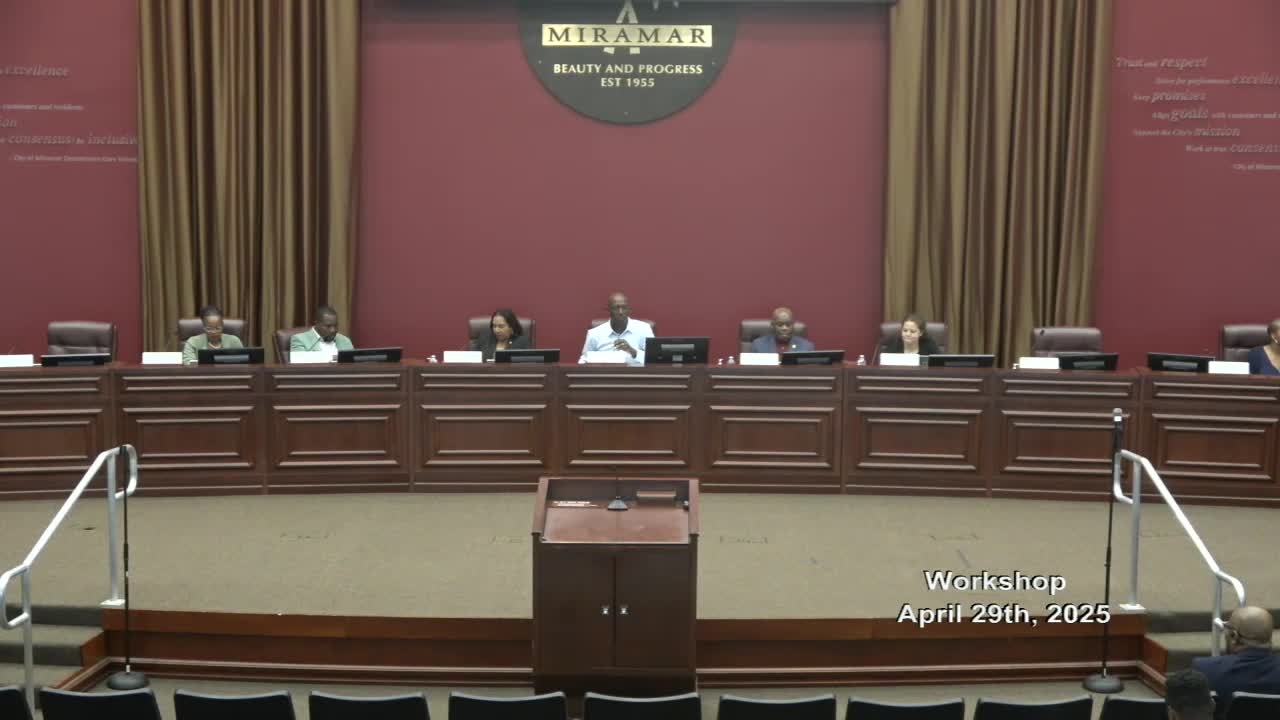
Nixon Lebron, Miramar’s director of building, planning and zoning, told the City Commission at a workshop that staff is preparing evaluation-and-appraisal amendments to the city’s comprehensive plan and will transmit a full package for the May 7 meeting. "My name is Nixon Lebron. I'm here to present, the evaluation and appraisal review based amendments to the city comprehensive plan," Lebron said.
The amendments respond to changes in state law and local conditions, Lebron said, and would update the plan’s future land use and mobility elements, rename the transportation element to "mobility," add policies on climate resilience and neighborhood protection, and incorporate policies to promote affordable housing and food access. He said the city’s population is about 139,500 now and is projected to reach about 153,000 under the 20‑year planning horizon used for the draft amendments.
The proposed changes address several topics the city said are required or recommended under Florida Statutes, Chapter 163, including an updated approach to capital improvements, mobility and environmental policies, and internal consistency across elements. Lebron said the state’s coordinated review process governs the type of amendments being pursued and noted a state transmission deadline of May 9, 2025 for this round.
Consultant Jim Khan of Keith and Associates told commissioners that public feedback gathered at three neighborhood meetings and through an online portal reinforced recurring themes across the outreach: the local economy, affordable housing, resilience to flooding and other climate risks, and safety. "The same common themes were there at every 1. You know, the economy, affordable housing, safety, you know, the the resiliency," Khan said.
Commissioners used the workshop to press staff on three recurring concerns: whether outreach had reached enough residents, how the city will preserve single‑family neighborhoods while enabling redevelopment, and how state preemption laws — notably the "Live Local" statute discussed during the meeting — could limit local controls on height, density and certain land uses.
Commissioner Sherazard said she attended one neighborhood meeting and asked the consultant to describe how the limited in‑person turnout affected the plan’s responsiveness to community input. Khan replied that, despite modest in‑person attendance, in his experience the same themes arise in public meetings and online feedback and those themes were incorporated throughout the draft policies.
Commissioner Edwards and others asked staff to provide counts of responses from each outreach method; staff said those participation totals would be provided. Lebron and the city manager also urged commissioners to meet with staff before May 7 so the full amendment package can reflect any final commissioner input.
Several commissioners raised the Live Local Act and other recent state preemption laws as an implementation risk. Lebron told the commission that the comprehensive plan and the state chapter that governs it (Chapter 163) are separate from some newer preemption statutes, but acknowledged the practical impact on local land‑use control: "The Live Local Act... preempts everything we do because it's basically preempts us from applying when it comes to density, height, and, and use," he said, and explained that qualified projects under that law still must meet local requirements for utilities, sanitation and other public‑facility capacity.
Commissioners also discussed impact fees and incentives for affordable housing. Staff clarified that, under current practice, impact fees are typically charged once at building permit or connection and are intended to pay for the developer’s proportional share of new infrastructure; the commission discussed updating impact‑fee studies and schedules to ensure fees remain commensurate with infrastructure costs.
Lebron and staff described next steps: staff will finalize the amendment packet, present the full package at the May 7 meeting, and transmit the amendments to the state under the statutorily required review. The city manager and staff offered to meet one‑on‑one with commissioners to address technical questions prior to formal hearings.
Why it matters: the comprehensive plan sets long‑range goals and the policy framework for Miramar’s land use, transportation, utilities and resilience investments. Changes to the plan can affect where redevelopment is encouraged, how future growth is served by sewer and water systems, and what protections the city can adopt for neighborhoods and vulnerable areas.
Commissioners asked for clearer public education about the plan’s role so more residents can weigh in on choices that affect housing, mobility and neighborhood character in the next 10 to 20 years. Staff committed to making the full amendment packet available for the May 7 meeting and to follow up with requested outreach data and one‑on‑one briefings.
The workshop concluded with the commission asking staff to return the full amendment package and related materials for the upcoming public hearings and to provide written counts of outreach responses and other clarifying materials requested during the meeting.