Get Full Government Meeting Transcripts, Videos, & Alerts Forever!
Get email alerts on the Veterans Recognition topic
No spam. Unsubscribe anytime.
Lawmakers press House to recognize Hmong, Lao ‘special guerrilla unit’ veterans with HF 2444
Summary
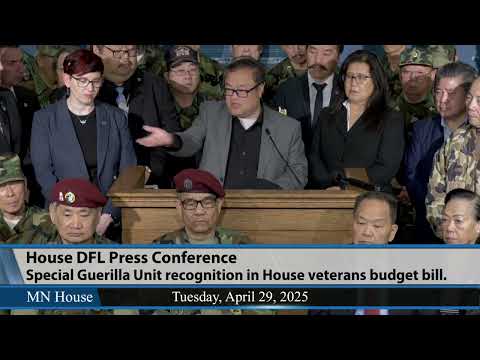
At a Minnesota House Veterans and Military Affairs Division hearing, lawmakers, veterans and advocates urged passage of House File 2444 to formally recognize ‘special guerrilla unit’ (SGU) veterans who served alongside U.S. forces in Laos during 1961–1975.
At a Minnesota House Veterans and Military Affairs Division hearing, lawmakers, veterans and advocates urged passage of House File 2444 to formally recognize ‘‘special guerrilla unit’’ (SGU) veterans who served alongside U.S. forces in Laos during 1961–1975.
Jay Shong, DFL co-chair of the Veterans and Military Affairs Division, said the inclusion of the provision in the division’s finance and policy budget bill marks “a historic moment for Minnesota” and called the recognition long overdue for veterans who “have been overlooked, left out of textbooks, excluded from formal honors, and denied [the] full measure of gratitude they earned.”
The bill, chief author State Representative Ethan Cha said, “is to restore the spirit, the dignity, and the honor” of SGU veterans and would apply to those who served in Laos from 1961 to 1975. Cha said the bill is intended to provide official veteran recognition in Minnesota and to signal a path other states might follow.
Supporters, including SGU veterans testifying in uniform, described decades of wartime secrecy and heavy community losses. Li Po Xiong, director of the Center for Hmong Studies at Concordia University, summarized the historical context that led to the U.S. use of irregular forces in Laos and urged the legislature to ensure the veterans “will not be forgotten.” Yang Li, identified in testimony as a former T‑28 pilot, said only about 10 SGU pilots remain in the United States and that “2 [are] living here in Minnesota.”
Representative Goldie Hark outlined the bill’s key provisions: it would add a new definition in state law for veterans of the secret war in Laos, create eligibility criteria for benefits and privileges, authorize the commissioner of veterans affairs to verify veteran status, and establish a 12‑member task force to advise the verification process. Hark listed examples of the state benefits and privileges the bill would make available subject to departmental capacity, including veteran designation on driver’s licenses and state IDs, purchase of grave markers, honor guard and state veteran cemetery access, veteran preference in hiring when permissive, and use of MDVA (Minnesota Department of Veterans Affairs) meeting quarters.
Cha and other speakers said the bill was written to avoid fiscal strain on the state. “Because of the fiscal outlook for the state,” Cha said, “there is no monetary benefit to it,” but the bill authorizes recognition and a set of non‑cash privileges the department could support. He credited a deputy commissioner (unnamed in the hearing) and stakeholders for helping shape language the department could administer.
Several veterans and family members gave personal testimony about wartime service and loss. A retired U.S. Army lieutenant colonel who identified himself as the son of a late SGU major said his father lost substantial use of an arm from combat wounds and never saw official recognition before he died. Historical testimony cited by Li Po Xiong and others described thousands of Hmong and Lao casualties during and after the conflict; speakers repeatedly emphasized the heavy toll on Hmong communities.
Lawmakers and witnesses repeatedly called the measure bipartisan. Jay Shong acknowledged Republican co‑chairs and “25 Republican signatures” on the bill’s authorship list. Multiple speakers noted that a version of the measure had already passed the Minnesota Senate unanimously.
Questions from press and attendees focused on implementation details: how many SGU veterans remain alive, how verification would work, and whether the recognition could spur curriculum or public education changes. Witnesses estimated roughly “about a thousand or so” surviving SGU veterans nationwide, and speakers highlighted the task force and verification interviews as mechanisms to establish eligibility. Cha and others said broader education efforts could follow but would require separate legislative or policy work.
The hearing transcript documents extensive testimonial support for HF 2444 and plans for departmental verification, but it does not include a recorded committee roll‑call vote on final passage in the House. Several speakers said they expected the House to pass the bill that day; the transcript stops short of recording a formal vote outcome.
If enacted as described in testimony, HF 2444 would: define SGU veterans in state law, authorize MDVA verification, create a 12‑member advisory task force, and extend non‑monetary benefits such as veteran designation on IDs, grave markers, honor guards and cemetery access. Supporters described the measure as primarily symbolic recognition coupled with administrable, limited privileges rather than new direct cash benefits.