Get Full Government Meeting Transcripts, Videos, & Alerts Forever!
Get email alerts on the Parks And Recreation Cip topic
No spam. Unsubscribe anytime.
Prince George's parks agency outlines FY26 capital plan; council raises concerns about fund balances and procurement equity
Summary
The Maryland-National Capital Park and Planning Commission presented its amended fiscal 2026 capital improvement program for the Department of Parks and Recreation on April 29, detailing a larger first‑year capital budget and new cost pressures while council members expressed concern about fund balances and procurement rules.
The Maryland-National Capital Park and Planning Commission presented its amended fiscal 2026 capital improvement program for the Department of Parks and Recreation on April 29, detailing a larger first‑year capital budget and new cost pressures while council members expressed concern about fund balances and procurement rules.
Peter Shapiro, chair of the Prince George's County Planning Board and Commission, joined Director Tyler and Claire Wurstel, capital budget manager, to outline the department's priorities and funding changes. Wurstel said the amended CIP shows a $1.8 million increase in general obligation bond funding, a $1.45 million increase in state bond funding and a $776,000 increase in state Program Open Space funding, bringing the amended first‑year budget to $129,700,000 and a six‑year expected spend of about $440,000,000.
The presentation emphasized four FY26 priorities: stewarding existing assets, fully funding current projects, growing inventory to meet demographic changes, and equitable distribution of projects. Wurstel said the department is using an asset‑management approach to prioritize playgrounds, athletic fields and trails and cited the county’s adopted 2040 functional master plan and the 2022 Land Preservation, Parks and Recreation Plan as policy guides.
Wurstel also warned of rising material costs and potential tariff impacts, citing a projected $1.8 million cost increase for the Good Luck Community Center if tariffs take effect. She said the commission has increased staffing, contracting capacity and on‑call contractor pools to complete a backlog of previously funded but unfinished projects.
Council members and commission staff discussed procurement requirements for a planned multigenerational center. Council member Wanika Fisher said local contractors told her request for proposals (RFPs) looked so prescriptive that only a single firm could meet them, and raised equity concerns about minority‑ and women‑owned firms being excluded from prime roles. The commission’s division chief for capital development said design‑build teams are not yet selected and confirmed the RFP asks for experience on multiple similar large projects; he said the requirements were developed with the county’s corporate procurement office to ensure teams could manage scope and market risks.
Commission staff said they had increased local disadvantaged business participation requirements and will require design‑build teams to hold opportunity fairs. Peter Shapiro and Director Tyler reiterated a commitment to increase minority business enterprise (MBE) participation as primes as well as subs and agreed to provide procurement procedure briefings and updates on awarded contracts to the council.
Council members pressed commissioners on the longer‑term fiscal picture. Council member Danoga asked about PAYGO versus bonding after staff noted two enterprise funds — the Park Fund and the Recreation Fund — show declining balances in the six‑year forecast. Corporate budget director Terry Bacot Charles and Gavin Cohen, corporate treasurer, told the council the projection used assumptions from several months prior and that the displayed forecasts represented a cautious scenario; Charles said the commission plans to develop a framework that balances PAYGO and bonding and will provide a more detailed long‑term forecast to the spending affordability committee and the council in the next CIP cycle.
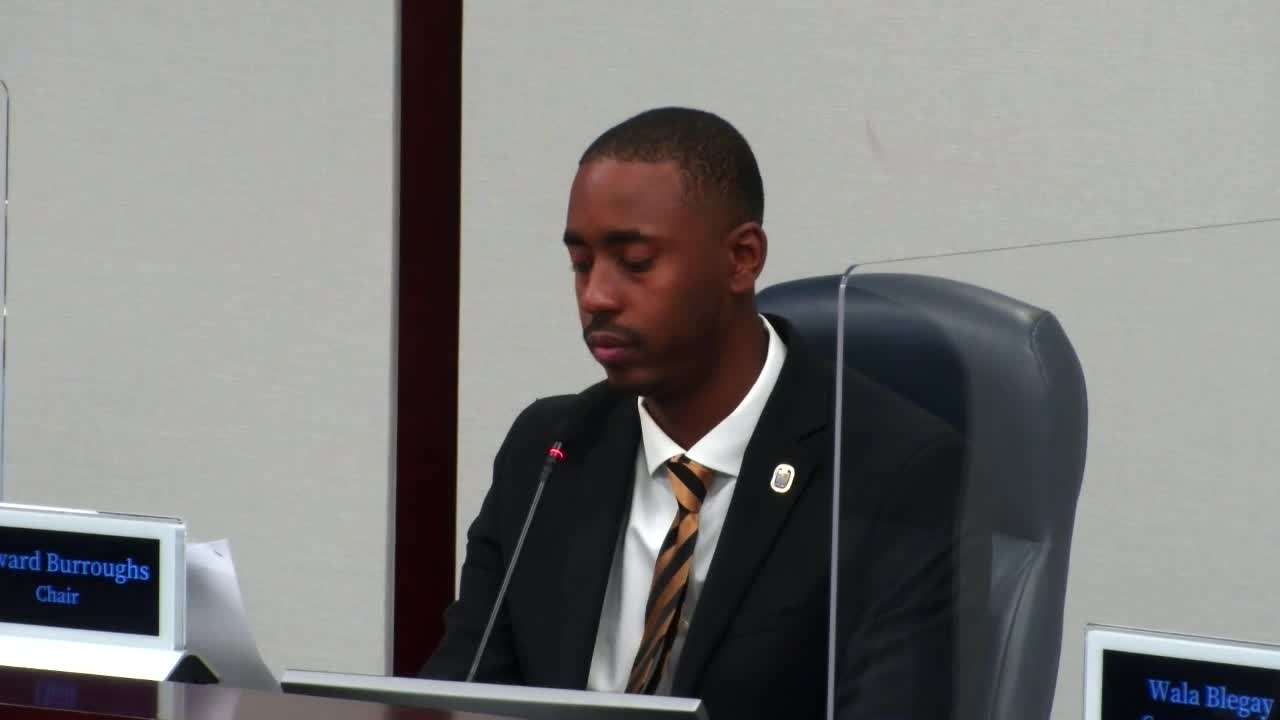
Several council members voiced alarm that the recreation fund appeared to run negative in about two years under current projections and asked the county auditor for an independent review. Chair Burrows and other council members tied concern about fund balances to previous capital choices, including earlier appropriations for the Largo Headquarters building. Commission staff said renovation work on Largo Headquarters began in FY25 with a $30 million appropriation and that unspent FY25 funds were carried into FY26 to complete the work.
Commission staff also reviewed equity metrics, saying roughly 60% of proposed CIP projects by count and 56% by dollar value are in areas categorized as low or medium‑low equity based on factors including income, age, racial demographics, transit access, English proficiency and proximity to parkland. Per‑capita spending is roughly $1,293 in the county’s North and $1,115 in the South; staff said one additional large project in the South would approximately equalize per‑capita spending.
The commission and the council agreed on next steps: commission staff will provide additional procurement procedure information and updates on MBE participation for forthcoming awards; staff will develop a PAYGO/bonding framework and a more detailed multi‑year fund forecast; and the county auditor was asked to provide an independent assessment of the recreation and park fund projections. No ordinance or appropriation was enacted during the presentation itself; several later agenda items received committee recommendations for favorable action.
The discussion underscored two tensions for the FY26 CIP: immediate cost pressures from materials and tariffs that may require supplemental funds for planned projects, and the need to reconcile equity goals with limited fund balances and statutory bonding limits.